








This story was originally published by Canary Media and is reproduced here as part of the Climate Desk collaboration.
It’s not just federal headwinds that threaten to constrain renewable energy development. State and local restrictions on solar and wind are spreading across the United States, too.
Few states highlight this fact as well as Ohio does. The Buckeye State makes solar and wind farms go through extra hurdles that don’t apply to fossil-fueled or nuclear power plants, including counties’ ability to ban projects. Its siting authorities have also deferred to local opposition for renewable energy while granting opponents little say over where petroleum drilling rigs and fracking waste can go.
A bill now working its way through the Republican-controlled Ohio legislature threatens to raise even more barriers for wind power and solar farms. On Tuesday, the Ohio Senate’s Energy Committee held its third hearing on Senate Bill 294. It’s unclear whether the committee will hear additional testimony, so under state law the bill could pass out of committee as soon as its next meeting.
The bill’s primary backers are “among the most notorious climate-denial organizations out there.”
The bill would declare it to be state policy “in all cases” for new electricity-generation facilities to “employ affordable, reliable, and clean energy sources.” But the bill’s definitions not only veer from common usage in ways that would exclude renewables but also threaten to block wind and solar development altogether.
“If Senate Bill 294 were enacted, the Ohio Power Siting Board would be unable to support renewable energy projects under the bill’s restrictive definition. This would place Ohio at a disadvantage,” said Evangeline Hobbs, a deputy director at the American Clean Power Association, in joint testimony for that group and fellow industry organization MAREC Action. “At precisely the moment when Ohio needs every available energy source, this bill would tie the state’s hands.”
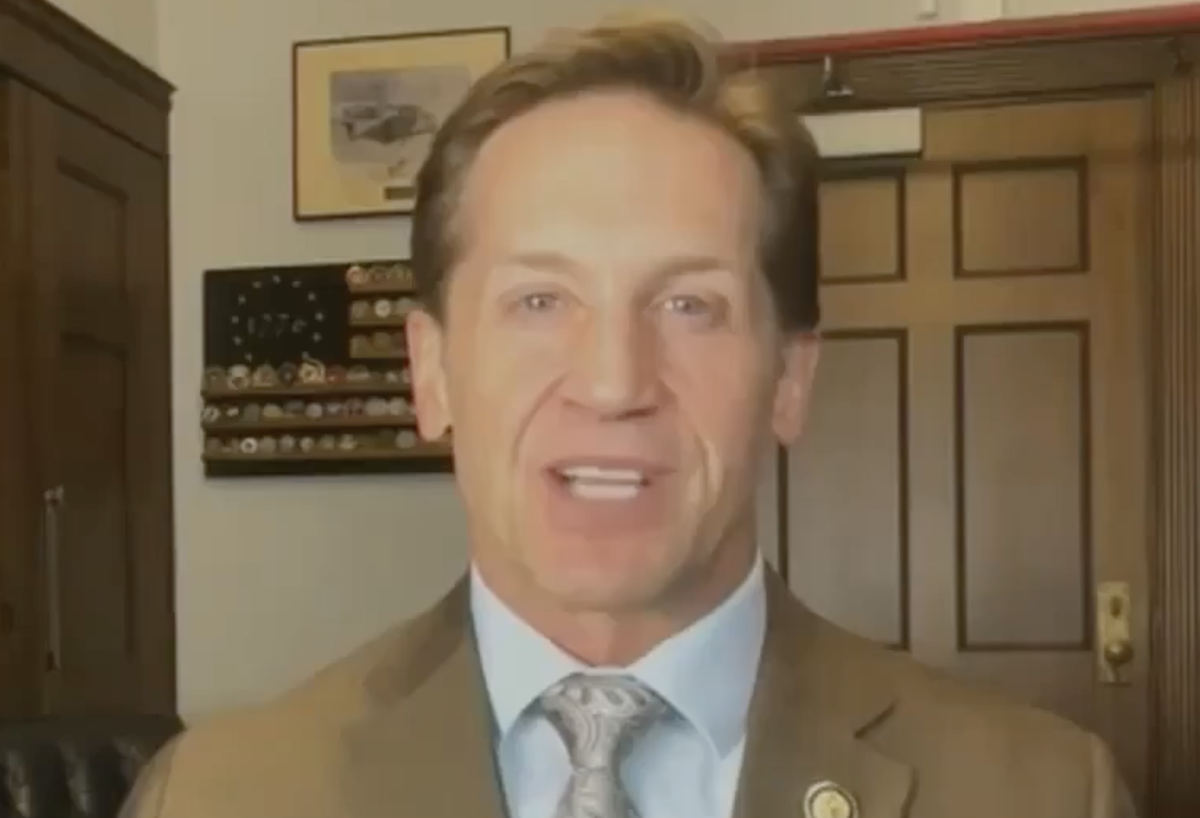
Based on model legislation from the American Legislative Exchange Council, or ALEC, SB 294 is sponsored by Republicans George Lang of West Chester and Mark Romanchuk of Ontario.
Louisiana passed a similar bill last year that prioritized natural gas. A pending bill in New Hampshire says that energy sources “shall” be reliable, meaning not subject to routine daily weather variations.
Lang praised natural gas during his October 28 proponent testimony, noting the bill is designed to take advantage of the fossil fuel. In contrast, he claimed renewable energy “doesn’t meet those qualifications of being cheap. It misses the reliability…And it doesn’t really meet clean yet.” During the February 10 hearing, however, he claimed solar and wind were not really excluded and stressed that “there are definitions that have to be met.”
Those definitions, however, uniformly ding renewables.
SB 294’s definition of a reliable energy source would require it to be “readily available” with minimal interruptions during high-usage times and for it to have a 50 percent capacity factor. That’s the ratio of its actual power output to the potential maximum. This condition would exclude virtually all land-based wind and solar generation.
SB 294 “will destroy competition by declaring renewable energy unreliable, and it’s picking winners and losers.”
A high capacity factor “does not mean that an energy source will be available during extreme weather, or even generally available at peak times,” said Michelle Solomon, manager of electricity for Energy Innovation, an energy and climate policy think tank. In practice, grid operators “consider how combinations of resources on the grid can work together to meet needs.”
Instead of ensuring systemwide reliability, a single-minded focus on a high capacity factor will distort markets and raise costs for consumers, noted Brendan Pierpont, Energy Innovation’s director of electricity.
In fact, a high penetration of renewables can reduce the intensity of blackouts and vulnerability to extreme weather, according to a 2024 peer-reviewed study in Nature Energy. And, in general, a portfolio of energy-generation resources is more reliable than dependence on only a few sources.
“Reliability is really not a characteristic of a certain technology,” said Diane Cherry, MAREC Action’s deputy director. “And so taking things out of the ‘all-of-the-above’ is a problem.”
SB 294’s perspective on what counts as clean energy is even more questionable than its definition of “reliability.”
Under the legislation, natural gas is called “clean energy,” and language in the bill could potentially even count some coal plants as clean. Meanwhile, solar and wind are only implied to be clean, by way of the bill’s reference to a federal law that deems them so. Nuclear power, which is carbon-free when generated but produces radioactive wastes before and after that point, is also dubbed “clean.”
The definition of “affordable energy source” likewise diverges from the common meaning of those words.
Data released by the consulting firm Wood Mackenzie last October shows land-based solar and wind having lower average lifetime costs, called their “levelized cost,” compared with those of other types of power. Storage costs have also dropped substantially since 2020, and will likely fall even more.
Yet “the bill seems to want energy that is cheaper than renewable energy, which really does not exist,” Solomon said.
Ultimately, consumers would pay under the legislation, at a time when utility bills are already rising fast. Failure to add more clean energy sources to the PJM Interconnection region will cost the average Ohio customer roughly $6,500 more by 2035 than they would otherwise pay, American Clean Power reported in a Feb. 6 fact sheet.
Overall, SB 294 adds uncertainty for the industry and investors at a time when they want to build projects, Cherry said. Many companies are under the gun to start construction by July 4 or place projects in service by the end of 2027 in order to get federal tax credits.
The bill also does not mention energy storage, which can require permits from the power siting board. Pairing storage with renewables can raise their capacity factor.
“Energy storage will be increasingly critical to grid reliability and cost control,” said Nolan Rutschilling, managing director of energy policy for the Ohio Environmental Council Action Fund, calling for the bill to be amended to include storage so that the board “has the full toolbox to evaluate projects that can deliver reliability without increasing fuel-price volatility or long-term customer costs.”
For their part, representatives of ALEC and the Heartland Institute gave proponent testimony on the bill last fall.
Both are “among the most notorious climate-denial organizations out there that have been funded by fossil fuel interests,” said Dave Anderson, policy and communications manager for the Energy and Policy Institute. Yet they also “claim to be totally free-market and libertarian,” he added, an ironic point given the bill’s potential to distort the market in favor of fossil fuels.
To that end, SB 294 “will destroy competition by declaring renewable energy unreliable, and it’s picking winners and losers,” said Janine Migden-Ostrander, who formerly served as the Ohio consumers’ counsel and is a fellow at the Pace Energy and Climate Center. “The legislature should not be deciding this. Let the market decide. If projects are uneconomical, they will not be built.”