







This story is published in partnership with The Daily Yonder.
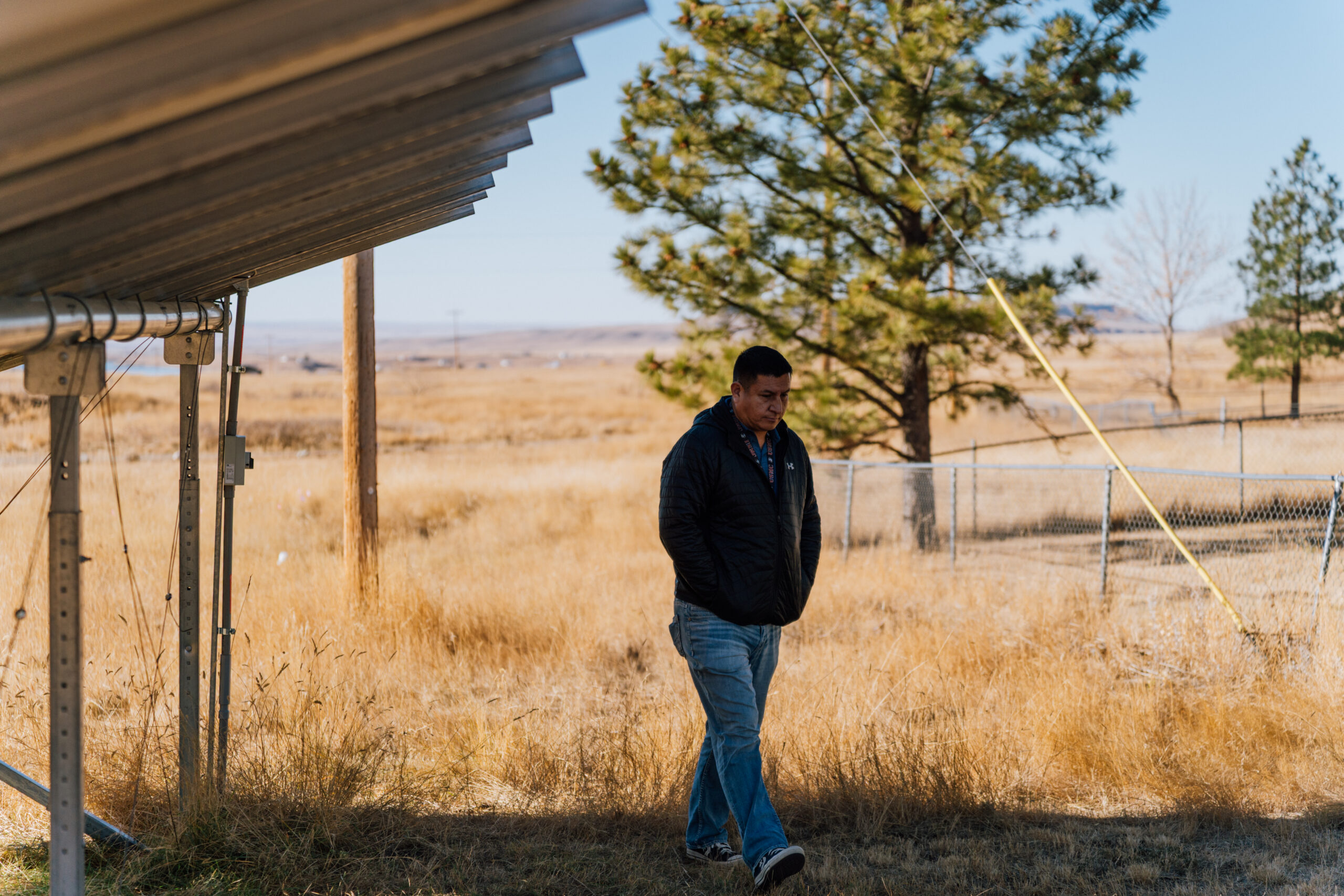
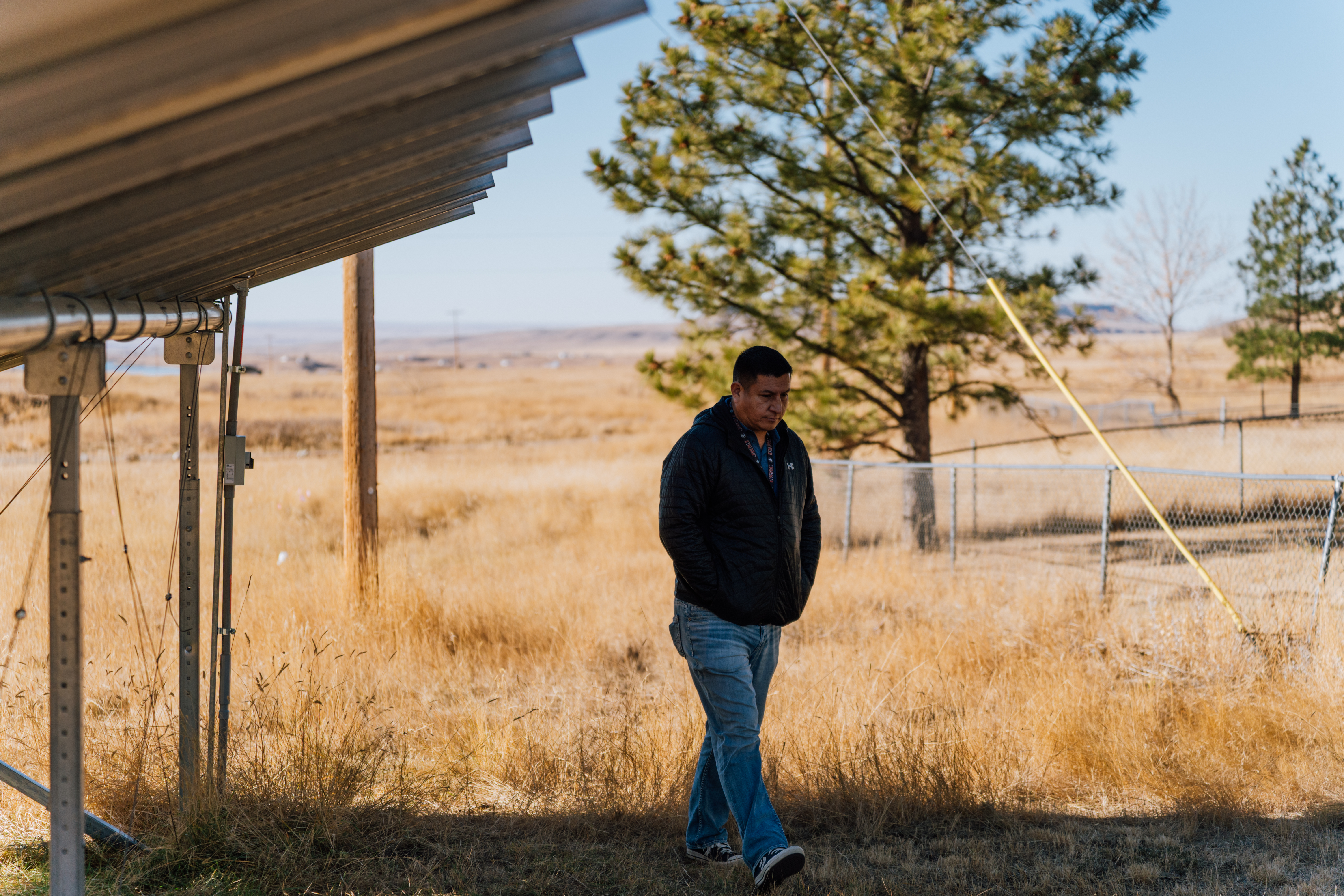
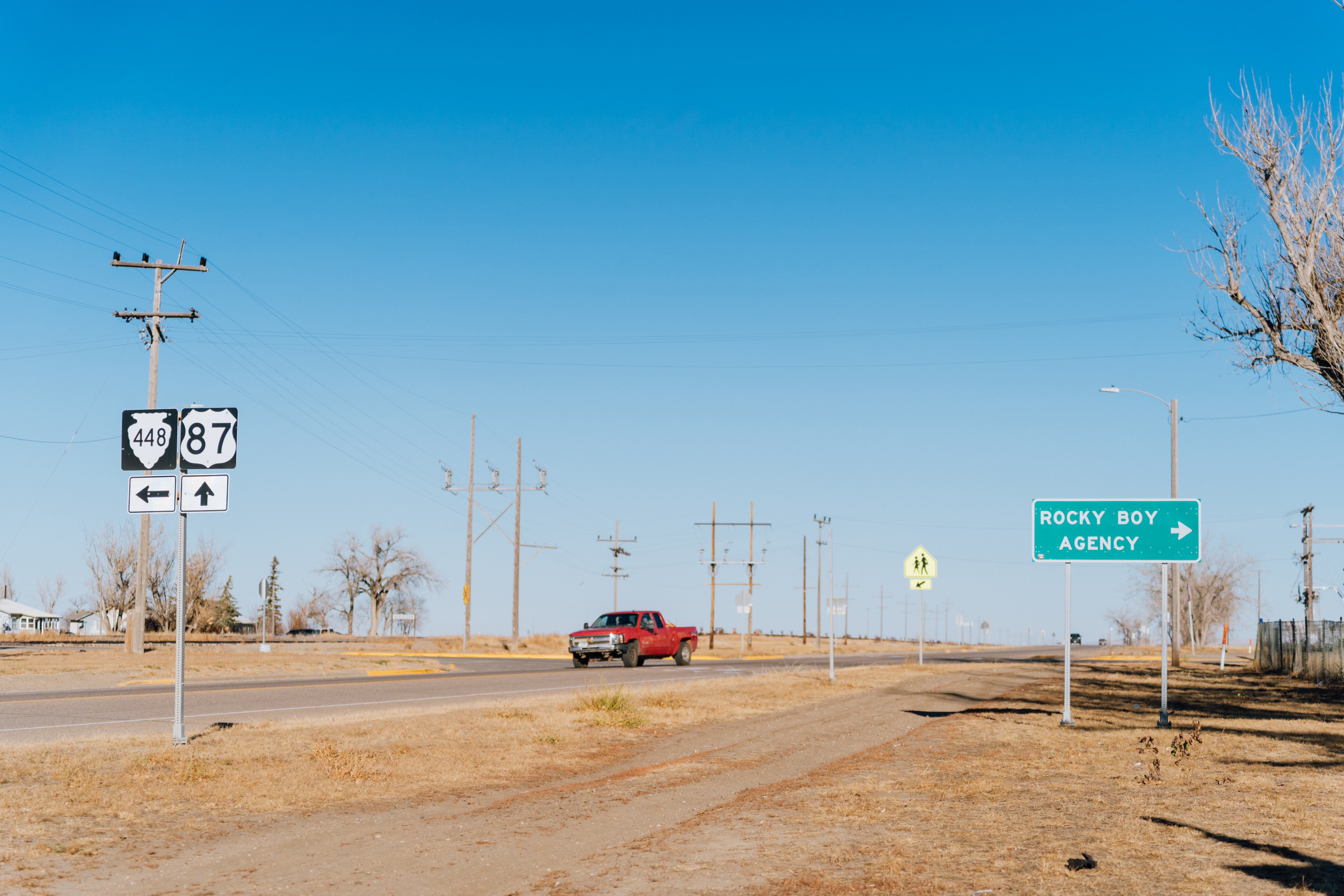
It was sunny and warm for the end of November on the Rocky Boy’s Reservation in northern Montana. Joseph Eagleman was standing on a grassy hill, looking at a 20-panel solar array in the backyard of a Chippewa Cree elder.
It was built under the Solar for All program, a Biden-era Inflation Reduction Act-funded project that distributed $7 billion to build residential solar across the country. Here on Rocky Boy’s, around 200 homes would have received solar funded by the federal dollars.
This was the first to get panels in Queensville, a small community of modest homes in one of the reservation’s valleys. The home is brown, two stories, and fully electric, which is one of the requirements to qualify for Solar for All funding. Eagleman met me there to give me a tour of the panels that all but eliminated the resident’s $200–$300 monthly electricity bills, according to Eagleman.
Eagleman is the CEO of the Chippewa Cree Energy Corporation, an organization that manages energy development for the tribe. Here in the Northern Plains, a coalition of 14 tribes received a $135 million grant. The money would have provided around $7.6 million for each reservation to build residential solar, and Eagleman would have managed the Solar for All funds for the Chippewa Cree.
Then came President Donald Trump. His administration cut Solar for All in August.
“It’s terrible. We were getting ready to take off,” Eagleman said.
Residents had seen this solar array, which was built in the fall of 2024, and were excited about the possibility of free solar. Eagleman had a list of 40 households that were applying for the first round of the project. But only this house got a completed array before the program was stopped.
“It was a gut punch,” Eagleman said.
Listen to this story, featured in a recent episode of Reveal, in the player below.
Subscribe to Mother Jones podcasts on Apple Podcasts or your favorite podcast app.
The reservation is about an hour and a half from the closest city, Great Falls, Montana, and has a population of 3,300. Driving down to meet Eagleman, I passed a cafe/casino/bar/gas station, a school, a skate park, and many residences, but little else. “There’s not a lot of opportunities, except for leaving the reservation,” Eagleman said.
Electricity costs are high on the reservation, as they are across rural America. Building and maintaining infrastructure without density drives up costs for these areas. Applicants showed Eagleman their bills to demonstrate why they wanted solar so badly, and some were up to $900 a month. Around 35 percent of the reservation’s residents live below the poverty line, more than double the rate for the United States. Solar installations like these cost thousands of dollars—money that most residents don’t have.
Eagleman had hired Zane Patacsil, a local resident who had experience installing solar, a month before the cuts. Patacsil joined us in the sunny backyard, overlooking the hills and valleys that make up the Rocky Boy’s Reservation.
He said Solar for All would have brought some economic development to Rocky Boy’s and the other reservations that received the grant: an office and people to manage it, as well as training and hiring solar installers to do the labor.
“There were even members who were talking about starting their own solar businesses so they could be installing,” Patacsil said. “It was very disheartening to hear that news, because we lost all of that with it.”
When protests raged against the Dakota Access Pipeline in 2016, Cody Two Bears was on the tribal council for the Standing Rock Sioux. He saw another layer to the dispute: energy extraction on tribal land that not only hurt residents, but also brought no relief for high energy bills.
Two Bears wanted to bring energy sovereignty to his community and other tribal nations. He started the nonprofit Indigenized Energy in 2017. “I do this because of energy and energy sovereignty as well, but it creates a sense of hope for our tribal nations,” he said.
Sovereignty and self-governance are what tribes allegedly gained in exchange for giving up traditional homelands when treaties were signed over the past centuries. Tribal sovereignty is about not only protecting culture and traditions, but also self-sufficiency. It’s also legally protected by the US Constitution. But that’s easier said than done without the resources to support true independence, which have been systemically removed by the US government.
Native Americans are more food insecure and rely on Medicaid at higher rates than their white counterparts, depending on the US government for subsidies while desiring the sovereignty that was promised. Energy independence is a way to regain a degree of that sovereignty, and Two Bears has made that his goal with Indigenized Energy.
“My ultimate goal is to work myself out of a job,” he said. “I want to build so much capacity into these tribes where they don’t need Indigenized Energy anymore.”
But the funding picture changed dramatically when Trump’s administration slashed solar spending.
Indigenized Energy had already been building residential solar on the Northern Cheyenne Reservation for a few years, and it ramped up to prepare for more work through Solar for All. But when the program was cut, Indigenized Energy laid off around half its staff, including Donica Brady, the coordinator for the Northern Cheyenne Reservation in southeastern Montana.
I first met Brady in September 2025, about a month after the layoff, and the pain of losing a job she loved was evident. Brady had spent the past couple of years building trust in a community where promises have been made and broken over and over again. Solar for All became yet another one.
Part of programs like Solar for All is job development within the solar industry. Brady was part of a training program through Red Cloud Renewable, funded by previous grants for solar on reservations. Solar for All would also have funded training and trade development on these reservations.
When I caught up with Brady again at her house in Busby, she was working two jobs, and the only time she had for me was at 9 p.m. on a Tuesday, after her daughter’s choir recital. I found her in the garage with a kitchen knife in hand, skinning a deer her wife had shot a few days previously. She asked if I wanted to help and handed me a knife.
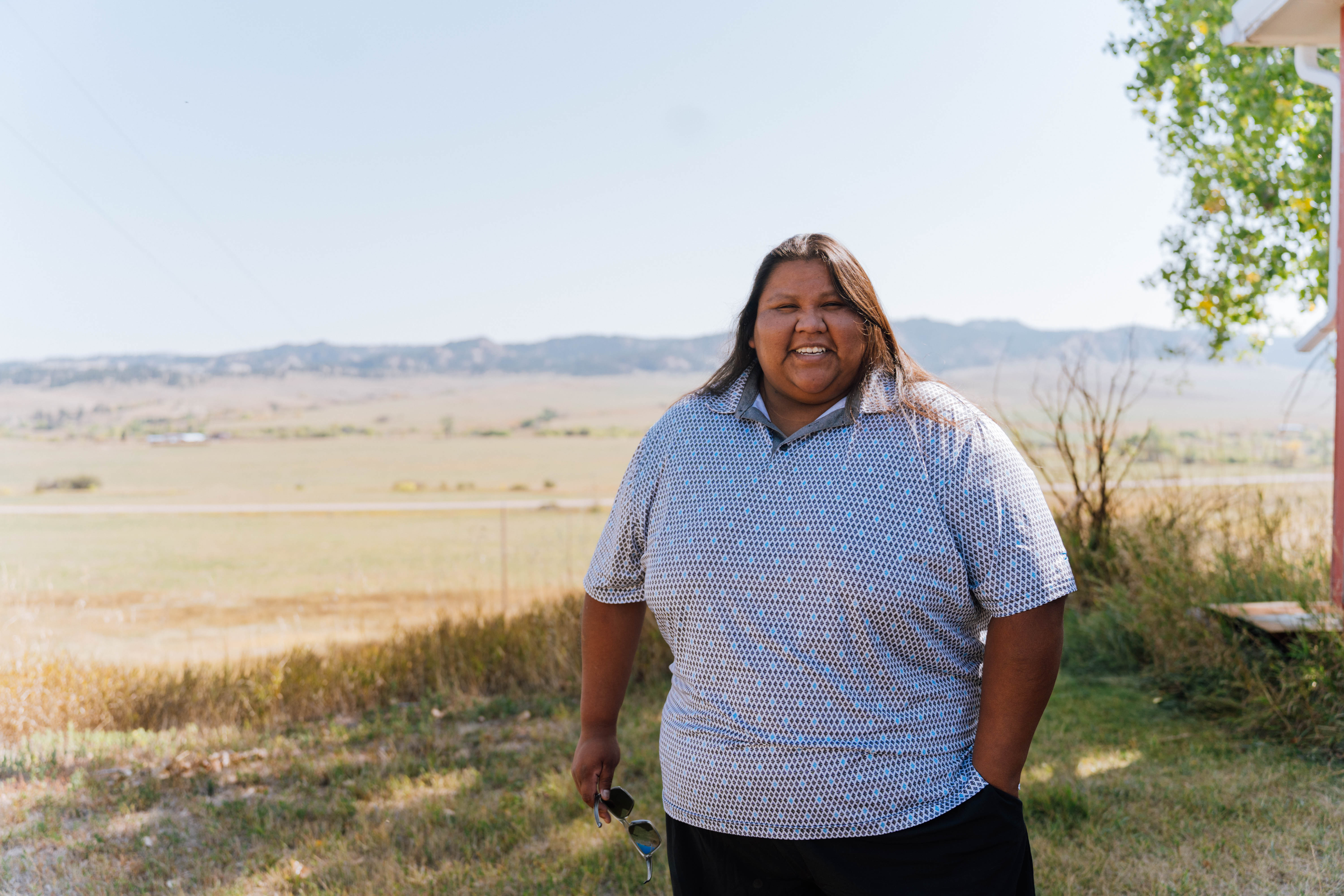
We chatted as we worked on the deer skin, cutting fat and sinew away from the dark red meat. She’d returned to her previous job as a bus driver and was hired by Freedom Forever, a solar installation company based in California. She’s still working in renewable energy, and Freedom Forever does work on reservations at times, but Brady’s job is no longer on the ground working with her community like she craves.
“I want my people to be able to be self-sufficient, not have to rely on funding or things like that that can be taken away,” Brady said. I heard this over and over: People don’t want to have to depend on the federal government for “handouts.”
As Brady cut out the tender backstraps and set them aside to give to her auntie, she talked about solar’s deeper meaning. “People call it progress, but I see it as going back to what we were taught, but in a new way,” she said. It’s more than just energy; it’s harnessing the sun, an important reflection of Northern Cheyenne culture.
The deer we were cutting up felt like a symbol summarizing everything we talked about. It was one way Brady could become self-sufficient and support those she loves. If only the power of the sun could be harnessed as easily as a deer skinned in a garage.
Some time later, just outside Lame Deer, Montana, the tribal headquarters of the Northern Cheyenne, I got lost looking for Thomasine Woodenlegs’ house. My phone had no service, so all I had was Woodenlegs’ instructions: Look for a bright-green house at the end of the road. Many U-turns later, Woodenlegs welcomed me into her kitchen, where photos of loved ones covered the walls and two cats, one orange and one black, lounged on the couch.
Woodenlegs works for her tribe, and she has lived in this house for 50 years. She plans to pass it down to her family. But she knows she will be saddling them with a financial burden, too.
“How am I going to survive after I retire? And how is whoever inherits my house?” Woodenlegs asked. “I’ll need to warn them that the electricity runs like $400 or $500, and they’d have to have a really secure income to live here. Otherwise, they’d be without lights.”
Woodenlegs saw solar panels from previous grant programs like the White River Community Solar Project, funded by the Department of Energy, going up around the reservation in 2020 and 2021. Solar for All’s big allocation for Indigenous communities brought more hope. She put in her own applications, feeling jealous of friends and acquaintances who received them, wondering when it would be her turn. She’s still waiting.
Tina Cady, another Northern Cheyenne resident, lives just outside Busby and has applied for solar panels multiple times. She worked for the Indian Health Service for 25 years until she went on disability. Now she lives on a fixed income of about $1,000 a month, and her husband picks up as many hours as he can as an adjunct professor at the tribal college. She showed me her October electric bill, which was $225.13.
Brady handled her application and told Cady what she’d learned in the field so far: Cady was a prime applicant for solar panels and she should be at the top of the list. “I’m an elder, and I’m disabled,” Cady said. Plus, she owns her own land. But Cady never heard anything more about it.
I asked whether she felt betrayed by the funding cuts, after so many previous letdowns to tribal communities. Cady said no, because it wasn’t her money to be betrayed. But she was disappointed and disenchanted: “I have seen them do this before. You get so you don’t trust anybody anymore.”
Four different lawsuits have been filed in federal courts against the Trump administration for ending Solar for All. It was terminated after the One Big Beautiful Bill Act rescinded “unobligated funds for the Greenhouse Gas Reduction Fund,” which had provided the funding for Solar for All.
The lawsuits claim that Solar for All was already a year into operation, so the funds were obligated, and that taking away already obligated funds is illegal.
All the lawsuits are still active. One from Climate United will move into oral arguments this month. Another from a coalition of 22 states is seeking an injunction to keep the Solar for All funds available.
But even without results from the lawsuits, solar installers like Two Bears and Eagleman plan to continue to fight for solar development on Northern Plains reservations.
Eagleman said he’s going to keep looking for funding to help bring affordable electricity to the Chippewa Cree on the Rocky Boy’s Reservation. He’s been looking at other public funding through the Department of Energy, as well as private philanthropic options.
Two Bears said he is moving forward with his company’s list of families awaiting solar. Indigenized Energy is ready to break ground on a project on the Menominee Reservation in Wisconsin, which was next in line when the funding was cut. He said it found private funding for that project, as well as another solar array for the Rosebud Sioux.
“So even though the money is not there, we’re still finding alternative resources and funding to make these possible and make’em feasible,” Two Bears said. It’s just going to take longer.”