









How far would you run for a year’s worth of free lunch?
This question has rattled around in thousands of runners’ brains throughout January, due to an eccentric athletic competition. The rules are simple: jog endless laps around an agreed-upon pizza joint or taqueria or bakery in your city. At the end of January, the person with the greatest distance wins the free food.
The challenge is called Burrito League.
“Once you start competing and see the leaderboard, it gets into your soul,” Jamil Coury, Burrito League’s co-founder, told Outside. “There are rivalries. There’s strategy. It’s unlike any running competition I’ve ever witnessed.”
This idea may sound familiar to Outside readers. A year ago, we published a story about the 2025 Chipotle X Strava challenge, a marketing gimmick between the Mexican eatery and fitness tracking app that was built on the same premise. People run laps around a local Chipotle store, log the miles on Strava, and the winner gets a year of free burritos. Writer Marley Dickeinson ran several hundred miles around a Chipotle in Toronto hoping to win the grand prize. Dickinson came close, but was unfortunately outdone by dastardly Internet gamesmanship.
As it turns out, an even wackier Chipotle X Strava battle occurred around the eatery in Tempe, Arizona. Coury, a veteran ultrarunner and the promoter of the Javalina 100 and other ultramarathons, battled thru-hiker Kevin Russ around the .22-mile lap. The two ran neck-and-neck, and their battle lasted for the entire month. Coury eventually won the challenge by running for 40 consecutive hours right up to the deadline. The insane athletic feat generated headlines and brought considerable attention to the Chipotle/Strava collaboration.
Fast forward to January 1, 2026. Anticipating the challenge’s return, Coury, 40, started jogging miles around the Tempe Chipotle again, hoping to get a head start. He wasn’t alone.
“I noticed other folks show up on January 3,” Coury said. “We were all wondering if they’d announce it this year.”
A day went by, then three. By January 5, Coury said, it became obvious that Chipotle and Strava had no intentions of launching a 2026 edition of the challenge. Coury took to Instagram to prod the two brands, and to ask his followers what he should do.
A note came in from a local runner who wished to remain anonymous.
“He said if I organized the challenge, he would personally buy an $850 Chipotle gift card for the winner and $450 for second place,” Coury said. “At that point, I didn’t have any excuse because we already had the segment and the prize.”
Coury and a runner named Connor Dyer created rules, built a leaderboard on Strava, and created a catchy Burrito League logo. And on January 5, they posted the big news. The challenge would be returning to Tempe, and that runners hoping to win the grand prize could officially begin logging miles starting at midnight on January 6. Runners simply needed to log their miles on Strava—and upload the distances after each run—to try and win.
“Five people showed up, and we kicked it off at midnight,” Coury said. “It was like a party.”
And then, like so many stories involving a great idea, pent-up frustration, and the Internet, the whole thing took off. It turns out runners in other cities across the globe were also hungry to run laps.
Someone in Redlands, California, pinged Coury asking if he could replicate the challenge in his hometown. Coury sent him the rules and logo. Other requests came in from Salida, Colorado, Houston, Texas, and New York City. Then more came in from runners in Australia, New Zealand, and parts of Europe.
Coury sent them the rules, the logos, and some advice on how to organize and log the local challenge.
“You need a short segment, you need a prize, that’s pretty much it,” Coury said. “In one city, the grand prize is free haircuts.”
By January 20, runners in 112 cities around the globe had started a version of Burrito League. The Tempe, Arizona league had built a YouTube livestream that runs around the clock.
Coury said the rapid expansion has created plenty of extra work, but after he tells the local organizer how to manage the Burrito League chapter, the challenge can go off with little legwork. There’s no entry fee to join—Burrito League is a labor of love.
Now, long-distance runners are a special breed, and many of these men are prone to taking on strange and grueling challenges. Last year, I wrote about a Colorado guy who ran the distance a marathon around a McDonald’s parking lot. You don’t have to Google too strenuously to find other examples of psychotic-sounding personal challenges inside the sport.
Still, the rapid adoption of Burrito League begs the challenge—what the hell is so appealing about running around and around and around the same restaurant for days on end?
When I posed this question to Courey, he paused, and then gave me a few answers that, I must admit, make plenty of sense.
There’s the social appeal, he said.
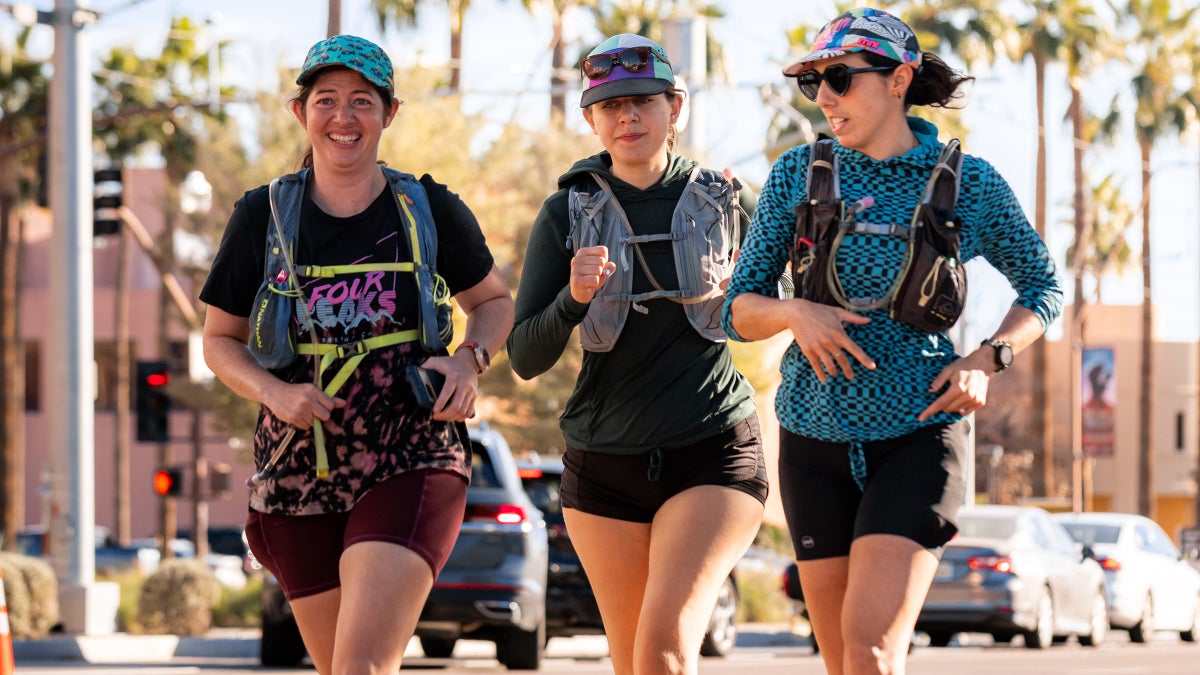
“It brings people together. You can meet new people because you know that someone will always be down there running the segment,” he said. “It’s an instantly welcoming environment—if you run for a few hours you’re going to interact with a ton of people.”
Running a short segment while chatting with others makes the miles pass quicklyt.
“You can get tons of miles in,” he added. “If you’re out there running and chatting with people, time just flies by.”
And, of course, there’s the competition. The bizarre rules and innovative format can trigger a runner’s thirst for racing, and an internal desire to push oneself. After a few days of running in Burrito League, even a seemingly normal person can become transformed into an obsessive and committed ultrarunner, Coury said.
“It was one of the most transformative running experiences I’ve ever had,” he said. “And I’ve been running ultramarathons for 20 years.”
You see, no matter if it’s a burrito, or a pizza, or a haircut that’s at stake, at some point, runners are hungry for a race.
The post How Running’s Burrito League Went From Internet Oddity to Mainstream Movement appeared first on Outside Online.