






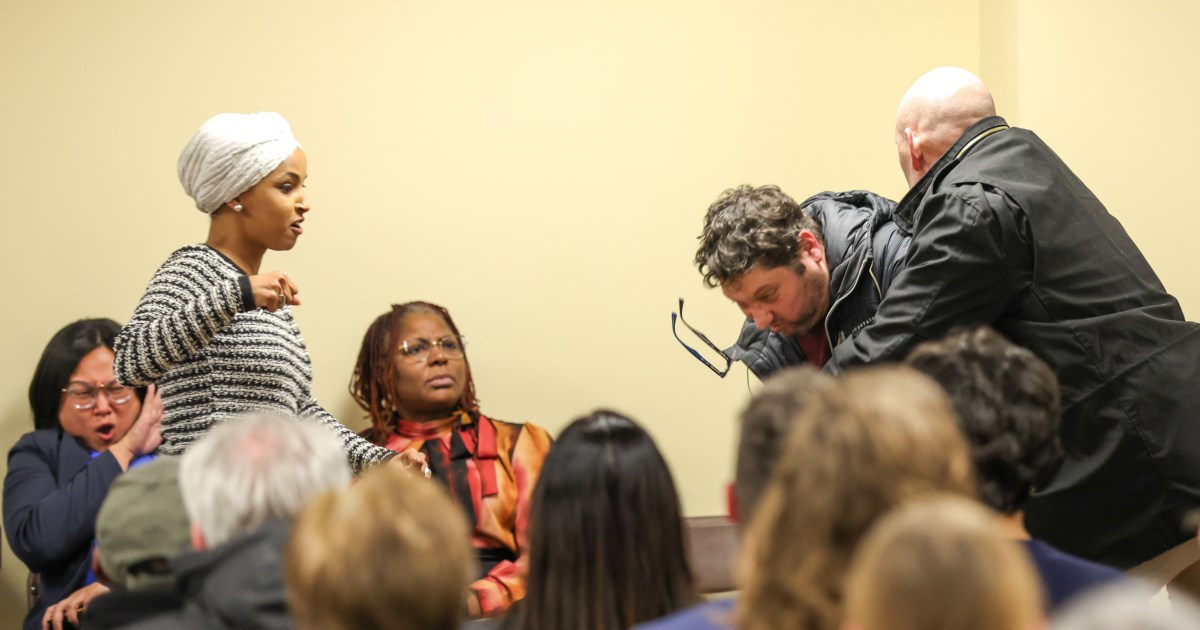
My heart was in my throat as I watched the video emerging late Tuesday. A disturbed, angry man had just rushed Democratic Congresswoman Ilhan Omar during a town hall in Minneapolis and assaulted her. He sprayed her in the chest with vinegar from a syringe, then was tackled by security and arrested. Omar reacted defiantly, kept her cool and carried on with the event. She was quickly hailed for her fortitude. All I could think was, thank God she’s not dead.
Initial media coverage referred to the attack by 55-year-old suspect Anthony Kazmierczak as “bizarre,” but it is worse than that. In more than a decade of reporting on violence prevention, I’ve studied many stalking cases and assassinations and the recognizable behaviors that precede them: the stewing grievances and desperation, the preparation, the final moment of action. The next assailant will just as easily have a knife or a gun.
In this era of surging political violence, even worse yet was the reaction from the president of the United States. ABC News correspondent Rachel Scott asked Donald Trump on Tuesday night if he’d seen the video. His response was to disparage Omar as “a fraud” and suggest the attack was staged: “She probably had herself sprayed, knowing her.” (There is zero evidence of that, and the perpetrator appears to have shared Trump’s acrimonious views of Omar.)
America has felt on a precipice this cold January. Minneapolis has been ground zero, culminating with the killings of Renee Good and Alex Pretti by masked agents carrying out Trump’s mass deportation operations. Minnesotans have mounted an inspired campaign of mutual aid and constitutionally protected protest. A growing majority of Americans are with them.
Trump’s rhetoric may sound ignorant and unhinged, but more importantly, it is calculated.
But Trump continues to direct contempt and rage at immigrants in so-called blue cities—and at Omar, long a top target of his vitriol. Last November, he responded to an unrelated terrorist attack on National Guard soldiers in the nation’s capital by railing against “hundreds of thousands of Somalians” in Minnesota, claiming they “are ripping off our country and ripping apart that once great state.” Days later, he called Omar, who is Somali American, and her community “garbage” during a live-broadcast cabinet meeting. As Trump declared they should “go back to where they came from,” many in the room applauded and Vice President JD Vance pounded the table enthusiastically.
Trump was at it again in the very hours before Kazmierczak assaulted Omar. During a speech in Iowa on Tuesday, Trump said Omar exemplified immigrants who “hate our country.” Those who want to stay here, he said, “have to show that they’re not going to blow up our shopping centers, blow up our farms, kill people.”
That may sound ignorant and unhinged, and it is those things—but more importantly, it is calculated. Trump made anti-immigrant demagoguery the core of his 2024 reelection campaign, and he has exploited political violence throughout his first year back in office, as I documented recently. He does so, political historian Matt Dallek told me, to rile up his base and further justify his extreme policies, including the violent and lawless actions of ICE: “The narrative he creates says to all his supporters that what he’s doing is ‘destroying the enemy within,’ that he’s taking care of the scourge that he promised to address. I think it’s a mistake to discount just how powerful that can be.”
Powerful politically—and unpredictable as to where and when it will unleash more violence. That also has been a hallmark of Trump’s political career: stochastic terrorism, a tactic of incitement that allows room for deniability but makes violent attacks more likely. We don’t yet know much about Kazmierczak’s motive. (As of late Wednesday, the FBI had taken over the investigation, and it was unclear whether Kazmierczak yet had any legal representation.) But we do know, according to media reporting and interviews with his brother, that he was a right-wing Trump supporter with a long history of mental health problems and “a hatred of the Somali community.”
Minnesota was the site of another grim example last summer, when a pro-Trump extremist hunted two Democratic state lawmakers at their homes, fatally shooting former House Speaker Melissa Hortman and her husband and wounding Sen. John Hoffman and his wife. Trump’s response to that horror was no less appalling.
A new report from the US Capitol Police, released coincidentally on Tuesday, shows that threats against members of Congress have continued to soar. In 2025, the agency’s threat assessment section investigated nearly 15,000 “concerning statements, behaviors, and communications” targeting federal lawmakers, a more than 50 percent increase from the prior year.
GOP lawmakers “know how much worse his rhetoric has made things,” said a federal law enforcement source.
Omar has long faced a deluge of threats and has sometimes been assigned a 24-hour security detail from the Capitol Police, according to the New York Times. That added protection is at the discretion of the House speaker, but for the past year Republican Speaker Mike Johnson has not offered it to Omar, the Times reported. After the attack on Tuesday, Omar made a formal request for extra protection and Johnson agreed, the Times noted.
A federal law enforcement source familiar with Capitol Police operations told me that, as a matter of close protection, the attack on Omar was a catastrophic failure with an “extremely lucky” outcome. Even though Omar reportedly will now have additional security, the Capitol Police have been heavily strained on this front. Moreover, lawmakers from Trump’s party “know how much worse his rhetoric has made things,” said the source, who has direct knowledge of conversations in which some lawmakers have admitted that “they can’t or won’t go against” Trump, because they fear for their political standing or the safety of their families. Several Republicans who have quit Congress in recent years have cited such reasons, including former Trump devotee Marjorie Taylor Greene.
The role of politics or ideology in an attack is often murky, the source emphasized. But the danger manifest again on Tuesday remains high, especially with Republican leaders cowing to Trump’s unrelenting politics of fear and contempt. “What does that mean for those individuals out there who are brittle, are in a tough place in life and have a lot of anger?” the source said. “Silence in the face of this can also be taken as permission.”