









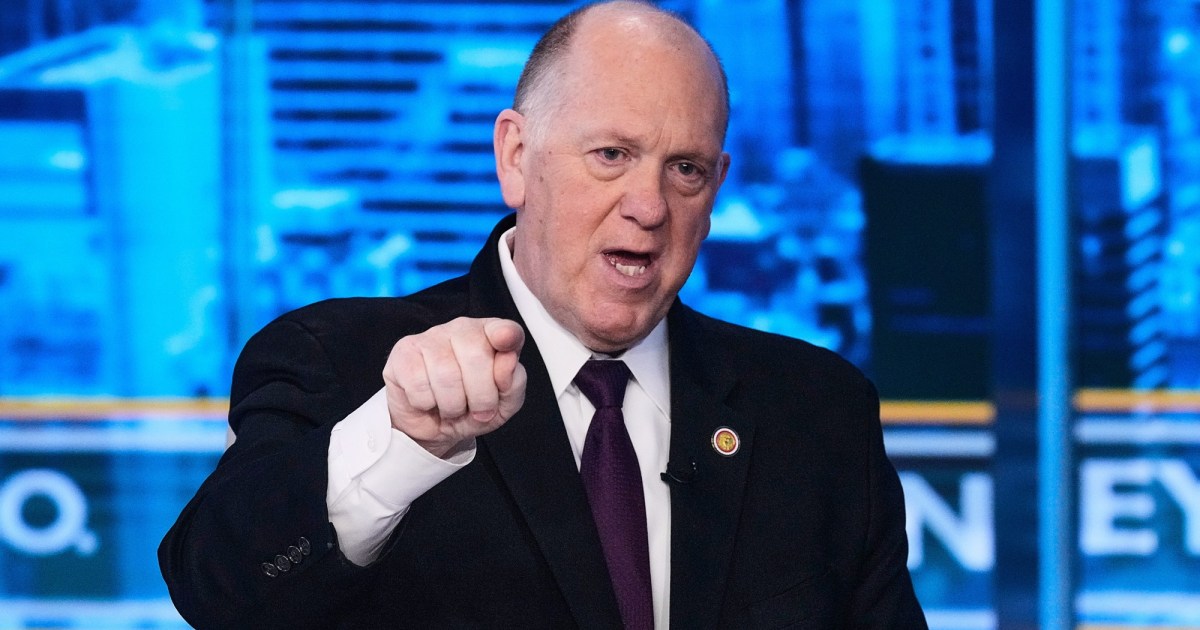
Donald Trump announced Monday that he is sending his border czar, Tom Homan, to Minnesota to take charge of the chaotic immigration operation that led to the killings of Alex Pretti and Renée Good by federal agents. According to Trump, Homan “knows and likes many of the people” in the state, and his arrival comes amid growing criticism—including from some Republicans and conservatives—over the administration’s violent crackdown. The Trump administration also removed hard-right Border Patrol official Greg Bovino from Minnesota.
Homan is being portrayed by many as a less extreme and more professional alternative to the leadership of Bovino and Homeland Security Secretary Kristi Noem. But these days, Homan is hardly a moderate. Last year, he called Rep. Alexandria Ocasio-Cortez (D-N.Y.) “the dumbest congresswoman ever” and attempted to enlist the Justice Department to investigate her over her efforts to educate migrants on their constitutional rights. In April, during a speech in Arizona, he waved off concerns that Immigration and Customs Enforcement’s tactics were spreading fear, saying that “if you’re in this country illegally, you should be looking over your shoulder.”
For decades, Homan worked at Customs and Border Protection, before being appointed to position at ICE during the Obama administration. He pioneered the use of family separations to deter immigration and helped implement that policy as acting ICE director in the first Trump administration.
Homan left government in 2018 and established a consulting business. In the summer of 2024, he was reportedly recorded accepting $50,000 in a paper bag from businessmen—who were actually undercover FBI agents—seeking help winning contracts with ICE if Trump returned to office. Homan has said he did nothing illegal and has stated that he “didn’t take $50,000 from anybody.” Trump’s Justice Department ultimately dropped the matter after investigators, according to Attorney General Pam Bondi, “found no credible evidence of any wrongdoing.”
In 2018, my colleague Noah Lanard wrote a lengthy profile of Homan. People who worked with Homan prior to the Trump years remembered him as a voice for nuance who was focussed on ensuring positive public optics for immigration policy. At the time, some officials who had interacted with him for years were surprised that Homan was fitting into the Trump administration’s immigration machine so smoothly. Homan, one said, had become “unrecognizable”:
Homan was “the person who made the most passionate argument against removing anybody,” [former Obama White House official Cecilia] Muñoz says. Muñoz had won a MacArthur “genius” grant for her work on behalf of immigrants, yet Homan was the one making the strongest case against arresting people who came to the US as minors. Homan, she recalls, said he didn’t want a repeat of the 2000 Elián González case, when a Cuban boy was taken from his Miami relatives at gunpoint. Homan says in a statement to Mother Jones that he didn’t think the arrests would have been “the best use of our limited resources.”
Still, Homan became the face of Trump’s aggressive enforcement efforts in the first term, recommending the policy that led to family separations. He was known for fiery attacks and for firmly backing his boss. And he seemed to understand how how to leverage Trump’s fixation with appearances:
Crucially for a president obsessed with appearance, Homan—a barrel-chested former cop—looks the part. His presence is imposing enough that two former colleagues said, unprompted, that they’d never seen him bully someone. In July, Trump said he’d heard that Homan looks “very nasty.” He replied, “That’s exactly what I was looking for.” Many of the 12 former colleagues of Homan interviewed for this article, from Arizona, Texas, and Washington, DC, say he has a soft side behind the gruff exterior. But that hasn’t stopped Homan from playing up his “cop’s cop” persona on TV, surely aware that it goes over well with his most important viewer.
In Trump’s second term, Homan’s perceived proximity to private interests has emerged as a significant issue. FBI sting notwithstanding, he pledged to avoid any involvement with federal contracting when he returned to government in 2025 as White House border czar. But as Mother Jones and the Project on Government Oversight reported last fall, at least some prospective government contractors seemed to believe he could be helpful. In one instance, we found that a company seeking federal contracts told investors that it was “trying to get access to Tom Homan and the folks over at DHS at the secretary level.” Meanwhile, some of Homan’s former clients are landing big federal paydays:
In addition, a review by Mother Jones and the Project On Government Oversight shows that a number of Homan’s former clients from his time in the private sector have been awarded lucrative border and immigration-related contracts during the second Trump administration. Those projects include constructing private prisons, sprawling migrant detention camps, and a section of border wall. It is not clear whether Homan has played any role in helping his former clients land these deals—the White House says he has no involvement in the “actual awarding” of contracts.
Regardless, the pattern highlights what critics call the legalized corruption of Washington. While Homan denies taking a bag of cash to rig a contract, he openly ran a business in which he traded on his years of government work and high-level contacts to help clients who paid him prosper in the procurement process. Now that he is back in government, even the impression that he can influence federal contract awards creates the appearance of corruption, ethics experts argue.
Homan will be reporting directly to Trump as he leads the operation in Minnesota. In a social media post on Monday afternoon, Trump seemed to be striking a conciliatory tone, indicating Homan would be working with Minnesota Gov. Tim Walz. It remains to be seen whether that will help diffuse the crisis Trump and his team have already created.