








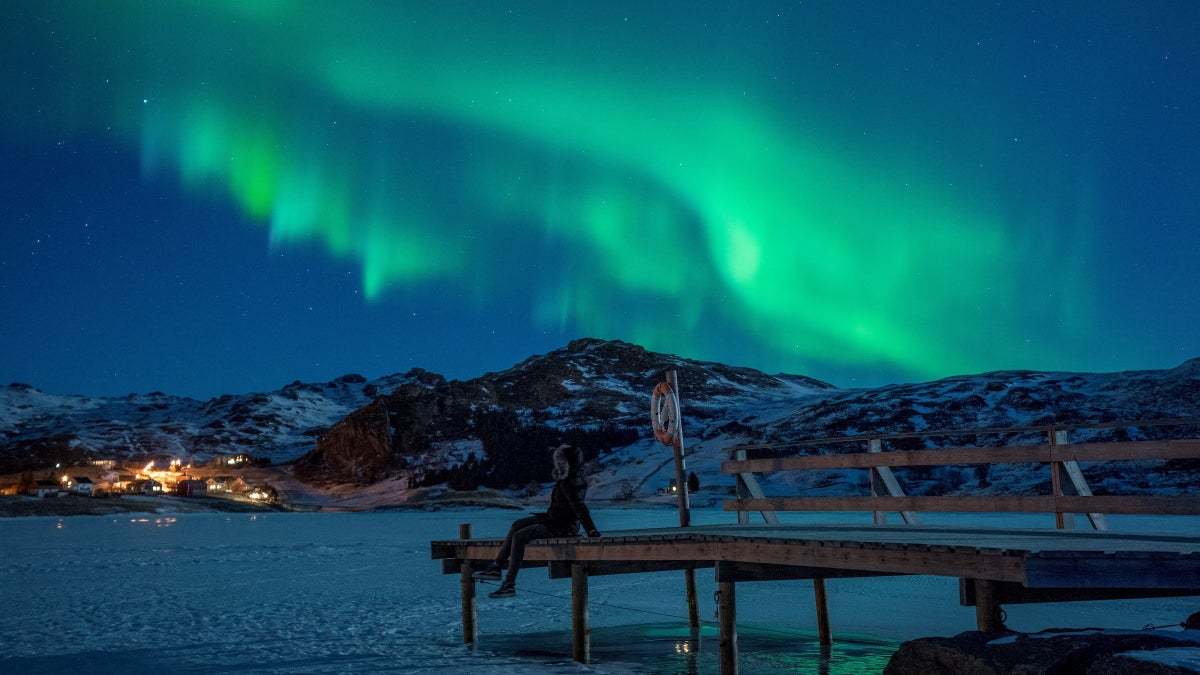
We were halfway to dinner when I noticed a white wisp speeding through the sky.
“Nate, can you pull over?” I said, trying to keep my cool. “I think I see the northern lights.”
This wasn’t the first time I’d seen the aurora borealis. I’ve caught green swirls around the world, from remote sheep farms in South Greenland to the land of polar bears in Churchill, Manitoba. Yet this trip to North Iceland was extra special—and a bit nerve-wracking. I’d plotted the entire journey around showing my husband and his two brothers, Nate and Jimmy, the aurora for the first time.
Aurora hunting is unpredictable, and this hunt had started with a bust: two cloud-stuffed nights. My hours of cloud-cover-map bingeing told me night number three could be it, and when we pulled over outside the town of Dalvik, I was right.
The skies erupted with greens and pinks. We canceled dinner, grabbed fish-and-chips takeout, then spent the rest of the night slack-jawed back at our remote cabin. It reminded me how fun it is to not only see the northern lights, but to help others spot them for the first time.
In this guide, I’m sharing everything I know about seeing (really seeing!) the aurora after at least 50 successful pursuits, from when and where to go to which apps to prioritize, and, most importantly, informal hacks for pulling off and photographing a successful chase.
Yes, you can see the aurora.
Before we start, I want to clear something up. It is absolutely possible to see the northern lights with the naked eye. We’ve enjoyed many incredible aurora displays in low latitudes in recent years, as far south as Texas and Mexico. I watched the major May and October 2024 shows on the waterfront in Cleveland, Ohio, and heard numerous spectators grumbling about only seeing the aurora with a camera—as if we aurora hunters have been lying all along.
I’m here to tell you that you can see it—not just with your phone—as long as the activity is strong enough, you’re away from light pollution, and you’re far north. Now, the naked-eye aurora is never as saturated as the aurora photos I take on iPhone or camera; these devices are more sensitive to light and color. But it’s absolutely visible to the naked eye if you do it right, and that’s what I hope these aurora-hunting tips can help you achieve.
1. Go North
The aurora occurs when charged particles from the sun get trapped in Earth’s magnetic field. They’re then funneled toward the geomagnetic north and south poles, where the protons and electrons interact with gases in the atmosphere, triggering that kaleidoscopic sky dance we trot the globe to see.
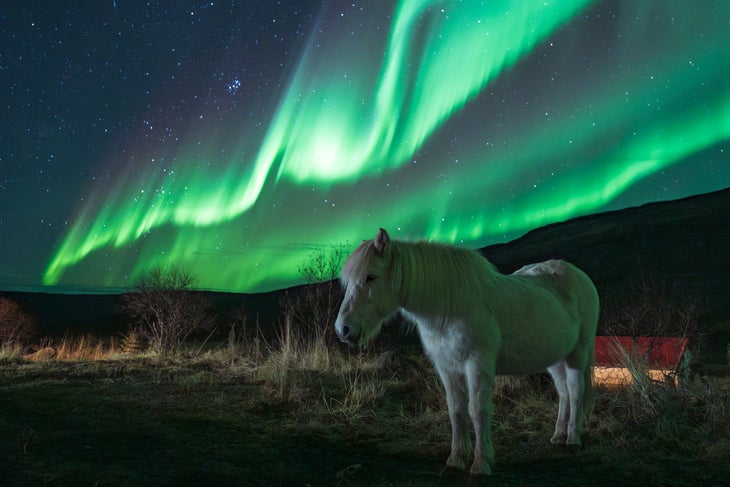
This colorful reaction occurs in a donut shape above the geomagnetic poles. This region, known as the auroral oval, spans from roughly 60 to 70 degrees north and south latitudes. That’s around the latitude of my favorite aurora-hunting perches like Fairbanks, Alaska; South Greenland; and Iceland (the entire island is within the oval).
During periods of strong geomagnetic activity, like those we’ve recently experienced, that oval can swell and bring lights further south. Contiguous U.S. aurora sightings are especially likely in the upper Great Lakes and Maine.
But if aurora sightings (I’m talking true, naked-eye sightings) top your bucket list, I recommend traveling within the auroral oval. The lights are much likelier and more visible here. Just make sure you’re far from city lights, because light pollution can hinder the show.
What’s the likelihood of a sighting up north? It depends on cloud cover, solar activity, and the sun’s cycle, but for scale, I took four northern lights trips in 2025—Yukon, Canada; Alaska; Churchill, Manitoba; and that family Iceland trip—and I saw the lights every single night we had clear skies.
Here are some of the best places in the world to see the aurora.
2. Monitor Geomagnetic Activity
To see the aurora borealis, you need at least some geomagnetic activity. This often follows a coronal mass ejection, when the sun belches heaps of charged particles, carried by solar wind through space.
Kp is one measure of geomagnetic activity; it’s on the scale from Kp 0 (quiet aurora) to Kp 9 (an absolute, get-outside-now bonanza). Most nights average anywhere from Kp 1 to Kp 3; even with that level of activity, you can enjoy a spectacular show up north. And a word of warning: Kp is just a starting point. Several other figures are much better, and more immediate, indicators of what could come.
For starters, look at the Bz. When we have a negative Bz, the solar wind’s magnetic field is oriented south, so it connects to Earth’s northward-facing magnetic field, improving the odds for a powerful display. Solar wind speed is also important. Faster wind can up your aurora-spotting odds, too.
I measure this with the app Space Weather Live, which also sends alerts following major CMEs and another aurora trigger, coronal holes, a dark region of the sun that emits solar material in high speeds. If you’re wondering what the aurora looks like at a certain time, other apps like My Aurora Forecast offer real-time webcams for lights-monitoring, too.
3. Understand Substorms
The aurora isn’t sashaying at full blast all night. It typically undulates through periods of intensity, although some especially strong storms can trigger a nonstop flurry from sunset onward.
In most cases, though, the lights start as a mild arc along the north horizon. Your camera will show it glowing green, but it looks like a broad white cloud to the unaided eye. Over the course of minutes or hours, this arc can grow and move until a substorm sparks; that’s when the lights are at their boldest and most saturated. These last anywhere from around 10 to 30 minutes before mellowing out to recharge and start again in anywhere from roughly 1 to 3 hours.
To keep an eye on possible substorm timing, I use the Glendale website.
4. Choose Accommodations Wisely
Apps are a great starting point, but if I’m within the auroral oval on a night with clear skies, I’m not looking at apps or webcams as much as I’m watching the skies with my own two eyes. That’s why I get picky about my aurora-hunting accommodations.
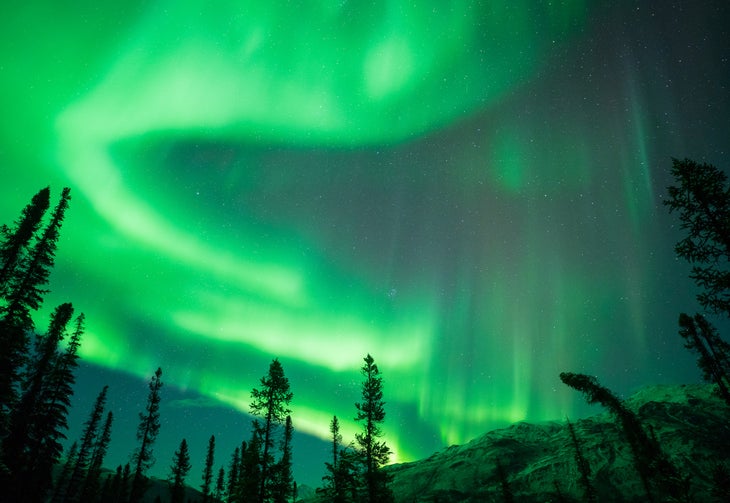
I need a perch far from light pollution with wide-open nightscapes; a thick forest can make it hard to see the lights. I also love lights-chasing accommodations with a little something special—a hot spring to make observing extra cozy or oversized windows to watch the lights from bed.
The options abound, but here are a few of my favorites:
- Borealis Basecamp in Fairbanks, Alaska, which I recommend for any first-time chasers, since they have not only sky-view igloos to watch the aurora between bedsheets, but a complimentary northern lights wake-up call so you don’t miss the show.
- Arctic Hive in Wiseman, Alaska, which I visited as part of a yoga retreat above the Arctic Circle. This getaway is truly off-grid with no electricity. Light pollution is nonexistent, and watching the lights shimmy above the Brooks Range is well worth the eight-hour drive from Fairbanks.
- Tundra Lodge in Churchill, Manitoba—aka the “polar bear capital of the world”—is another favorite. This train-car-style rover, run by Natural Habitat Adventure, has private bunk rooms and observation decks to watch for the aurora and polar bears, with bear safaris by day, too.
- Hotel Arctic in Ilulissat is among the best luxury getaways in Greenland, with glass-walled cabins to watch for scribbles zipping above icebergs—all without leaving bed.
5. Know When to Go
In the far north, the aurora season runs from fall to spring. The swirls still happen during the summer, but you can’t see them in places like Fairbanks due to the midnight sun. But during the warmer months, you can still aurora chase in the contiguous U.S. Places like Michigan’s Upper Peninsula enjoy darkness, even in summer, so you can watch the northern lights in nothing but a T-shirt and shorts. (Here’s how.)
Another thing to improve your odds: travel around the equinoxes. Geomagnetic activity often sees an uptick in the weeks around the spring and autumn equinoxes, so I try to plan my trips accordingly, with many spring and fall outings.
Timing also includes the hour on the clock. In general, activity peaks between 10 P.M. and 2 A.M. local time, although that varies by location. In places like Alaska, I learned, the best shows often happen in the pre-dawn hours—around 1 to 4 A.M. Many people often miss the lights because of this, so make sure to set a few early alarms, or stay in digs with aurora wake-up calls. Better yet: book a tour.
6. Monitor Weather (Especially Clouds)
You need at least partly clear skies to see the northern lights. As a good rule of thumb: if you can see stars, you could see aurora. The far north does tend to get cloudy, so it’s important to have apps like Windy.com handy to track forecasts and cloud cover. Just know that areas like Iceland and Greenland have unpredictable weather. Cloud forecasts can change on a dime, and they’re only accurate about a day in advance.
During especially uncooperative weather trips, I use the Windy app to scout cloud breaks, then plot my evening about driving to those potential holes. Of course, bad weather is inevitable, so I try to give myself a minimum of three nights, although the more days, the better.
7. Learn Solar Cycle 101
If you’ve researched anything about aurora hunting recently, you’ve probably heard that we’re in the decade’s peak of lights activity. What does that mean—and is now the only time you can see them? Not really, but it is a great time to plan a trip if you’re able.
The sun runs through roughly 11-year phases of activity, known as the solar cycle. During the peak, known as solar maximum, the aurora activity ramps up. We’re currently in the solar maximum phase, and it’s been a prolific one, with more northern lights sightings than I can count.
That said, the auroras don’t simply disappear after this. You can still get exceptional displays within the auroral oval, and even further south in places like the Great Lakes, during solar minimum. In fact, many of the strongest solar storms on record have occurred during this milder phase, but the likelihood of witnessing a powerful, naked-eye-visible aurora is especially high right now, given the sun’s tumultuousness.
8. Learn from the Experts
I’m a travel journalist, photographer, and self-taught aurora hunter, but I’m not an astrophysicist. While I have my system pretty down pat, I still look to the scientists for real-time tips and advice. For example, professional aurora hunter Vincent Ledvina shares aurora updates and analysis on Instagram, which is especially helpful following a CME.
Many aurora experts also gather at the Aurora Summit in the upper Great Lakes every November for a weekend of education and hands-on chasing. I attended and spoke in 2025, and greatly upped my intel, including how to track those coveted substorms.
Or, maybe you want to see the lights without all of this DIY hassle. I hear you. It’s a lot. For that, I highly recommend booking a guide with someone who knows how to do the chasing—even better if it’s with an Indigenous northern lights hunter in Canada.
The post The Ultimate Guide to Aurora Borealis Hunting appeared first on Outside Online.