








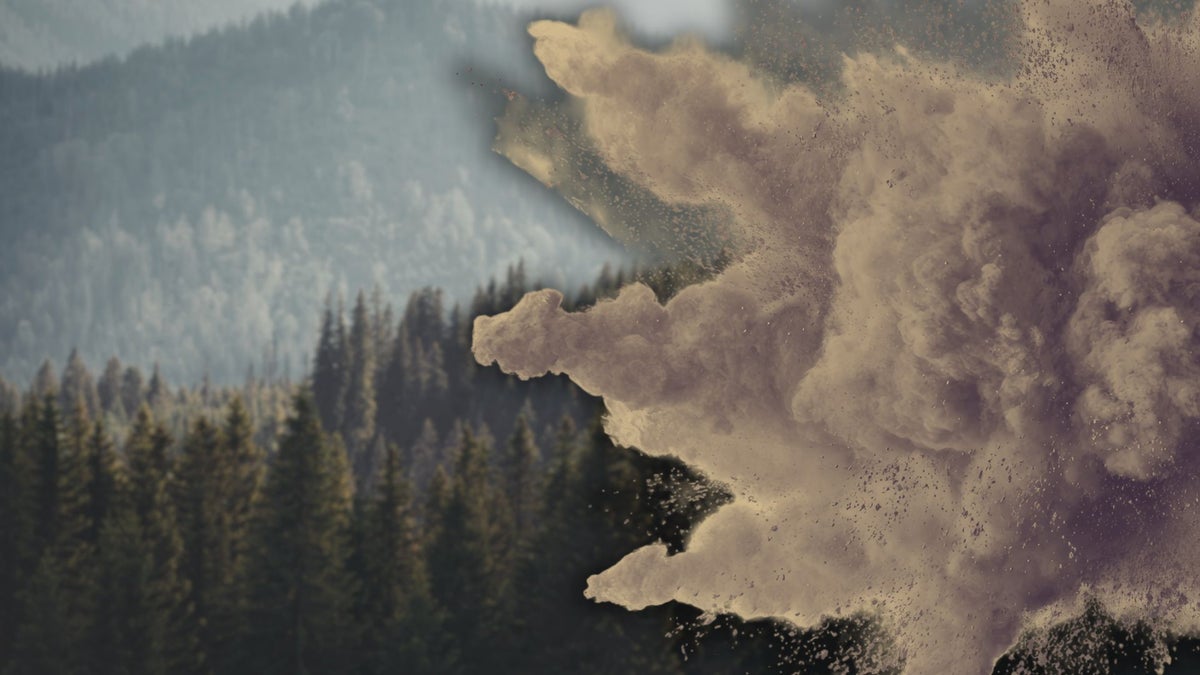
Many years ago, Lakota elder and tribal historian Victor Douville was traveling through the Black Hills of South Dakota in the dead of winter. It was early in the morning, and temperatures had plummeted from the previous day to well below freezing. Suddenly, the silence around him was broken. Loud cracks, like fireworks, began to echo through the forest.
“I thought it was the strong winds bending the pine trees, with the frost on the branches making the noise of the breaking branches, but there were no strong winds present,” Douville told Outside.
Douville later learned that the trees around him were literally cracking apart, detonating from the inside.
What Causes a Tree to Explode?
As a polar vortex roars through parts of the U.S. in January, a growing number of social media posts are warning Americans about so-called exploding trees. During extremely cold conditions, the National Forest Foundation says, liquid sap inside tree trunks can act like water in a pipe. If it’s exposed to a rapid, deep freeze, that sap expands, creating immense internal pressure, until the tree’s bark splits open with a violent crack.
For a tree to rupture, the temperature drop has to be rapid enough that the tree can’t acclimate, causing its sap to freeze instantly. Rarely does an entire tree explode. More commonly, branches are destroyed, or a permanent vertical scar is left in a tree’s trunk, known as a frost rib.
For some North American Indigenous groups like the Lakota, however, the crackling of a forest in the deep cold is just the sound of winter.
Marking a Passage of Time
Indigenous experts told Outside that the phenomenon simply marks the changing of the seasons. In the lunar calendar of the Lakota, the month of February is known as Čhaŋnápȟopa Wí, or Moon of the Popping Trees. For the Cree, the final moon of the year is called Pawacakinasisi Pisim, or Frost-Exploding Trees Moon.
Alex FireThunder is the Department Chair of Lakota Studies at Oglala Lakota College, in South Dakota’s Pine Ridge Reservation. He’s also an expert on the Lakota language. Unlike traditional Western timekeeping, FireThunder says the Lakota calendar is observational rather than numerical.
“The names of our months or moons often describe what’s going on in nature during that time of year,” he told Outside. For the Lakota, the Moon of the Popping Trees remains a consistent marker of the deep, bitter freeze of late winter.
An Ancient Culture in Modern Times
This knowledge is ancient, dating back at least 3,600 years, and has long been recognized as a reaction to rapid changes from warm to cold, says Douville. Today, he works as a professor at Sinte Gleska University on the Rosebud Reservation. He adds that Lakota winter camps were typically set up very close to stands of trees, so these cracking or popping noises were always clearly heard by the tribes during the winter.
“Traditional Lakota describe the phenomena of tree branches popping when extreme cold overcomes the state of fall,” Douville said. He added that the Lakota knew the trees cracked “when winter cold fronts clash, at the very moment an extreme freeze breaks down the warmer front.”
So on that day, long ago, when Douville was making his way through the Black Hills, he recalled his Lakota teachings, which he’d learned from his uncle. The season was around the time of the Čhaŋnápȟopa moon, and čháŋ means tree, while nápȟopa means to pop.
“I suddenly remembered the translation,” he said.
It was the first and last time Douville ever heard the noise of trees popping from the cold, but it wasn’t a modern scientific text or a viral TikTok video that explained it for him. It was his tribe’s ancient charts, passed down for thousands of years.
The post The Internet Is Panicking About ‘Exploding’ Trees. Indigenous People Have Experienced Them for Centuries. appeared first on Outside Online.