








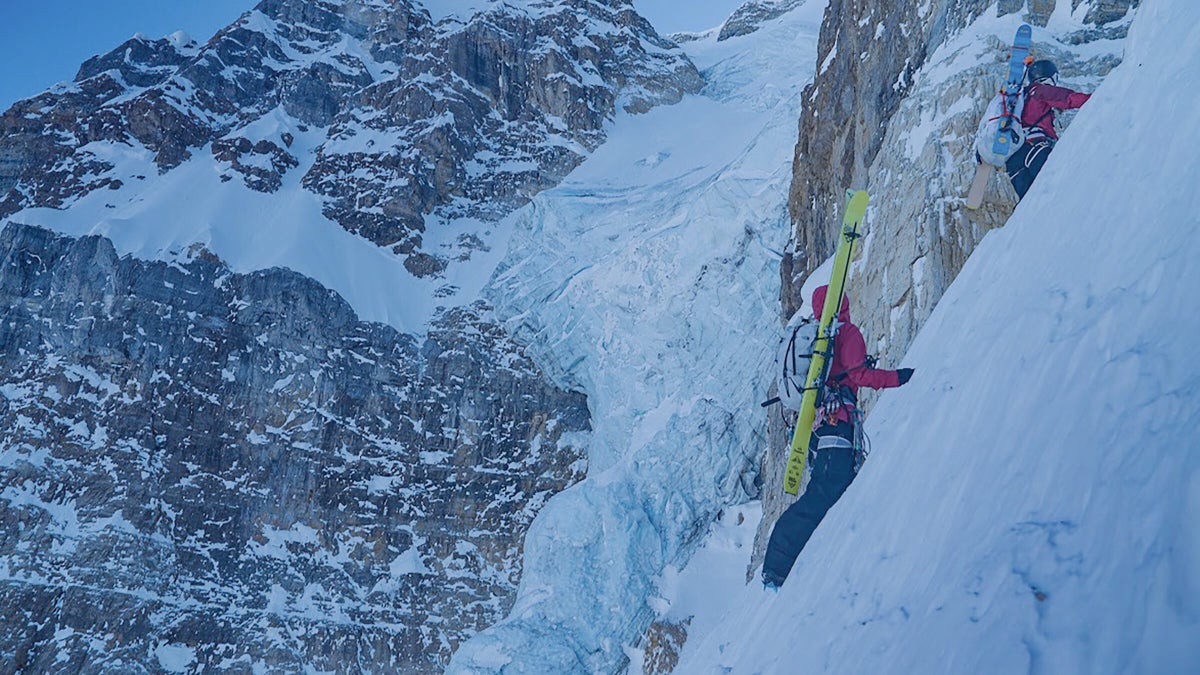
Picture yourself on a sheer mountainside looking over a dizzying 300-foot cliff. Now, imagine that there are two skyscraper-sized glaciers towering above your head, and every hour or so, giant blocks of ice break free and tumble in your direction.
OK, here’s the kicker: you’re trying to descend this treacherous landscape on skis.
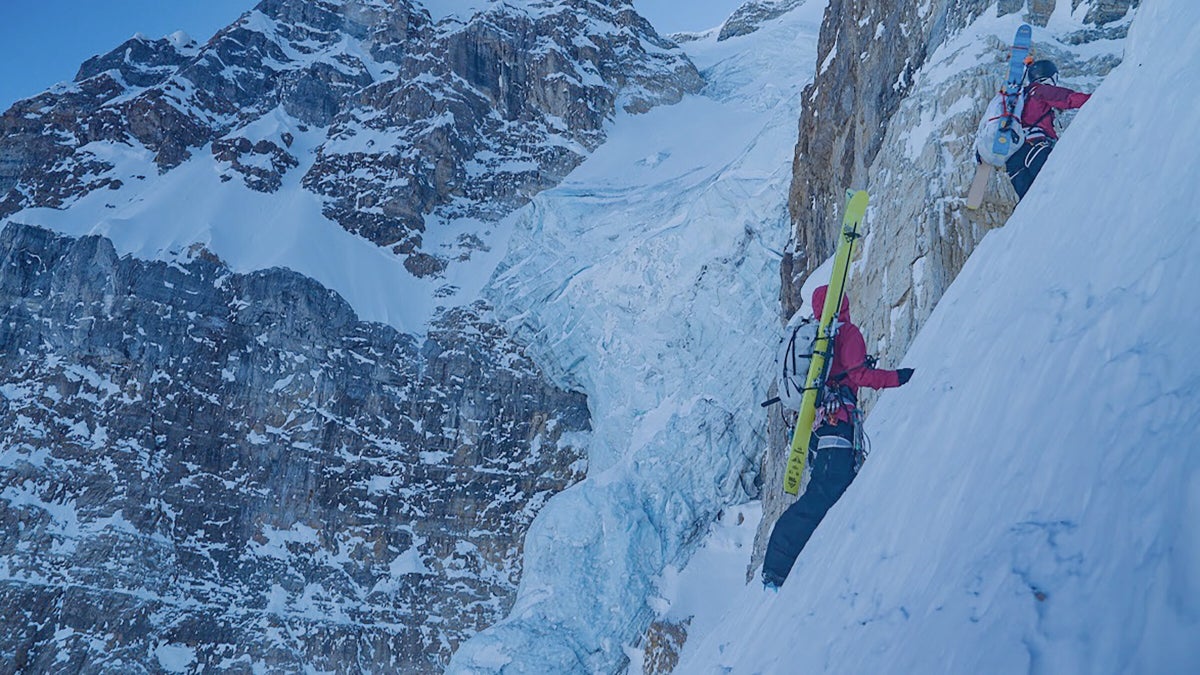
Christina Lustenberger and Guillame “Gee” Pierrel found themselves in this exact situation earlier this month. From January 17 to 19, the two ski mountaineers, along with climber Brette Harrington, climbed the 11,234-foot Deltaform Mountain in eastern British Columbia. The trio then recorded a first ski descent on a patch of snow and ice so sketchy that it boggles the mind to even think about.
There’s no such thing as an easy way down on this run.
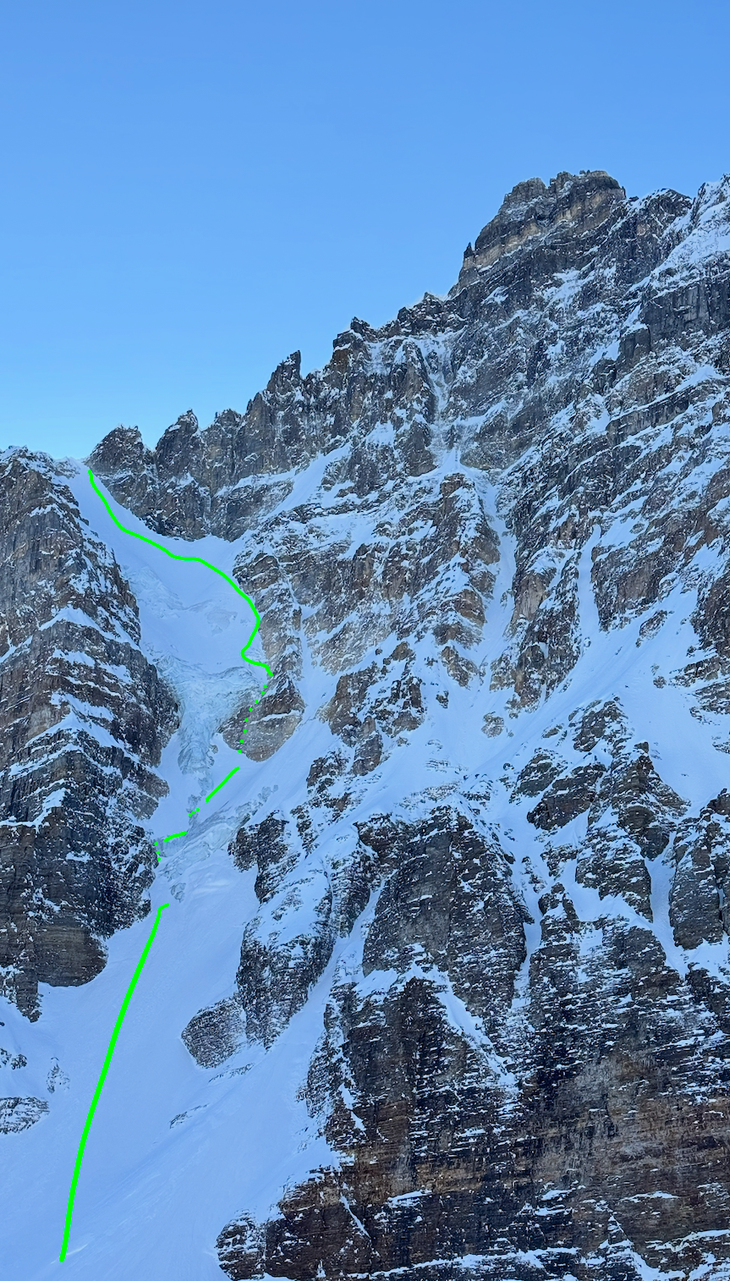
“The intensity of the ascent and descent made this one unique,” Lustenberger, 41, told Outside. “Having that much exposure, and skiing on a hanging glacier was super wild.”
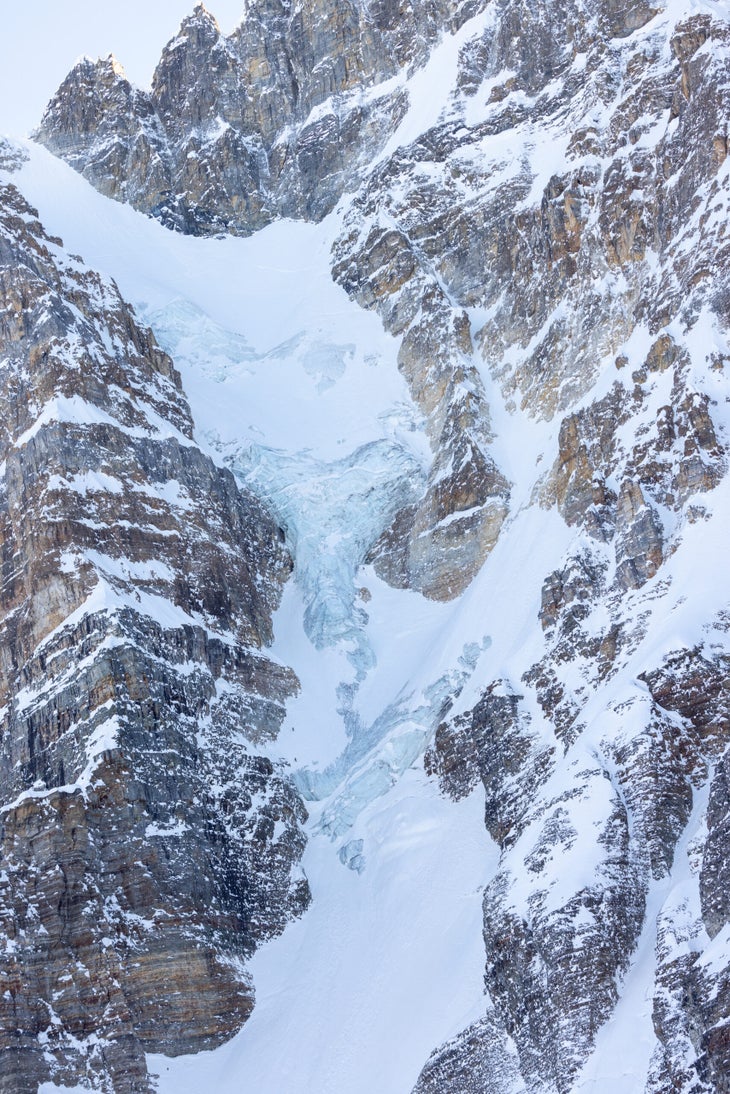
Take a moment to look at the images above of their ski line, highlighted in neon green. Forget about a black diamond—that run deserves a skull and crossbones rating.
“This one packed a punch,” Lustenberger added.
You Can’t Climb It, but You Can Ski It
Skiing down narrow, icy slopes on sheer mountainsides is what Lustenberger and Pierrel do best. But Deltaform Mountain presented a few tricky challenges that gave even these veteran ski mountaineers some hair-raising experiences.
The line they skied passed over a hanging glacier—a vertical wall of ice that clings to the side of a mountain. That glacier, as well as another one near the summit, posed immense danger from falling ice.
The group chose not to climb up their planned ski descent to avoid being struck by icefall.
“There was always the reality of falling ice,” Pierrel told Outside. “When you get up close to it, you can see these pieces, like two or three meters, just hanging and ready to fall.”
That decision robbed them of valuable reconnaissance on their actual ski line. Ski mountaineers often ascend the route they plan to descend and test the snow surface and scout the mountainside for buried rocks and obstacles.
“We had no observation of what the snow would be like on our ski line,” Lustenberger said. “It felt like entering another world when we dropped in.”
The descent of Deltaform wasn’t exactly a well-marked and flowing ski run. The band of snow they chose weaves in and out of couloirs, between bands of rocks, and over four separate sheer cliffs. There’s a vertical wall of ice at the midpoint.
To reach the bottom, the two had to stop at each drop-off, affix safety ropes, and then rappel down a cliff. Each time they stopped to rappel, the duo had to inch their skis up to the cliffside to set ice screws and other anchors. But with every step came the potential of a slip, or of a collapse of the snow.
“Skiing up to the edge of a void is always pretty intense,” Lustenberger said. “You’re not skiing up to this established anchor point where people have done it before. We’re figuring it out.”
In total, the line they skied encompassed approximately 2,300 feet. Sections of the slope approached a 50-degree pitch, Lustenberger said, far steeper than any hillside you’d encounter at a resort. And every inch of the descent brought danger of a deadly fall, and the fear of falling ice from the hanging glacier near the summit.
Not a Famous Mountain? No Problem.
Deltaform Mountain may not have the same catchy, name-brand appeal as the other peaks that Lustenberger has scaled and then shredded on skis. In 2025, she and Pierrel recorded a harrowing first descent on the south face of Mount Robson, the highest mountain in Western Canada. They skied a new line on New Zealand’s tallest peak, Mount Cook/Aoraki, in 2024, which came on the heels of Lustenberger skiing the Trango Towers in Pakistan alongside Jim Morrison that same year.
But Deltaform Mountain had special appeal. To reach the peak, the trio had to hike ten miles into the backcountry while pulling their skis, safety equipment, tents, and sleeping bags on toboggans. And afterward, they towed their stuff back to the trailhead.
There was no chairlift or four-lane freeway.
“It was a human-powered adventure,” Lustenberger said.
And it was also as close to a backyard accolade as Lustenberger could find. Deltaform Mountain sits in the so-called Valley of Ten Peaks, which lies inside Banff National Park. Lustenberger grew up two hours away in Invermere, a hotbed of British Columbia’s ski culture.
“We went into the valley and didn’t see anyone or anyone else’s tracks except for our own,” Lustenberger said. “This was a wild and pure Canadian adventure.”
The post Christina Lustenberger’s Latest Ski Adventure ‘Packed a Punch’ appeared first on Outside Online.