








Our collective desire to escape may be approaching a fever pitch. Escape what? Oh, take your pick. A few things on my personal list: Screens, the rise of authoritarianism, persistent wars, AI everything, and climate anxiety.
I’m not alone. In a recent Gallup poll, 40 percent of American women ages 15 to 44 (my demographic) revealed “they would move abroad permanently if they had the opportunity.” A little more than a decade ago, in 2014, only 10 percent of women ages 15 to 44 reported feeling that way. To a lesser degree, men also want out; 19 percent of men in that age group would also leave if they could. The New Yorker even recently published a guide entitled “How to Leave the U.S.A.”
Maybe that’s what’s driving the rising travel trend of escapist and surrealist destinations. In its newest annual trends predictions, Pinterest called “fairytale meets fever dream” the greatest trend in travel of 2026. Think mystical forests, mysterious formations, and ethereal places that make you feel like you’re in an alternate reality or on another planet.
While you do what you can to make things decidedly less dystopian, every once in a while, we all need an escape. For anyone who feels the same, I’m sharing some of the most mystical, ethereal places I’ve visited in the past—and the otherworldly destinations topping my future travel list this year. Happy escaping.
The Most Ethereal Places I’ve Ever Been
Scottish Highlands, Scotland
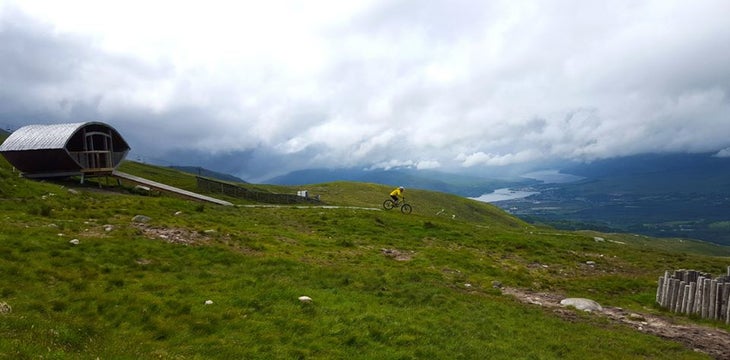
With near perma-fog surrounding craggy, emerald hills and castles, the Scottish Highlands are quintessential “mystic outlands,” as Pinterest dubs this travel trend. Having visited twice, I understand why the Scottish Highlands aesthetic has become so sought after. There’s a reason fantasy series like Game of Thrones and Harry Potter were filmed here—you can visit shooting locations for both.
My first visit to Scotland was for my honeymoon. My husband and I lugged two massive packs filled with trad climbing gear (P.S., when I’m not writing travel stories, I’m the editor-in-chief of Climbing) around the country. But due to persistent rains, we were only able to actually climb once. Instead, we spent our time traveling back in time to the 13th century at the Eilean Donan Castle (which appeared in a James Bond film), hiking around the enchanting Fairy Pools in the Isle of Skye, and drinking too much scotch while playing cribbage in cozy pubs.
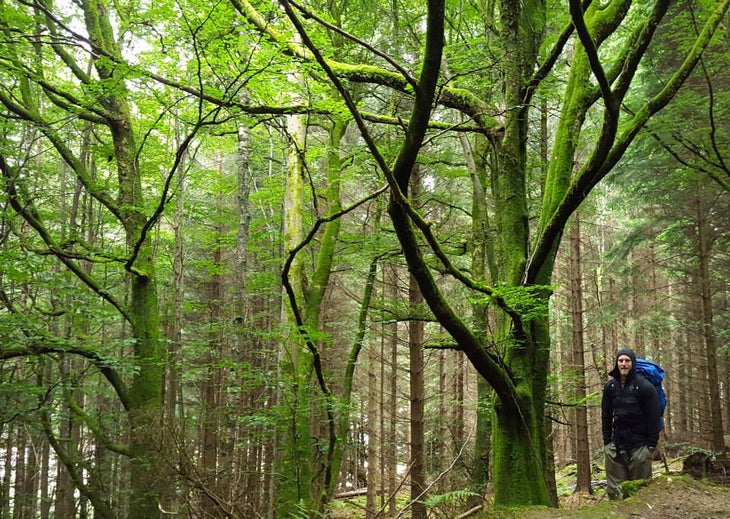
Head to the Highlands if your escapist travel fantasy has medieval undertones, you might believe in monsters lurking beneath lakes, and you prefer weather forecasts conducive to finishing entire fantasy novels in a matter of days over sunny skies.
The Amazon
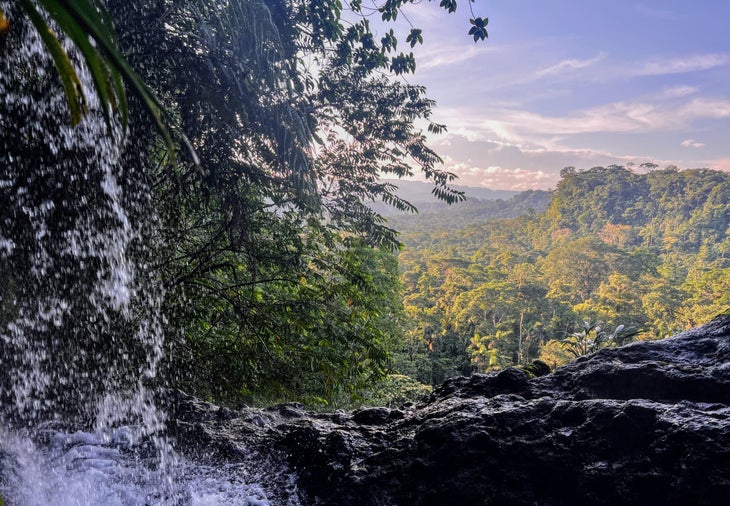
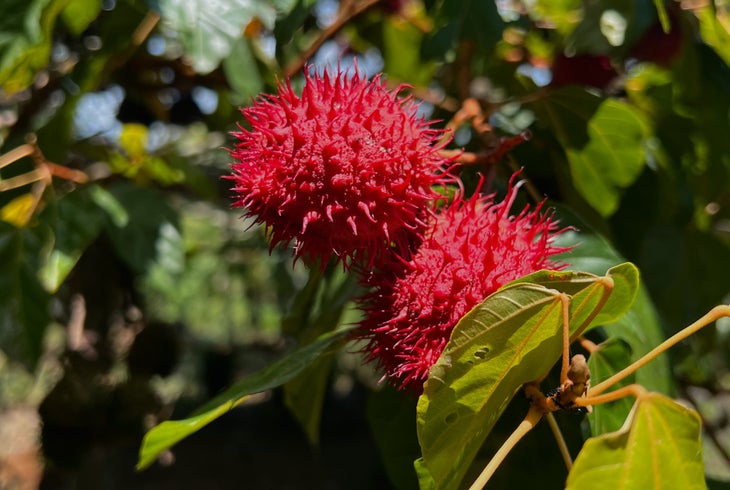
If you need a breather from the chaos of modern life, head to the “Lungs of the Earth.” A different kind of chaos thrives here, and it’s called biodiversity. A couple autumns ago, I had the chance to visit a regenerative ancient chakra farm in Ecuador. I tasted more fruit than I could record in my notebook, swung from a jungle vine, and observed how the Indigenous Kichwa people use Amazonian plants for everything from medicine and dyes to hairbrushes.
But the moment that will stick with me for the rest of my life was when we emerged from the beautiful chaos of the jungle during a walk led by a Kichwan family. All of the sudden, the thick vegetation and tangles of vines cleared as we reached the edge of a cliff, where water pooled above a roaring waterfall descending hundreds of feet to more rainforest below. A tapestry of trees stretched out for miles as birds dipped in and out of sight overhead. The vastness was staggering (this is apparent in the drone shot of us in this Instagram post below, taken by our trip photographer James Roh).
A visit to the Amazon—whether in Ecuador, Brazil, Peru, or another country home to part of the world’s largest rainforest—is equal parts mystical and motivating. You will escape the concrete jungles, but you will also be reminded of how lush and alive our planet is—and how important it is to fight to conserve it.
Bolivia’s Salar de Uyuni
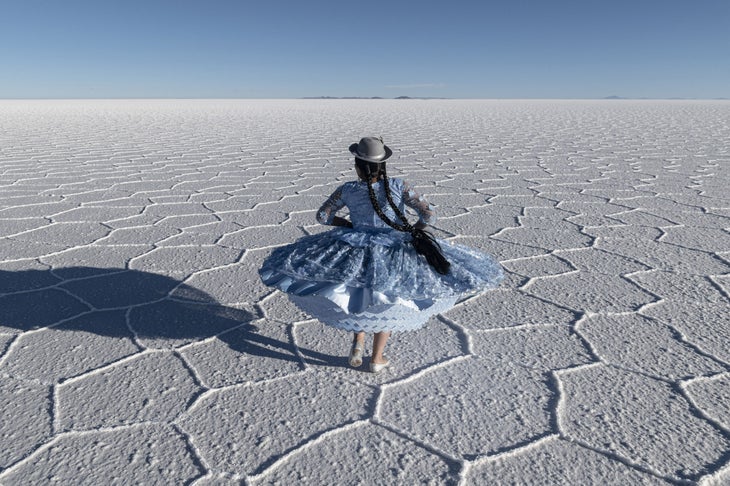
Technically, I never made it to Salar de Uyuni, the mind-bending salt flats that stretch by some accounts as far as 4,633 square miles. That’s because I broke my foot shortly before we were supposed to arrive while bouldering in the Valle de Rocas. With no crutches available in any of the small towns in central Bolivia, I spent two days hopping around while riding in the lower luggage compartment of a bus to make it back to La Paz—and I never got to see the largest salt flats in the world.
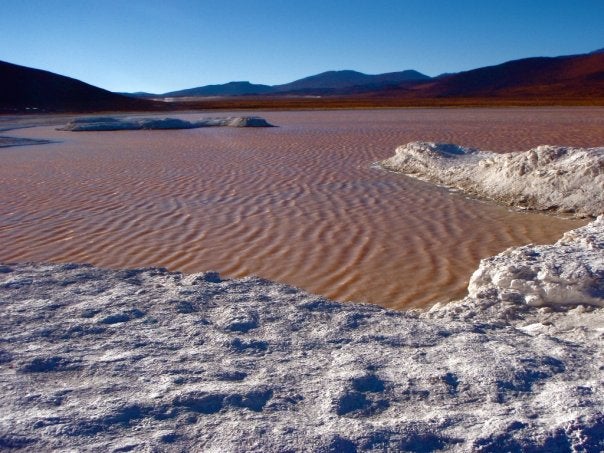
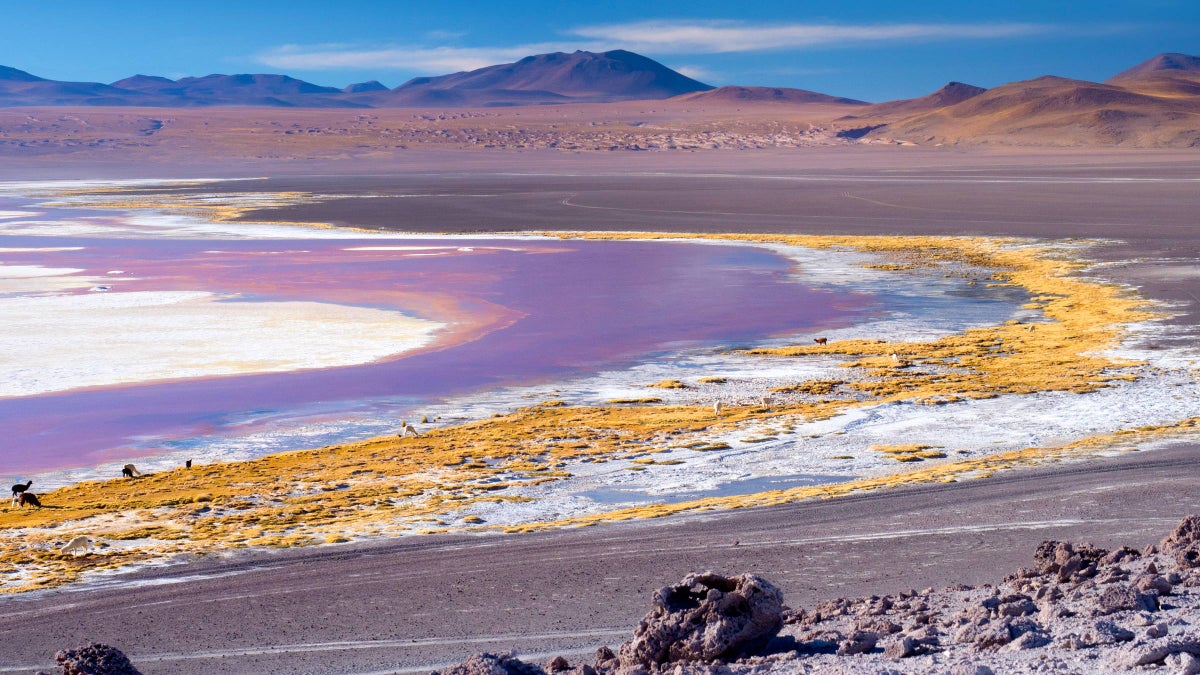
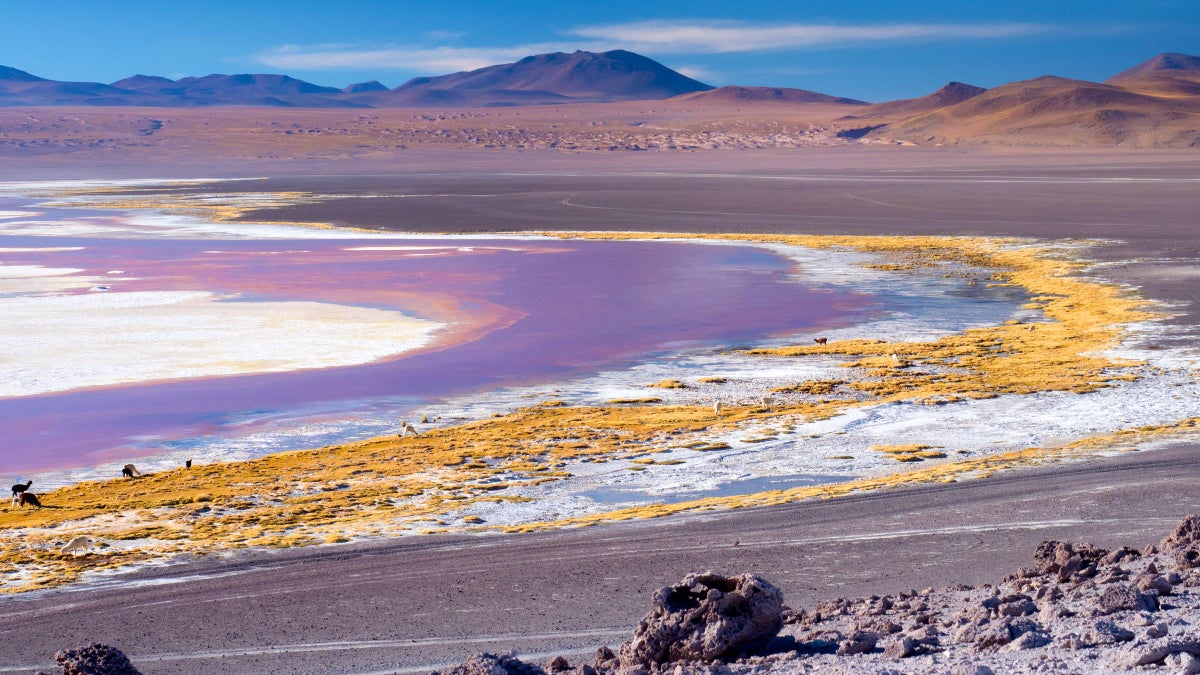
But shortly before the accident, I visited a highly saline lake called Laguna Colorado. Stretches of salt flats lined its shores, where flamingos perched. I have also been to the Bonneville Salt Flats of Utah, where I live. Walking on the saline landscape feels lighter than life—and peering into the horizon will blow your mind. For photographers, the opportunity to play with perspective is irresistible.
Here, the fever dream is what you make of it—a landscape that doubles as a blank canvas for illusions and moon-age daydreams. Walking on salt flats does feel like what I imagine a stroll on the lunar surface would be.
Spiral Jetty in Salt Lake City, Utah
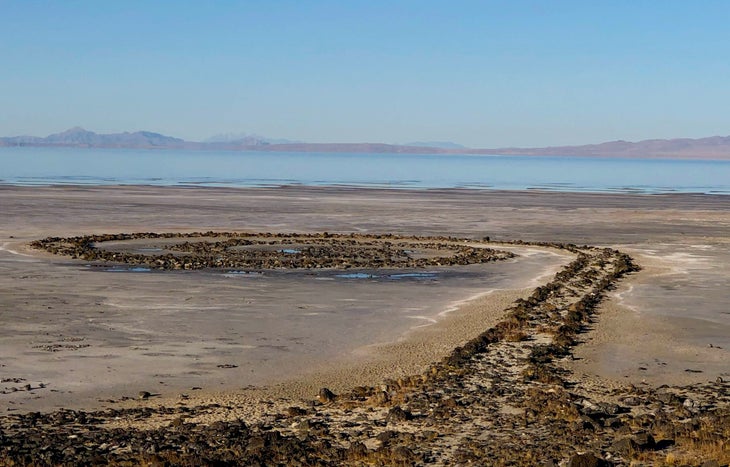
Speaking of salt, you can find it surrounding this iconic piece of land art at the northeastern shore of Utah’s endangered Great Salt Lake. Completed by Robert Smithson in 1970, the counterclockwise spiral stretches 1,500 feet long and 15 feet wide.
While it was once frequently obscured by lake water, the endangered saline lake rarely submerges this artwork nowadays thanks to a megadrought and the state’s water demands. This means that during most visits, you can walk the spiral and contemplate its meaning: entropy—the breaking down of things, the descent into disorder.
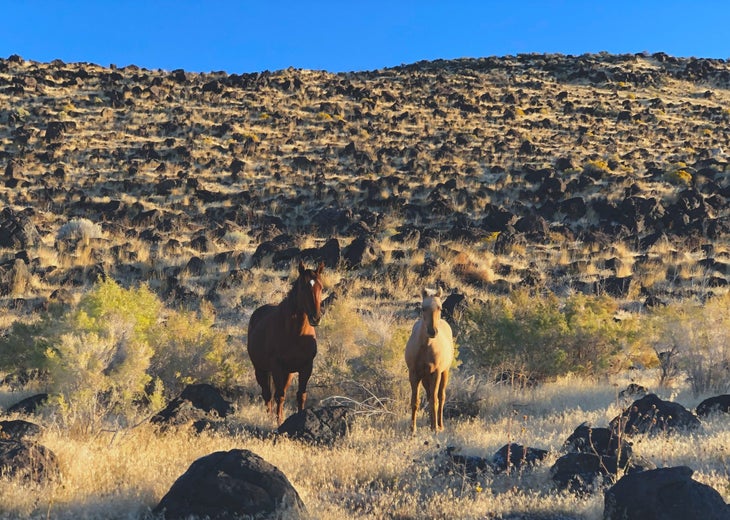
When I visited Spiral Jetty a few years ago, I arrived alone, after an hour on dirt roads, where I passed a Cold War-era rocket garden and the Golden Spike, the point that marked the completion of the transcontinental railroad in 1869. As I pulled up to Smithson’s spiral, wild horses eyed me from the hills above the lake. Walking the spiral in a silence interrupted only by the occasional buzzing fly is an experience I’ll never forget.
Continue the land art escape by making the two-and-a-half-hour journey west to see another piece of historic land art in Utah: Nancy Holt’s Sun Tunnels, best visited during the winter or summer solstice.
Ijen Crater in Java, Indonesia
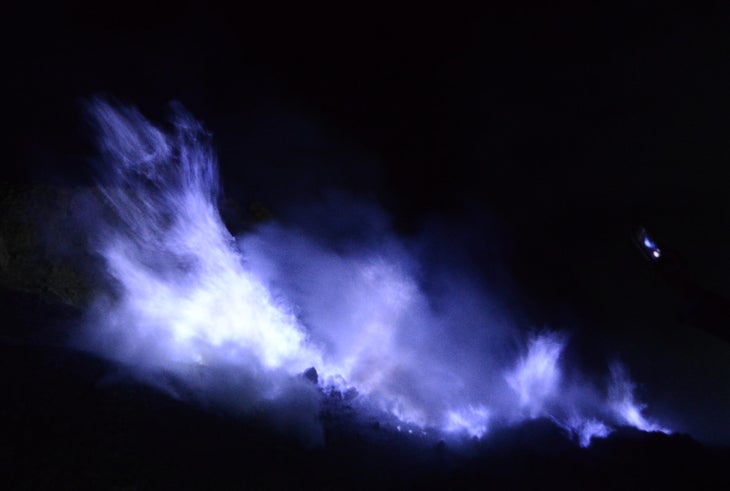
I am a bit torn about including Ijen Crater—or Kawah Ijen in Malay—on Indonesia’s island of Java on this list. It’s undoubtedly perhaps the most mystical place I’ve ever been, but it’s also the site of a dangerous mining operation. As we hiked up to the rim of the crater in pre-dawn darkness, dozens of young men pushed wheelbarrows filled with sulfur-emitting toxic gasses up and down the trail. Unmasked, these miners breathe in carcinogenic sulfur dioxide that can lead to respiratory problems and other health issues. At the top, we tried to support them by buying yellow trinkets they’d fashioned from the volcanic sulfur.
The world’s largest acidic lake, Ijen bewitches all who behold it with its unreal cerulean blue surface. As it emits sulfuric gasses, the air above glows sapphire, giving the lake the nickname “blue fire.” The sight appears more spectacular by night, but we reached Ijen too late at sunrise to see the full effect.
Just as surreal as the volcanic lake itself is the surrounding landscape. On our trek back down, mist hovered over rolling hills of dark grasses and trees, some of which were leaf-less, gnarled, and dead due to the toxic fumes of Ijen. Back on flat land, vendors set up makeshift tents, where we bought instant ramen and processed what we’d seen.
If you’re considering an escape to experience the yogic vibes and temples of Ubud or to the beaches of Bali’s coast, consider adding on an excursion to Ijen. Visually, it will grip you—and give you a lot to think about.
House on Fire, Bears Ears National Monument, Utah
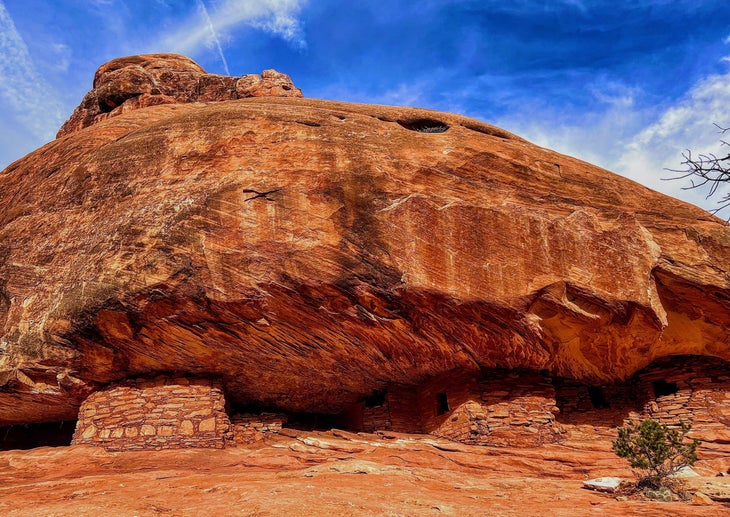
One more Utah spot for this list of ethereal places—since I’m biased as a Utahn of nine years and a local travel guide author. Several more otherworldly destinations exist in Utah that I considered adding here—Pando, Monument Valley, and Singing Canyon, among them. But ultimately, House on Fire, a cultural heritage site in the desert, stands out.
One of the only national monuments co-managed by a coalition of local tribes with ancestral ties to the land, Bears Ears National Monument remains a sacred place to many. This never felt more poignant to me than at House on Fire, which is actually not the remains of a house, but of ancient granaries constructed by the Ancestral Puebloan people. I navigated to GPS coordinates, pulled over on the side of a road, and found the faint trail through Mule Canyon, which I followed as a strong fall breeze rustled the brush around me.
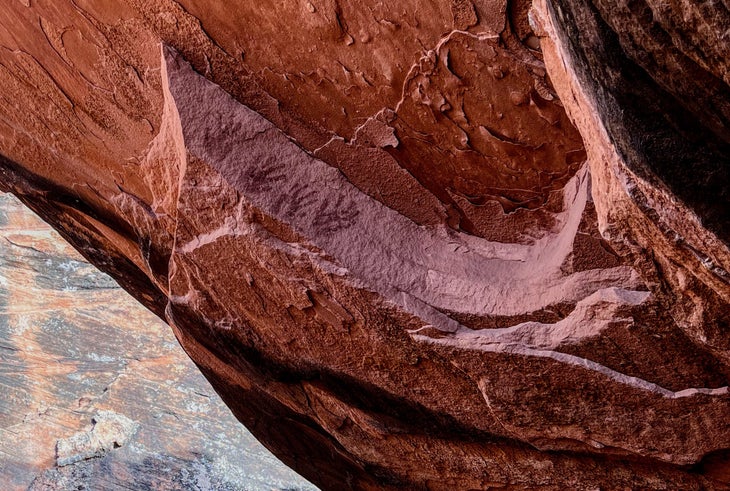
I turned a corner and there it was: structures of stone huddled beneath a mushroom-like sandstone dome. An older couple was there, but left after I arrived, leaving me alone at the site. I hiked around the granaries, imagining them brimming with heaps of seeds, ears of corn, or pine nuts. Past the granaries to the left, I saw a constriction leading upward. I scrambled up a boulder and wandered through a dim alcove, when I saw two umber handprints, centuries old, imprinted on the rock. Further through the alcove, I saw four more. Bears Ears is truly otherworldly in the sense that it transports you back in time geologically and culturally.
The Most Ethereal Places on My Travel List
Japan’s Arashiyama Bamboo Forest
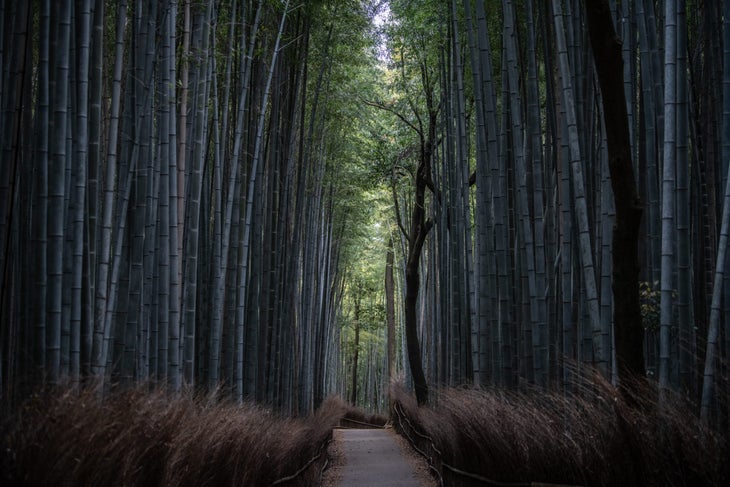
The roots of this giant forest of bamboo lie centuries ago during the imperial Heian period, from 794 to 1185 C.E. Back then, Kyoto, where the forest is located, served as the capital of the Japanese empire. This dense grove of bamboo includes stalks as high as 92 feet, immersing the visitor in a world of green—and Zen embodied. In Japan, bamboo symbolizes strength, resilience, and the Zen philosophy. Since this arboreal attraction entices many visitors, it’s best to arrive before sunrise and seize that golden light. But I would love to go at sunset, then stay for stargazing amid the green giants swaying in the winds of darkness.
Faroe Islands
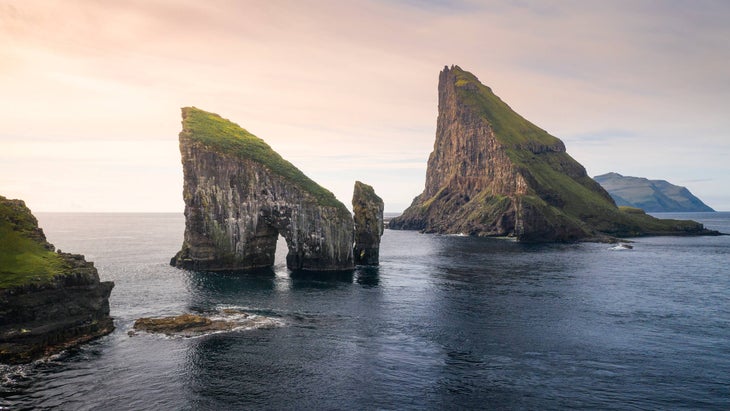
Located in the North Atlantic, nearly equidistant between Iceland to the northwest, Norway to the east, and Scotland to the south, this archipelago is actually part of Denmark, nearly 1,000 miles away. The Faroes formed over 50 million years ago as volcanoes erupted, blanketing the land in flows of lava that solidified into basalt. Ghostly sea stacks, perpetual waterfalls, and dramatic cliffs make this destination as “mystic outlands” as it gets. Amid the natural splendor, loom Viking burial mounds and archaeological sites—and a lot of sheep. While I’m hesitant to plan a climbing trip to this land of rain, mist, and probably sketchy rock like I did in Scotland, I would love to lean into the water, kayaking between sea stacks.
The Wave, Coyote Buttes
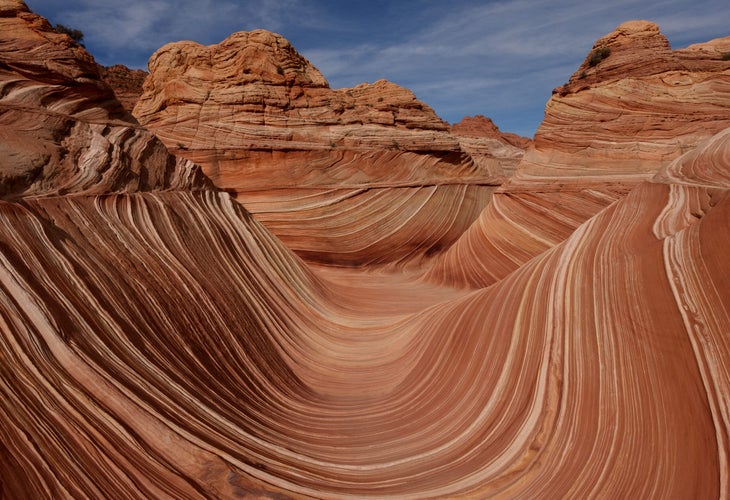
Imagine sand dunes in a violent wind storm coaxed into dramatic swirls and forms—then freezing in place forever. That’s the best visual description I can come up with for this psychedelic sandstone formation on the border of Utah and Arizona. Technically, “The Wave” itself lies in northern Arizona, but the Wire Pass trailhead starts in southern Utah. For several years, I’ve been vying for an advanced lottery permit to hike to this elusive—and highly in-demand—area. No dice for me yet, but maybe 2026 will be my year. If you don’t have little kids or a 9-to-5, you can also be more opportunistic. While in southern Utah, try for an easier-to-obtain daily lottery instead.
Tips for the Escapist Traveler
To escape, you need the right destination, but you also need the right mindset. It’s a bit like your suspension of disbelief in reading a novel or watching a fantasy trilogy set in, say, some mystic outlands. You know you are still on this same earth, in your same reality, beholden to your same responsibilities. But you need a respite from it all. You need an escape you can temporarily get lost in. A place to find greater beauty and perspective in the world upon your return.
Here are a few tips for making the most of the escapist travel trend:
Turn your phone on airplane mode.
No emergency work check-ins, no group text drama, no social media. Just the escape.
Bring a non-phone camera.
This way, you can take photos without getting swept away by unplanned doomscrolling. Consider bringing a DSLR, a Polaroid camera, or even a point-and-shoot for nostalgic prints post-trip. Don’t have a camera? Rent one from your local camera shop or online.
Plan a good, fitting read.
Find a historic novel set in the destination you’re visiting. Fantasy max with a good romantasy or the first tome in an epic series. Or throw it back with some age-old fables or fairy tales.
Make an escapist playlist.
If you’re road tripping or renting a car, the right music will set the mood. Depending on your destination, consider some Bjork, Wind Rose, Air, Phillip Glass, or cinematic soundtracks.
Travel like a true LARPer.
This tip isn’t for everyone! But recently, I stayed at a scifi-themed resort in the middle of nowhere that fully leaned into the concept with wardrobe rentals, character cards, fictional narratives about each building posted on plaques, and more out-there details. If you’re up for it, go all in. Pack an imaginative wardrobe to match the vibe of the ethereal place you’re visiting. Role play with your travel mate. And bring what you need for some D&D (or other fantasy-inspired games) on the road.
TELL US: Is there an otherworldly place you’re dreaming of visiting this year? Or an unreal spot that stopped you in your tracks?
The post Escape Dystopian Times at These 9 Ethereal Places appeared first on Outside Online.