








What You Should Know
– New research from Firstup reveals that 81% of hospital nurses attribute patient care issues directly to organizational miscommunication.
– With traditional channels like email failing a “deskless” workforce, communication gaps are now a primary driver of clinician burnout and a “retention tax” costing hospitals an average of $61,110 per lost RN.
Firstup 2026 State of Nursing Communication Report
As hospitals nationwide navigate margin pressure and a projected global shortage of 11 million health workers by 2030, a fundamental “last mile” challenge has emerged: the inability to reliably reach the frontline. The Firstup 2026 State of Nursing Communication Report, based on a survey of 1,000 U.S. hospital nurses, reveals that while hospitals are communicating more than ever, the message is rarely landing.
Email in a Shift-Based World
The primary culprit is a reliance on legacy communication infrastructure. Eighty-six percent of hospitals still use email as their primary channel, a method that assumes nurses have dedicated time to sit at workstations.
- The Bandwidth Gap: One-third of nurses report they simply do not have time to read workplace updates during their shifts.
- The Signal-to-Noise Problem: Nearly 70% of nurses receive updates several times a week, but 48% say those messages are only “somewhat relevant” to their specific roles.
- The Resulting Friction: Consequently, 67% of nurses admit to skimming or deleting messages without fully reading them.
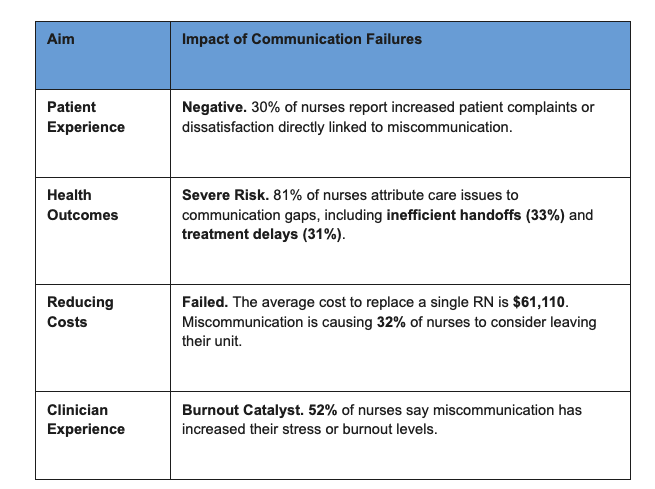
Nursing Communication Quadruple Aim Assessment
Moving to Mobile-First
For a Chief Nursing Officer (CNO) or CEO, the Firstup report suggests four immediate operational pivots to de-risk the workforce:
- Mobile-First Delivery: Reach “deskless” nurses on their own devices so they can check schedules and updates without a workstation.
- Role-Based Targeting: Eliminate the “mass blast” email culture; only send insulin protocols to those who actually dose insulin.
- Two-Way Feedback: Create channels where nurses can ask questions before a policy goes live.
- Prioritization: Make critical safety messages visually unmissable to cut through the digital noise.
“Nurses are doing everything they can to care for patients in incredibly demanding conditions, but they are being asked to navigate communication systems that were not designed for clinical environments,” said Bill Schuh, CEO of Firstup. “Hospitals depend on nurses to make rapid, informed decisions and deliver high-quality patient care. Nurses depend on timely, relevant information to do their jobs safely, effectively, and compassionately. When communication breaks down, the entire system breaks down – and any lapse can negatively impact patient care or lead to costly incidents.”