






I’ve tried all the usual recovery tools—foam rollers, CBD balm, protein shakes, breathwork apps. But lately, they haven’t been cutting it. The knee stiffness after short runs, the shoulder tension after Pilates—it all lingers. With the elder in “elder millennial” starting to hit a little harder, I wondered if older, less optimized methods might work better. So, for one week, I swapped my modern recovery routine for recovering like a Viking.
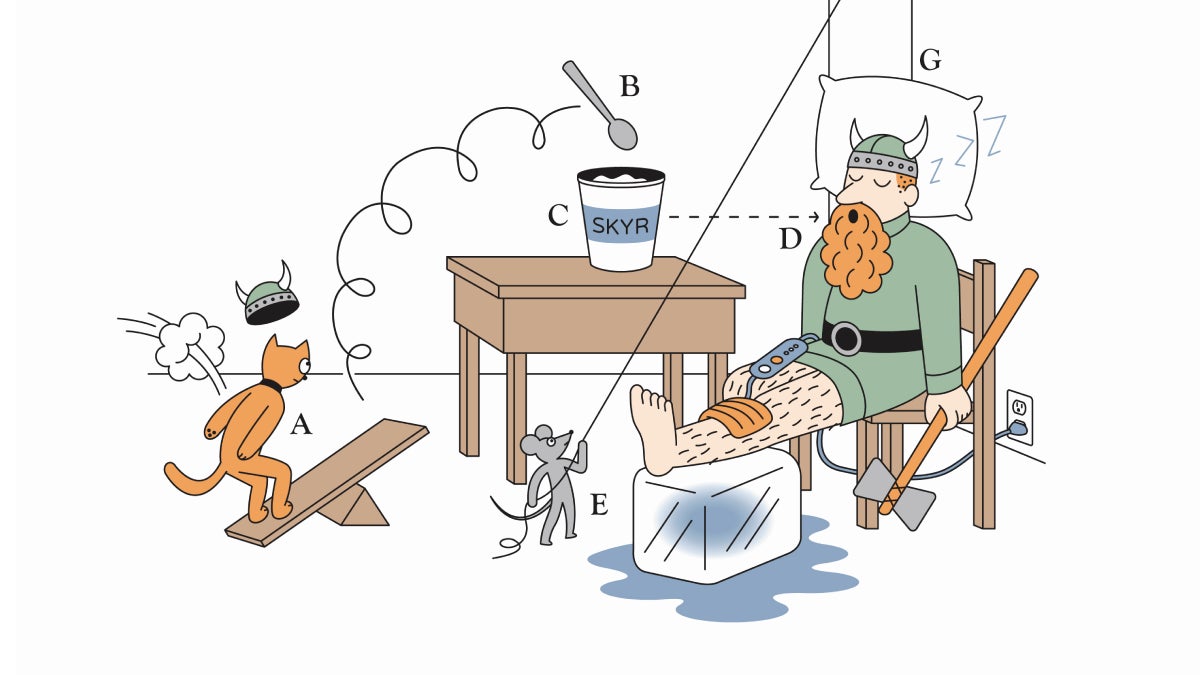
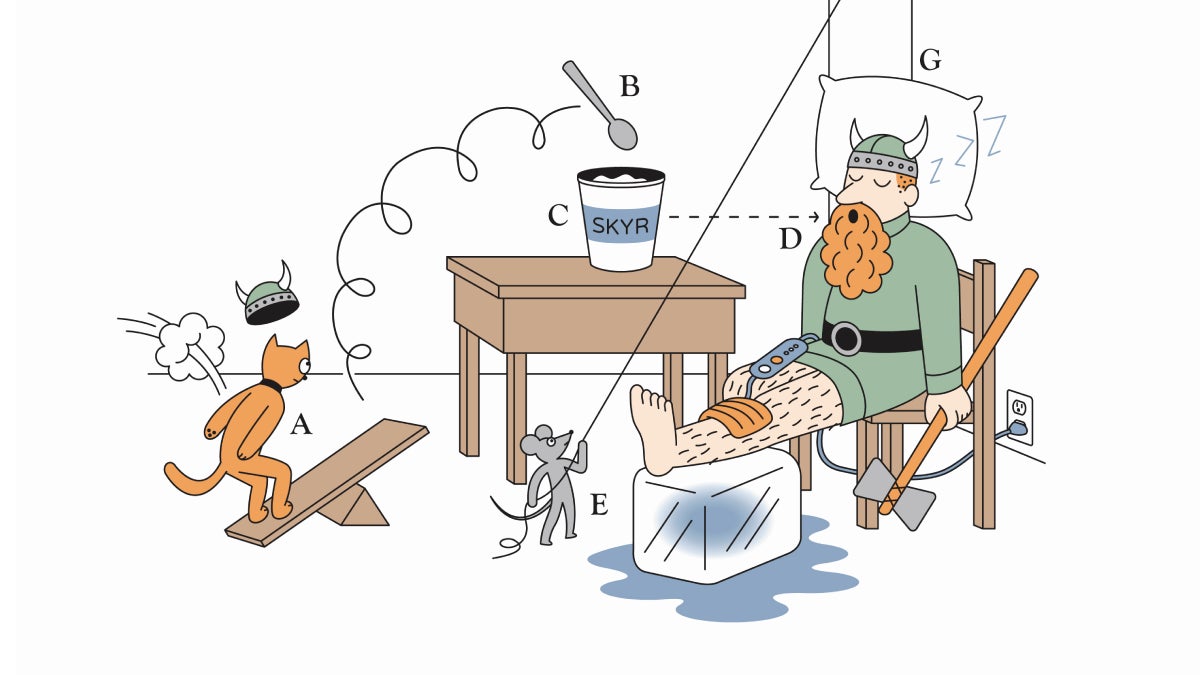
I kept my regular workouts—weights, runs, daily yoga, or Pilates—but replaced stretching videos and supplements with three interventions: Skyr (a dense, protein-rich Icelandic dairy), hot and cold exposure (within limits), and pre-industrial sleep patterns—either segmented or upright, like a medieval sentry catching rest near the hearth.
Each day, I tracked specific wellness metrics on a one-to-ten scale, along with a tongue-in-cheek “warrior level.” I logged sensory details too—anything that helped me understand what this kind of recovery felt like, not just what it changed. I wasn’t aiming for authenticity or aesthetic minimalism by recovering like a Viking—just clarity. Could these older rhythms cut through the noise of modern wellness?
Why I Chose to Recover Like a Viking
The Vikings, Norse seafarers between the 8th and 11th centuries, left behind saga-rich records of survival, exploration, and conflict. Their recovery methods weren’t as well-documented; still, some pieces remain traceable.
Fermented dairy, like Skyr, has deep roots in Icelandic tradition. While the word doesn’t appear in Viking-era texts, archaeological evidence suggests that dairy fermentation was widespread in Norse settlements. Skyr’s modern form (high in casein protein, low in sugar) carries that lineage forward.
As for hot-cold therapy, structured contrast bathing is a relatively recent development. The modern Nordic sauna tradition began centuries after the Viking Age. Iceland’s geothermal hot springs and Finland’s sweat bathing culture hint at ancestral warmth, but there’s no hard evidence that Vikings intentionally alternated hot and cold exposure for recovery.
Segmented sleep—two distinct sleep periods split by a waking hour—was common in pre-industrial Europe, especially in northern latitudes with long winters. Historian Roger Ekirch documents it extensively, though no record confirms intentional Viking participation. The upright sleep? That’s pure speculation—possibly inspired by later monastic or military traditions.
This experiment draws from these threads, not to re-create Viking life, but to test what happens when modern recovery mimics older lifestyles.
Experiment Protocol
The rules were straightforward, even if the execution wasn’t always perfect. I kept my regular workouts: three-mile runs three times a week, light weightlifting, and daily Pilates or yoga. I replaced my standard post-run stretches and recovery routines with three Norse-inspired methods:
- Hot/cold exposure: Sauna was the original plan, but the closest Nordic spa was 45 minutes away, which made daily visits unrealistic. So I adapted: 15 minutes with a heated weighted blanket on my knee, followed by ten minutes with an ice pack. Once a day, I attempted a hot-to-cold shower—though my finicky water heater often turned it into more of a lukewarm-to-chilly rinse.
- Skyr consumption: I used Icelandic Provisions Plain Skyr—150 grams daily, with 17 grams of protein and about 120 calories. I ate it plain for the first few days, then added homemade protein granola.
- Sleep adjustments: I alternated between segmented sleep and sleeping upright—yes, really. I slept from 9 P.M. to 1 A.M. Then, I stayed awake for an hour. Then I slept from 2 A.M. to 6 A.M. Other nights, I slept sitting in a chair with my legs elevated and a neck pillow keeping me aligned. I’d done something similar during a previous injury, so I knew what to expect: short, disrupted rest in three to four chunks, punctuated by discomfort and sliding.
Each day, I tracked soreness, sleep quality, mood, energy, and mental clarity (on a scale of one to ten), plus “warrior level” as a self-assessed grit meter. I also paid attention to sensory shifts: the sting of cold water, the tang of skyr, the mental stillness at two in the morning.
Seven Days of Ritual, Recovery, and Restraint
Day 1: Baseline Reset
Soreness: 6/10
Sleep Quality: 7/10
Energy: 6/10
Mood: 6/10
Mental Clarity: 7/10
Warrior Level: A flat 5
I started with my usual recovery routine: a three-mile jog, followed by a YouTube yoga routine from one of my favorite instructors: Yoga with Tim. Soreness settled in—my left knee creaked on the incline—and I felt the familiar post-run tightness. Sleep was solid (7 hours), though nothing restorative. Mental clarity was a touch better than energy and mood.
Stretching worked, technically—but it felt more like a chore than a tool. I caught myself rushing, holding my breath in the name of efficiency. Functional, not thoughtful.
Day 3: Into the Cold (and the Weird Sleep)
Soreness: 5/10
Sleep Quality: 5/10
Energy: 5/10
Mood: 5/10
Mental Clarity: 6/10
Warrior Level: 6
This was the first full day with segmented sleep. I slept from 9 P.M. to 1 A.M., then again from 2 A.M. to 6 A.M. I got roughly six hours total. I woke during the gap and stared at the ceiling for a while, then journaled. It was oddly calming. But restfulness dropped—my body noticed the break.
An ice pack on my knee for ten minutes, followed by a heated blanket, helped more than expected. Soreness dipped. The contrast shower was underwhelming (lukewarm-to-cold), but it slowed my breath in a way that stretching rarely did. That caught my attention. Post-Pilates skyr (plain) felt dense and chalky, but not unpleasant.
What improved wasn’t the range of motion—it was presence.
Day 5: Upright and Uncomfortable
Soreness: 4/10
Sleep Quality: 4/10
Energy: 7/10
Mood: 7/10
Mental Clarity: 8/10
Warrior Level: 7
Upright sleep was predictably awful. I wedged myself into a chair with legs propped on an ottoman, a neck pillow keeping me from collapsing forward. I slept in two three-hour chunks, waking each time to readjust.
But soreness dropped. The heated blanket made a clear difference, especially in the morning. Skyr (with granola now) felt less like sour cream, more like fuel. The contrast shower still left me feeling ambivalent, but breathwork afterward came easier—slow, nasal, steady.
I felt physically steadier, even if my sleep was wrecked. Compared to my usual routine, recovery didn’t feel like a checkbox. It felt like I was doing something.
Day 7: Return to Normal Sleep, with New Edges
Soreness: 3/10
Sleep Quality: 8/10
Energy: 8/10
Mood: 8/10
Mental Clarity: 9/10
Warrior Level: 9
I went back to monophasic sleep (7 hours, uninterrupted) and woke up clear. Soreness was down again. I hadn’t skipped any workouts that week, but my joints felt more stable. The hot/cold combo had turned into a rhythm, not a novelty.
Skyr with granola had become a default, something I looked forward to. The contrast shower still didn’t deliver much shock, but the shift in my breath lingered long after. Deep inhales came naturally, and held longer.
No magic, no overhaul. But by the end, I felt more grounded than I had in weeks.
What the Science Says About Recovering Like a Viking
Halfway through the week, I turned to the research. Not to verify my “warrior level,” but to make sense of what I was feeling: less soreness, deeper breath, slightly sharper focus.
Turns out, hot/cold therapy does have support. A 2023 review in Frontiers in Physiology notes that contrast water therapy (alternating between hot and cold) can reduce delayed onset muscle soreness, improve circulation, and help clear waste from the muscles. The method works through vasoconstriction and vasodilation (tightening and widening blood vessels), which moves blood and byproducts more efficiently.
Skyr, nutritionally, pulls its weight. A 150-gram serving of Icelandic Provisions Plain Skyr packs 17 grams of slow-digesting casein protein, along with probiotics and calcium. Casein supports muscle repair over time, especially overnight. I wasn’t expecting much from a dairy cup, but paired with post-workout recovery, it held up—and didn’t spike my appetite later.
Segmented sleep is well documented in pre-industrial societies. Ekirch’s work shows people often slept in two phases, waking for an hour in between to read, pray, or work. Whether that kind of rest is helpful now is debatable. Some studies suggest it supports memory consolidation and hormone regulation; others link it to grogginess and interrupted REM. For me, it felt more meditative than restful.
Breath control was the outlier. I didn’t plan for it, but cold exposure made me breathe differently—slower, deeper, more focused. Some early research hints that cold triggers parasympathetic activation (the body’s calming response), but most of the buzz here comes from anecdotal sources, not clinical trials. Still, I noticed it. And it stuck.
What I’d Keep—and What You Might Want to Try
Seven days of recovering like a Viking gave me a clearer sense of what actually helps—and what just sounds cool.
What I’d Keep
- Ice and heat: Alternating a heated blanket and an ice pack worked. Soreness dropped from a 6/10 to a 3/10. My knee felt stable, not just stretched, and the routine added a sense of calm I don’t get from standard cooldowns.
- Breath control: This was a surprise. Cold exposure naturally slowed my breathing, helping me shift out of post-workout adrenaline. It wasn’t a technique—I just noticed I was breathing better. More slowly, more deeply, more deliberately.
- Skyr: The plain flavor tasted like yogurt was trying too hard to be a thicker, less tangy version of itself. But with a little homemade granola, it became an easy, sustaining recovery food—one I’ll keep using.
What I’d Leave Behind
- Segmented sleep: I’m a sleep snob. Early to bed, early to rise, no interruptions. Splitting the night made me groggy, not grounded. I missed the consistency of real rest.
- Upright sleep: Even with a neck pillow and my apartment chair angled just right, it felt like a test of patience—not recovery.
- Contrast showers: In my apartment, they never quite delivered. The cold didn’t stay cold, and the result felt incomplete.
- The time cost: This kind of recovery isn’t plug-and-play. It takes consistency, attention, and a willingness to linger. If you like your cooldowns quick and efficient, this might feel like too much. But if you’re looking to change the rhythm of how you recover—not just the results—it’s worth exploring.
Final Thoughts
This wasn’t a transformation. But it was a reset. By the end of the week, I wasn’t chasing soreness—I was listening to it. I moved more slowly, breathed deeper, and noticed more. The biggest shift wasn’t physical; it was paying attention in a way that my usual recovery routine didn’t ask of me.
No one needs to sleep upright or eat skyr to feel better. But giving recovery the same presence I give movement? That’s a habit I’ll keep.
Want more Outside health stories? Sign up for the Bodywork newsletter. Ready to push yourself? Enter MapMyRun’s You vs. the Year 2025 running challenge.
The post I Tried Recovering Like a Viking for a Week. Here’s What Worked and What Didn’t. appeared first on Outside Online.