








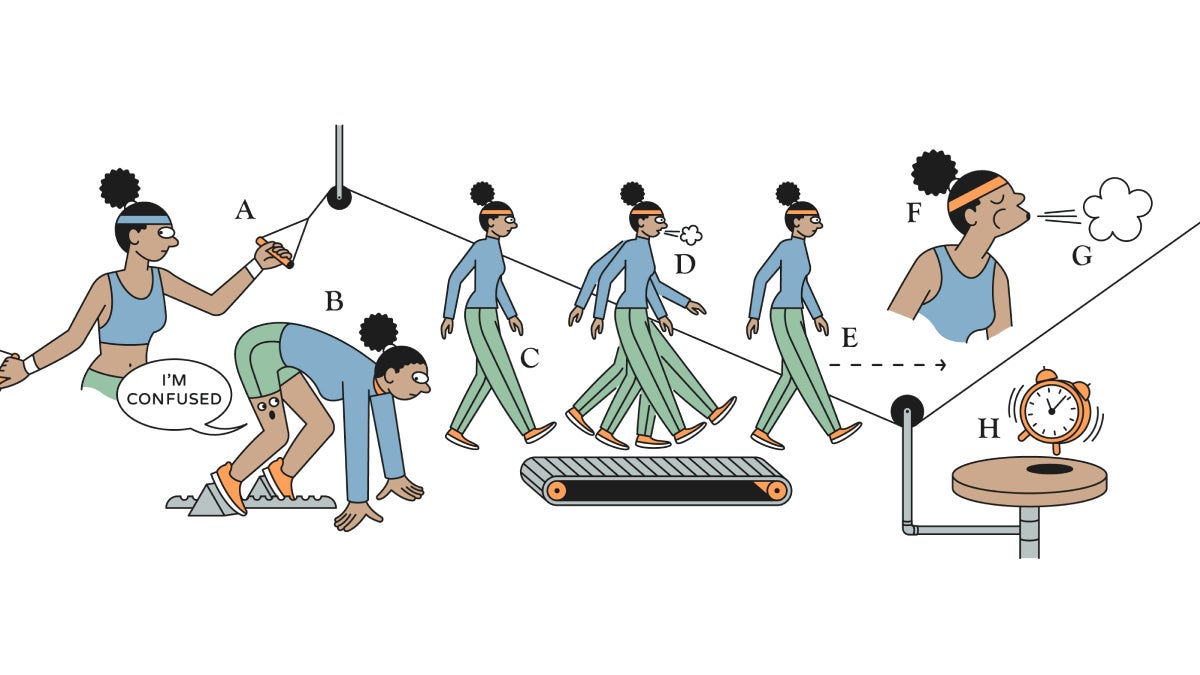

There can get a point where you’re climbing mountains, navigating rough terrain, or carving fresh pow and feeling good—but not quite crushing it. If that’s you, it might be time to unlock a new level of strength and endurance. The simplest way: try muscle confusion two days a week.
Confusing your muscles means stimulating different muscle fiber types with activities you don’t normally do, according to exercise physiologist Janet Hamilton, CSCS.
Muscles are made up of individual fibers, and there are two different types of fibers that respond differently to demands: slow- and fast-twitch. Slow-twitch fibers are resistant to fatigue and get recruited for endurance, like during a 10-mile hike. Fast-twitch muscle fibers tire more quickly and are used when our bodies need greater force production over a smaller period of time, like a short ski run.
Every muscle in your body contains both types of muscle fibers, Hamilton says, but a muscle may have more or less of one based on the activities they’re used for and your genetic makeup.
With muscle confusion, your muscle fibers will see an increase in density and size, Hamilton explains, which translates to more muscle volume overall—especially in your hamstrings, adductors, and quads, suggests a small 2020 study in the European Journal of Sports Science.
Keeping it super straightforward, like tacking sprints or interval walking (like the Japanese walking method) onto the end of a planned workout, can be an easy way to conquer plateaus. It also keeps your routine fresh and exciting, says Jakub Szylak, CPT, certified personal trainer.
If you’re not familiar, the Japanese walking method is a 30-minute high-intensity walking workout where you do three minutes of fast walking (at 70 percent of your peak aerobic capacity), then switch to three minutes of slow walking (at 40 percent of your peak aerobic capacity). You’ll repeat these intervals for the entire 30 minutes.
Even with just two sprint or Japanese walking sessions a week, you’ll see the benefits quickly: Your body will start improving how it uses oxygen in one to two weeks and get better at handling harder efforts in three to six weeks, Szylak says. And with both sprinting and interval walking, the science backs this up.
A 2021 meta-analysis in the Journal of Sports Medicine and Physical Fitness supports the fact that sprint training increases your VO2 max—aka the maximum rate of oxygen your body can use during exercise and a key indicator of cardiovascular fitness and endurance. The higher your VO2 max, the better your endurance.
Sprinting also improves bone density, per a 2023 review in the Sechenov Medical Journal. The stronger and denser your bones are, the less likely you are to experience fractures and bone loss.
A sprint workout might look something like this, says Hamilton: 50 to 100 meters (or around 10 to 20 seconds) of all-out sprinting on flat ground followed by 1 minute of recovery. Repeat this four to eight times. However, if your knees start screaming at the mere mention of “sprints,” the Japanese walking method has similar perks—without the impact.
According to a 2007 study in Mayo Clinic Proceedings—published by the method’s creator, Hiroshi Nose, MD, PhD—those who adhered to the Japanese walking method saw improved aerobic capacity and leg strength and reduced blood pressure (compared to those who followed a lower-intensity continuous walking regimen).
Newer research, like a 2018 study in The FASEB Journal, found that the Japanese walking method fends off age-related declines in physical fitness in older adults. Translation? With muscle confusion, you can continue to shred for years to come.
So during your next neighborhood walk, set your timer for three minutes and pay attention to your rate of perceived exertion (RPE) if you can’t track your exact peak aerobic capacity. Start at an RPE that’s “comfortably hard,” per Hamilton—a six or seven on a scale of one to ten. When your three minutes is up, switch to a moderate effort where you could carry on a conversation—an RPE of three or four. Go back and forth for the full half hour.
Easing Into Muscle Confusion
The goal for these muscle-confusion activities is for them to seamlessly transition into your existing routine. Still, doing something new can be a bit challenging—physically and mentally. Szylak offers a few tips to make it as easy as possible:
- Start tomorrow—not “someday.”
- Find a partner for accountability.
- Put them on your calendar so they’re locked in.
- Celebrate small wins—each session is progress.
“Remind yourself that this is a journey and you must start any journey with a clear recognition of where you are right now,” Hamilton adds. “Keep a vision in your head of where you want to be at some point in the future.”
The post Muscle Confusion Might Be the Secret to Sending It for Years to Come appeared first on Outside Online.