








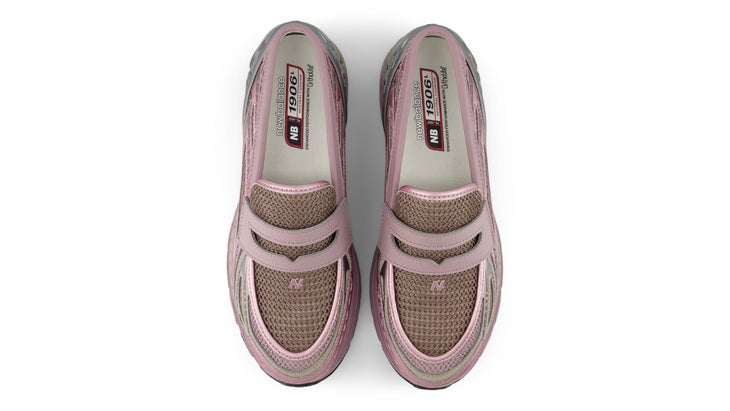
Ever since the New Balance 1906L debuted at Paris Fashion Week in 2024 in collaboration with Japanese designer Junya Watanabe, the “sneaker loafer”—AKA snoafer—has been gossiped about to a point that seems almost existential.
For nearly two years, the snoafer has dominated footwear headlines as if the Frankenshoe is what keeps us up at night. “Are you ready to wear ‘snoafers?’” NPR asked in May 2024, as if to prepare us for forced adoption, and in September 2025, after Crocs had “entered the snoafer chat,” British GQ posed a similarly consequential question: “Fashion wants you to wear a snoafer, but should you?” Even the New York Times asks, “Are these shoes hideous or genius?”
The deluge of headlines seems to be asking what it means about us, that we’re paying more than retail value for a mashup of running soles and penny loafer uppers. According to footwear designers and analysts, what it means is pretty simple (and, honestly, a little obvious): it means comfort is no longer taking a backseat, and we’re eager to reinvent what it means to be chic.
The Origins
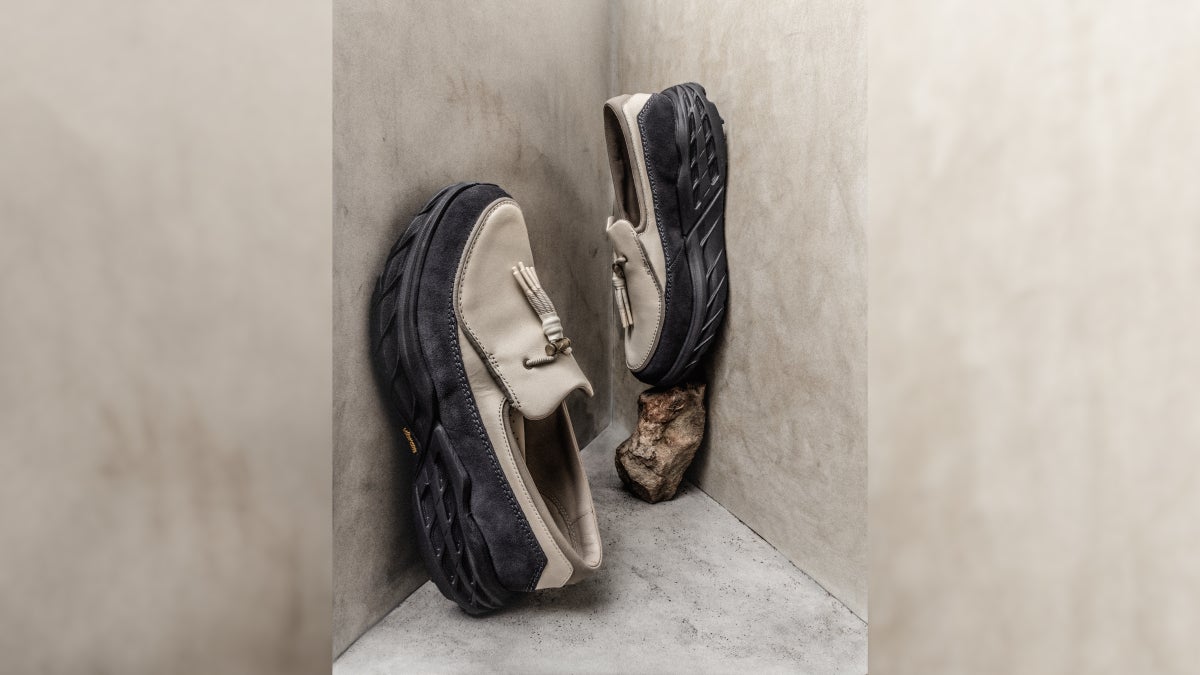
In the last year, scores of athletic brands have debuted their own sneaker loafer mashups, including HOKA’s Speed Loafer, PUMA’s Nitefox Loafer, Nike’s Air Max Phenomena x Serena Williams Design Crew, and KEEN’s UNEEK Loafer, which broke the company’s PR for shortest time from concept to production. In September, even Crocs got in the game.
None are as popular, however, as the 1906L, according to data from resale site StockX. They’ve seen about 9,500 trades of the silhouette since it debuted, most above retail value, and sales continue to trend upward.
Drew Haines, senior marketplace director, StockX: I initially thought it was just sort of like, a kitschy, fun thing. I didn’t know that it would take off to the extent that it’s an everyday product that a lot of people seem to be adopting. It certainly exceeded my expectations.
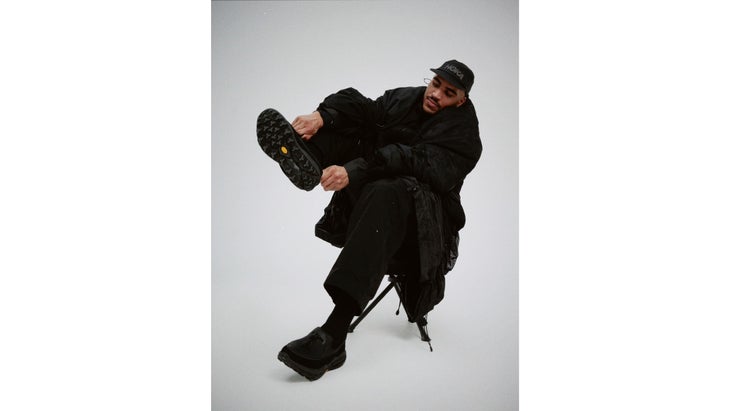
Chris Hui, design director of lifestyle footwear, HOKA: Some of our most technical styles have been embraced by a fashion-minded consumer. When the project kicked off, there was a growing trend back towards traditional footwear silhouettes like boots, loafers, and mary janes. Our idea was simple: how could we offer our take on one of these timeless silhouettes, but in a way that felt undeniably HOKA? We paired one of our most technical, performance trail soles from the Speedgoat 5 with a new, beautifully crafted leather loafer upper. It’s the look of the past with the feel of the future.
Scott Labbe, SVP of Product and Innovation for KEEN: [For us], the concept originated in Japan with our Tokyo Design Center, which saw a “dress-formal meets KEEN” trend emerging. The mash-up of UNEEK cords and KEEN.CURVE propulsion came from our HQ team as the execution engine. It moved at unprecedented speed—we went from concept to factory-ready shoes in three months.
Jacob Alexander, PUMA designer: One of our inspirations was the PUMA Beisser, which is one of the boldest, most progressive silhouettes in our archive. We clashed that energy with the craftsmanship of traditional shoemaking.
LABBE: We pictured it as “Outdoor Formal”—the go-anywhere piece bridging office, city streets, and weekend exploration. Seeing it sell out in minutes in Japan, on KITH US, and across EMEA partners validated that vision beyond our expectations.
ALEXANDER: We imagined people using it as a kind of bridge between worlds: It’s comfortable and sporty enough for everyday wear, but classic enough that you can pull it off in more formal contexts, too.
HAINES: I think it speaks to people wanting to express their individuality and unique style. They’re tired of just black, white, and gray basics.
The Controversy
Perhaps more popular than the shoe itself is talking about the shoe. There have been no shortage of strong opinions from shoe reviewers:
- Runner’s World: Have you ever yearned to chase serious vert while dressed as a businessman? If so, your dreams may have come true.
- The Telegraph: “They’re absolutely awful,” one style-conscious colleague told me [about the 1906L]. “Oh gosh, they’re dreadful,” another chimed in. “No, absolutely not… they don’t make any sense. Very ugly,” someone else spat out.
- GQ: At which point does a snoafer just become… a loafer? If the sole looks like any other trainer but the upper is pure penny loafer, is it really a hybrid? Or is it just a loafer experiencing an identity crisis?
And Reddit users have been far from restrained:
- “Had to check if it’s April Fools’ Day already
 ,” one user commented on the HOKA Speed Loafer.
 - “Your scientists were so preoccupied with whether or not they could, they didn’t stop to think if they should,” another user wrote about the 1906L.
Others:
- I’m telling you guys these are gonna take over.
- Disgusting, but Gen Z will be all over that.
- Honestly would wear tf out of these just because of how funny it is.
- All I can say is at least they aren’t trying to be “dress sneakers”… I do hate them.
- My grandad is rolling in his grave…in order to reach his phone to buy a pair.
The Success
You might say that the snoafer has become the Regina George of shoes. It doesn’t matter if you love them or hate them: Talking about them has only made them stronger.
HUI: Being true to HOKA was core to creating part of the viral sensation. Specifically, the use of our signature curved MetaRocker geometry created a silhouette that was undeniable. You couldn’t walk or scroll past the Speed Loafer without wanting to take a second look to discover what exactly was going on.
LABBE: Controversy means you’re pushing the edge. When we first launched the UNEEK sandal years ago, it sparked debate and then became a classic. The UNEEK Loafer WK is doing the same—redefining what “walking” and “formal” can look like when combined.
ALEXANDER: It challenges people’s expectations of what a sports brand can do. When you mix two worlds, formal and sportswear, you’re bound to spark conversation. Some people find that exciting, others might see it as controversial, but we think that’s a good thing. … If a product is polarizing, that usually means it’s making an impact, and that’s exactly what we set out to do.
HUI: We knew it would evoke emotion…good or bad…but never indifferent. I think the outpouring of love and demand for this model comes from this irreverence.
HAINES: Post-COVID era, we saw a lot of what I would consider to be somewhat lazy design, and a lazy approach to sneakers in terms of what the manufacturers were putting out. We saw a lot of products being put out in dozens and dozens of different colorways, many of which were very similar.… [Now, sneaker] brands are making more unique products than ever before. The sneaker loafer trend is just a microcosm of that.
What’s Next?
HAINES: We could be in the early stages of a trend here… I wouldn’t think that this would be something that fades quickly. If anything, hopefully we see more brands adopt their version of this style of sneaker, and those designs and releases push it to a new height.
HUI: We see a continuous evolution in how style, function, and technology continue to integrate into fashion. Consumers are more intrigued than ever in recontextualizing purpose-built products into a style of their own, taking ownership of something that was for one world and now for another… We are just beginning to demonstrate how much fun and excitement we are going to bring to this space in the future.
The post How the Snoafer Became the Most Polarizing Shoe in America appeared first on Outside Online.