









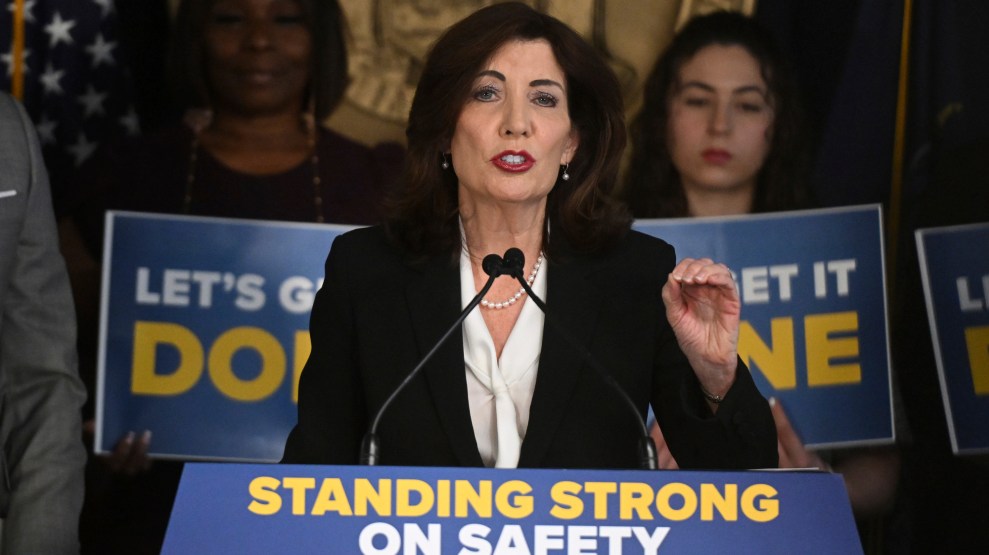
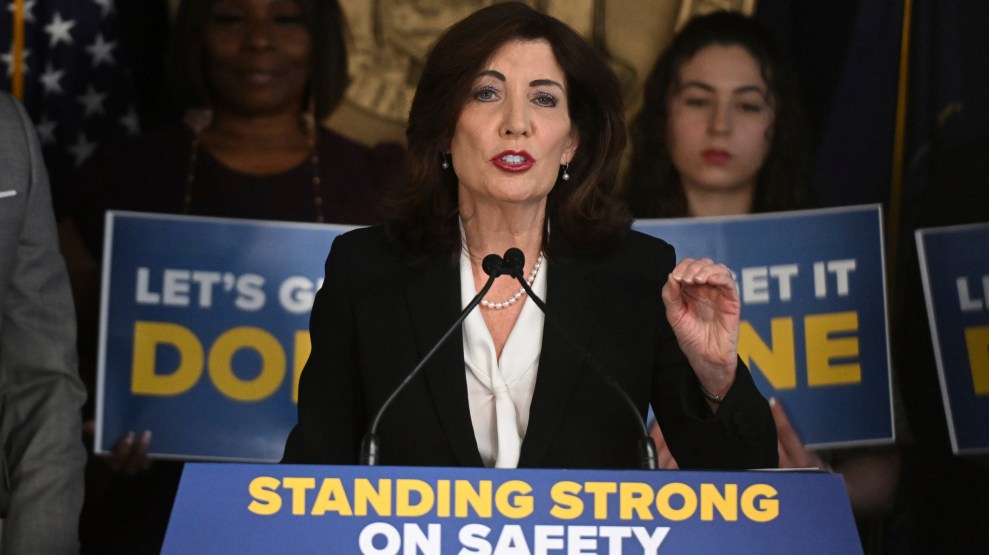
New York Governor Kathy Hochul signed into law a bill late Friday night that provides a remedy for victims of coerced debt—a kind of financial abuse where bad actors either take out lines of credit in another person’s name without them knowing or pressure someone into accruing debt.
The law, headed by Assemblymember Linda B. Rosenthal and Senator Cordell Cleare, is poised to help provide an avenue for survivors of intimate partner violence to leave abusive situations without being held down by debt they oftentimes didn’t even know they were accruing.
“This law will be transformative in providing financial relief for survivors, and I am thinking of so many clients this would have helped,” Naomi Mo Chee Young, a lawyer with the Brooklyn-based nonprofit CAMBA who advocated for the legislation, told me Monday. “We can’t wait to begin implementing, ensuring that survivors throughout New York will be advised of their rights.”
New York joins several other states across the country, including Texas, Maine, California, Minnesota, and Connecticut, that have passed versions of coerced debt legislation. The bill passed by Hochul this week will provide some of the most comprehensive protections in the nation for survivors of this kind of financial abuse.
The bill allows victims to petition creditors to have the debt in their name removed and transferred to the person who coerced them into the debt. The survivor must submit documentation showing that the debt was accrued either without their knowledge or through coercion. In turn, debt collectors would then be able to hold that person civilly liable for whatever money is still owed.
Across the country, forty-three percent of survivors report being pressured to take out credit in their own name when they did not want to, and 52 percent reported that an abusive partner put debt in their name through a fraudulent or forced transaction. This debt stays with victims by, for example, hurting their credit score and impacting their ability to gain access to housing.

“Domestic violence is rarely limited to physical abuse and it is past time that our laws recognize this,” Assemblymember Rosenthal said in a statement after Hochul signed the bill. State Senator Cleare noted: “survivors must be given empowering support to rebuild their life, and to grow and heal.”
It was a last-minute fight for the legislators and advocates to get the bill over the finish line as the financial industry, which did not make much noise during the voting process, were petitioning Hochul’s office to introduce several provisions that advocates worried would increase hurdles for victims of coerced debt.
As Lauren Schuster, vice president of government affairs at Urban Resource Institute, the largest provider of domestic violence shelter services in the country, told me last week, “The debt collectors have exceptionally deep pockets. They are well connected in ways that our survivors simply are not.”
Young told me on Monday that she will never take this law for granted. “I know we fought for it until the 11th hour,” she added, “facing major backlash from the financial services lobbies.”
CAMBA, where Young works, is a part of the Economic Justice for Survivors Collaborative, the leading advocacy group for the legislation. The group includes URI and CAMBA, along with Her Justice and the Legal Aid Society of New York.
“Money can’t buy this kind of dedication,” Young said, adding, “and I hope we all remember that, when we fight at a grassroots level, we win.”