Everest, Earth’s highest mountain, needs no introduction. Those are the opening lines of an upcoming special that takes the 60 Minutes investigative team to Everest Base Camp. And when the television show that has been around since 1968 spends ten days trekking to one of the most sought-after mountains in the world, they, too, need no introduction.
Outside was given an exclusive first viewing of the special, in which host Cecilia Vega hikes to Base Camp, 17,600 feet, where the air is so thin that every breath feels like it’s inhaled through a straw. In the video, Vega and her crew are seen with blue lips, a sign their bodies aren’t receiving enough oxygen, yes the team kept going.
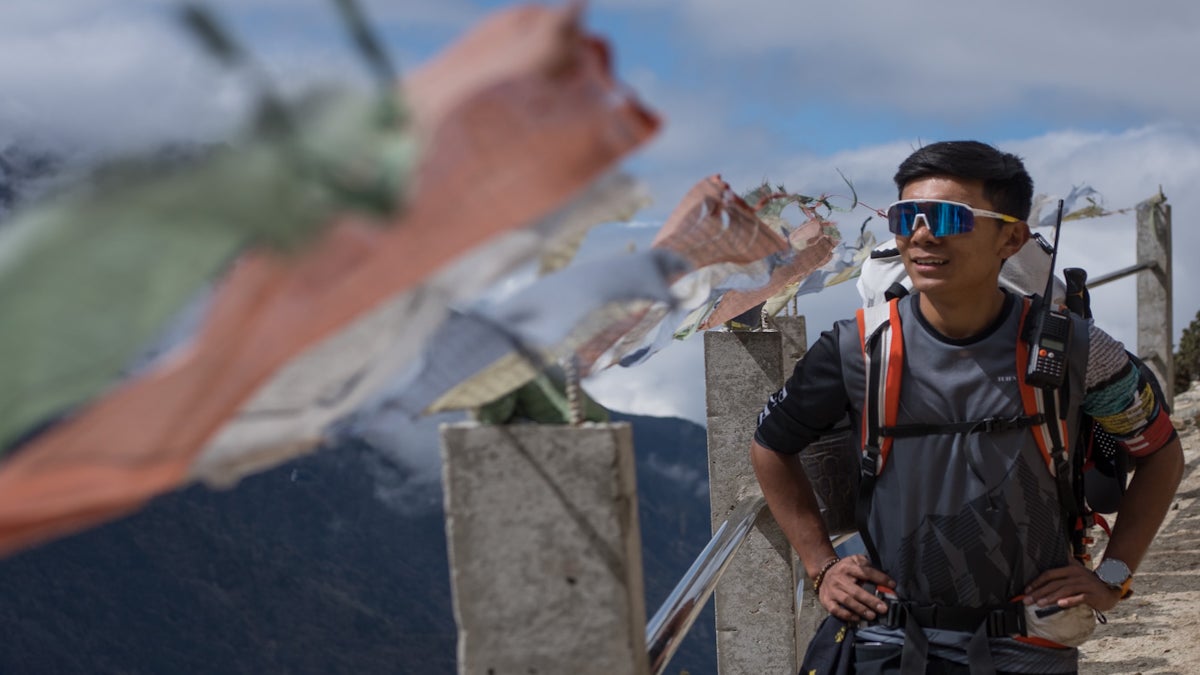
And that’s in large part due to their guide, Sherpa Nima.
Each year, 40,000 people hike to Base Camp. Where once it was a strenuous, niche exploration, this 50-mile trek has now become a highly commercialized venture of high-altitude luxury. People spend as much as $180,000 for premium packages, complete with private chefs and espresso machines. There are even drones that now help move ladders and ropes or remove trash. For some, Base Camp is like summer camp on a glacier.
Luxuries aside, making it to Base Camp is still an incredibly strenuous trek. After watching the special, I wanted to know why Vega wished to take on such an expedition. Before setting off, she had no mountaineering experience.
“The chance to climb all the way to Everest Base Camp is not something I ever thought I wanted to do. Now, having done it, I can say it was one of the most amazing and most difficult experiences of my life,” Vega told Outside.
It was a feat her team couldn’t have accomplished without the Sherpas’ help.
“They do everything,” she said.
Everything, in this case, included carrying hundreds of pounds of camera equipment, lighting, and hours of tedious setup.
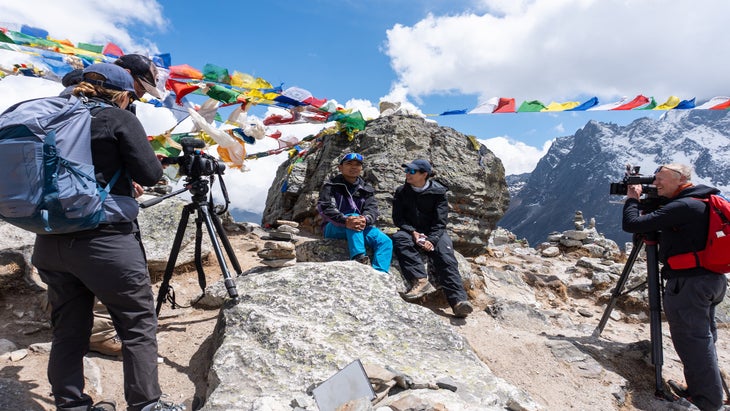
“A Sherpa is a people, it is a noun, it is a job. They are the porters who carry your gear, they are the leaders who lead the trek, they are the most experienced climbers,” said Vega.
Her guide, Nima Sherpa, holds the world record for being the youngest person ever to summit the world’s 14 tallest mountains. He’s 19 years old. And he learned from the best—his father and uncles hold similar records.
Yet Sherpas don’t often receive the same recognition as Western mountaineers. Earlier this year, 50-year-old Jim Morrison became the first person to ski Mount Everest’s most challenging route. Polish ski mountaineer Andrzej Bargiel also rocked the industry when he skied from the summit of Mount Everest to Base Camp without supplemental oxygen. Despite his many accomplishments at a young age, Nima noted he has yet to be offered a major brand endorsement.
As Outside previously reported, for more than a century, Western climbers have hired Sherpas to do the most dangerous work on Everest. Yet they’re often treated as if they’re disposable. In Nepal, for example, there are 150,000 Sherpas, less than 1 percent of the country’s population, yet they account for one of every three deaths on Everest.
“Every step is do or die. Every step is, maybe we are alive or not alive,” Nima said in the special. “It’s dangerous. Sometimes, it’s nighttime work. Sometimes, it’s an avalanche. But our goal is the summit.”
Groups that go beyond Base Camp rarely do so without the help of a Sherpa. The path forward is too unknown, constantly changing, and challenging for even the most experienced mountaineer. Sherpas know the mountain better than anyone else in the world, carving through ice in dangerous crevasses.
“Often they do all of that with much less glory, much less pay, and in significantly higher risk than Western climbers,” said Vega. “You think you know the story of the Sherpa people and how much they do on this mountain, but until you really see it for yourselves, you’ll understand how much the Sherpas put their lives on the line for hikers who come to do this for fun.
Even after three months of training leading up to the hike, Vega said her team was pushed to their limits.
“The altitude prevails, and it did prevail on many days. It knocked me back. Despite having trained my lungs as much as I possibly could, there was a lot of huffing and puffing and gasping for air as we got closer to Base Camp,” said Vega.
Sub-freezing temperatures, long, uphill hiking days—and a lack of infrastructure—make the hike even more strenuous. When asked if there was anything she had wished she’d known going into this expedition, Vega said it was a better understanding of the extraordinary work done by the Sherpas.
“Going into this, I knew the Sherpas were the people who literally carried the weight of these hikes on their shoulders and led you to the top. But witnessing it firsthand, I was blown away by the scale at which they do that,” she added. “They are heroes on that mountain who risk their lives for hikers to make it to Base Camp and beyond, and just to see them in action and do that is a breathtaking thing.”
The two-part special airs on 60 Minutes on December 21, 2025, at 7:30 P.M. EST, 7 P.M. PST. You can catch it after NFL Football on CBS Television and Paramount+.
The post ‘60 Minutes’ Went to Everest. Sherpa Nima Made It Possible. appeared first on Outside Online.