








On a dark November evening, I find myself outside one of the units at a garden-style apartment complex in Memphis, its parking lot alight in flashing blues and reds. The police are here—about a dozen cars—responding to reports of a violent crime. I’m accompanied by Mauricio Calvo, a 50-year-old local whose friend Diego lives here. Calvo knocks. “Soy yo,” he whispers at the door—“It’s me.”
“I told him not to open the door under any circumstance,” he informs me.
The door cracks open and Calvo nudges me through. I’m disoriented. It’s pitch-black inside, curtains drawn, lights off. Diego stands in the entryway, but I only see the outline of his body, not his face. Buenas noches, he whispers, and guides us to the living room. A little boy comes up beside me. “I wanna play!” he says in English, gesturing toward the TV and Xbox. Nobody turns it on.
This family has nothing to do with the situation outside, but still they are hiding. Diego, not his real name, explains that when the police pulled into the lot earlier that night, he instinctively hit the floor as though dodging bullets. “We were afraid, because what we are feeling these days is immigration is everywhere,” he tells me in Spanish, voice shaking.
He and his wife—a Dreamer whose parents brought her to the United States as a child—and three of their four kids, all US citizens, stayed that way about 10 minutes, flat on the ground in the dark. Then they called Calvo, who leads Latino Memphis, an organization that helps immigrants. “I got very scared they could start knocking on doors looking for the suspect and scared they would take him,” Diego’s wife says, nodding at her undocumented husband.
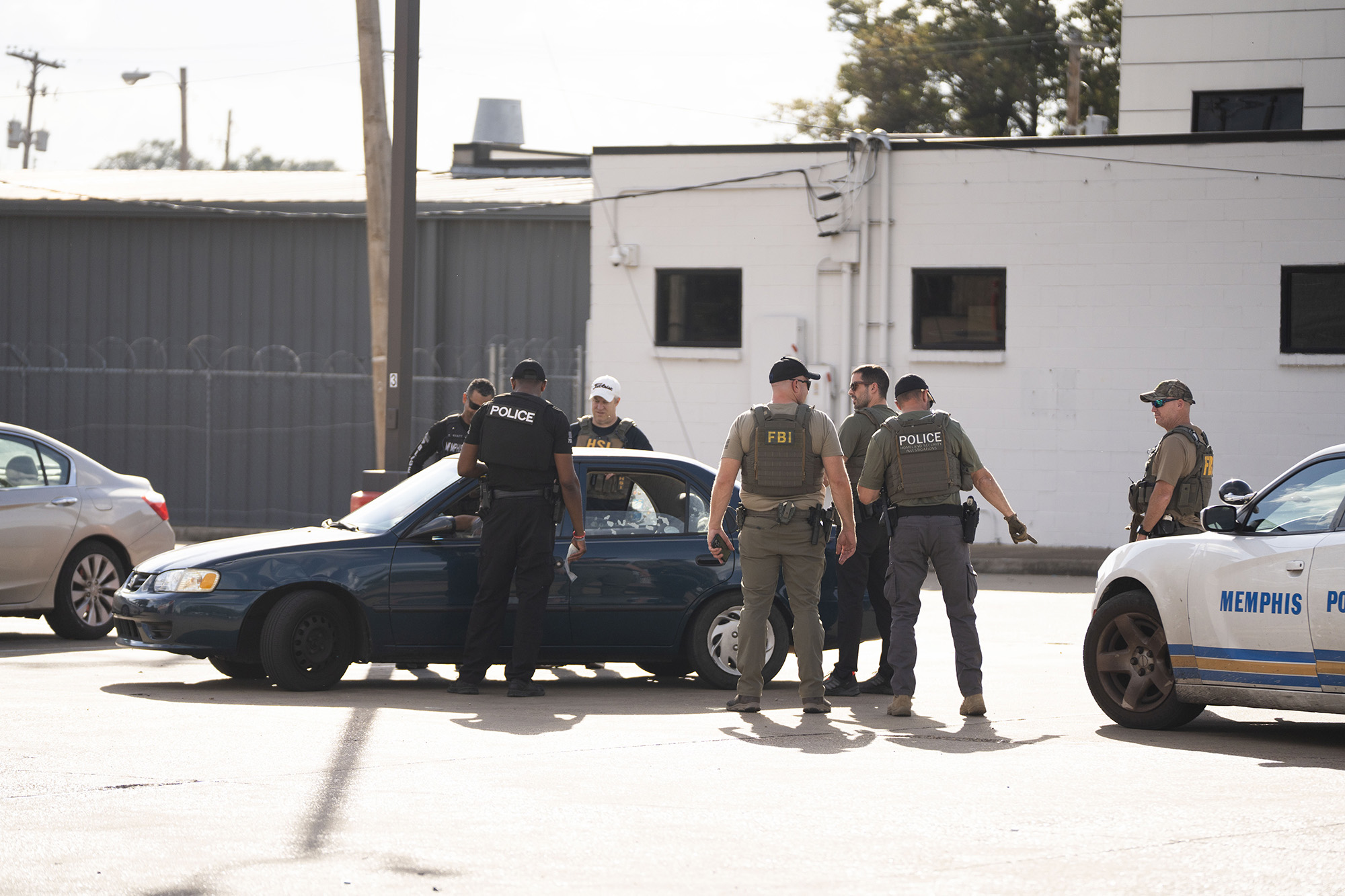
She knew that where police go in Memphis, lately at least, there will be immigration officers, too. On September 29, the Trump administration launched the Memphis Safe Task Force, deploying, according to the Washington Post, some 1,700 federal officers from a mix of agencies, ostensibly to help the Tennessee Highway Patrol, the Memphis Police Department (MPD), and the Shelby County Sheriff’s Office crack down on crime. It’s one of many such task forces the administration has launched, or plans to launch, nationally.
The MPD has reported success—large declines in serious crimes reported since the feds arrived. The feds are getting something out of the arrangement, too; local cops are chauffeuring Immigration and Customs Enforcement (ICE) officers around town, leaving many immigrant families afraid to leave their homes. Some refer to the task force as “the occupation” and say the feds are using the crime issue as a Trojan horse. “I feel nervous—I have to protect them and myself,” Diego’s 12-year-old daughter tells me as she sits beside her parents in the dark.
“I’ve lived here for a long time,” Diego adds, “and I’ve never seen so many police cars.”
Neither have I. Though I’m new to Memphis, I’ve been reporting on the criminal justice system for more than a decade and have spent time in cities with a lot of law enforcement. I’ve also lived in an authoritarian country overseas, yet I’ve never experienced a police presence like this. Some Memphians critical of the surge liken the city to a war zone, with helicopters circling over neighborhoods, National Guard officers patrolling downtown, and unmarked law enforcement vehicles in the streets. Immigrant citizens carry their US passports, lest they be detained. One volunteer I spoke with compared the vibe to 1930s Germany.
Tennessee Gov. Bill Lee, a Republican, has welcomed the task force, and Memphis Mayor Paul Young, a Democrat, has cooperated, crediting the effort for reducing 911 calls about gun violence. But Shelby County Mayor Lee Harris, another Democrat, compares occupied Memphis to a failed state. “Our risk is that [America is] gonna become a Yemen or a North Korea, or something else altogether, where there is an armed individual with a semi-automatic weapon and military fatigues on many corners,” he told me. “There may be zero crime, but we also won’t be leaving our houses. I know that’s a dark scenario, but that’s kind of where we are.”
My hours spent in the dark with Diego’s family—and talking with local activists, teachers, businesspeople, and residents—revealed how the militarized federal onslaught is reshaping daily life in blue cities like Memphis, keeping kids out of school and parents from work, and turning grocery shopping into a mission that risks one’s family being torn apart. When I finally left Diego’s complex that night, a police cruiser whipped past, lights and siren blaring, followed by another, and another—more than 20 in all—racing off to terrorize another neighborhood.

I had arrived in town three days earlier, hoping to document a local surge of federal law enforcement that hadn’t received nearly as much attention as those in cities like Chicago, Portland, and Los Angeles. That’s partly because the residents of Memphis—a blue city in a deeply red state—have not responded with the same headline-grabbing protests. There are no inflatable frogs, no sandwich-hurling federal employees, no throngs of demonstrators trying to block ICE vehicles. The thinking, Calvo speculates, is that “less resistance will make these people less interested in being here, and they will just move on. It’s like, why poke the bear?”
But that doesn’t mean there’s no resistance, or that locals appreciate the expansive police presence. I meet up with Maria Oceja, 33, who recently quit her job at a court clerk’s office. She’s offered to drive me around to show me how pervasive the task force presence has become. It doesn’t take long. Shortly after we set out, we see two highway patrol vehicles on the side of the road. Then a police car, then another. “Look, we got an undercover over there,” she tells me, gesturing toward an unmarked car that’s pulled someone over.
Oceja, who sports a pink nose ring and has a rosary hanging from her rearview, co-leads Vecindarios 901, a neighborhood watch with a hotline to report ICE sightings. She’s exhausted: They’ve been averaging about 150 calls a day since the task force took shape in late September. The group has documented home raids, too, but traffic stops are the most common way ICE rounds people up. The highway patrol will pull over Black and Hispanic drivers for minor violations like expired tags or a broken taillight, or seemingly no violation at all: “‘You got over too slow. You’re going one or two miles over [the speed limit].’ Just anything!” says Tikeila Rucker of Free the 901, a local protest campaign. Then immigration officers, either riding shotgun or following behind in their own vehicles—or, occasionally, vehicles borrowed from the Tennessee Wildlife Resources Agency—swoop in.
In one stop I witnessed, three Black friends were pulled over for their car’s tinted windows; one of them, from the Bahamas, was sent to ICE detention. The car’s owner, Keven Gilles, was visiting from Florida. He told me that he’d been pulled over five times in a week and a half in Memphis, and “every time, there’s at least five more cars that come, whether that be federal agents, more troopers, or regular city [police] cars.”
Memphis is the nation’s largest majority-Black city, with more than 600,000 people in all. Ten percent are Latino and 7 percent are immigrants. The biggest contingent hails from Mexico—according to the Memphis Restaurant Association, the city has more Mexican restaurants than barbecue joints—but there are also well-established communities from China, El Salvador, Guatemala, Honduras, India, Vietnam, and Yemen, and more recently Nicaragua, Ukraine, and Venezuela.
Oceja, whose parents immigrated from Mexico, says the city’s undocumented population is relatively young—lots of families with school-age children. She takes me to Jackson Elementary, which she attended as a child, to ask employees about how the policing surge has affected this immigrant-heavy neighborhood. “I’ve been here 22 years, and I’ve never seen it this bad,” PE teacher Cassandra Rivers tells me.
Because people are afraid of being detained while dropping off their kids, the Memphis-Shelby County School Board has agreed to create more bus routes. Meanwhile, daily attendance is down at least 10 percent at Jackson, Rivers says. Some students are so anxious that she has started calling their homes in the afternoon just to assure them that their parents are safe and sound.
Earlier, on Jackson Avenue, we’d passed a parking lot with a few men standing around. “This is where the day laborers come and ask for work,” Oceja told me. There are fewer lately, now that officers are pulling over contractors’ trucks and arresting workers at construction sites. “Prior to the occupation,” she explains after we leave the school and turn onto Getwell Road, “you could see immigrant vendors every morning on this street selling food.”
We drive by shuttered fruit stands and yet another police car, then stop at a gas station, where I meet Jose Reynoso, a Guatemalan man selling tamales and arroz con leche out of a pickup truck. He says he doesn’t know how long his business will survive—customers are afraid to come out. At Supermercado Guatemala 502 on Summer Avenue, manager Rigoberto Cipriano Lorenzo gestures at empty aisles and recalls how packed his store used to be. Alex Lopez, a barber down the block, says many clients ask him to cut their hair at home now. Religious leaders are worried, too. A local imam told me members of his congregation are asking whether they must pray at the mosque, or can they do so from home?
The county courthouse is overwhelmed. In its first six weeks, the task force conducted nearly 30,000 traffic stops, issued 25,000 citations, and made more than 2,500 arrests—creating a six-month backlog in traffic court, one attorney told me. That’s not including stops made by federal agents operating solo. An FBI agent speaking to a local rotary club noted that as long as the task force is operating, just about everyone in Memphis can expect to be pulled over at some point. (The latest, just-released figures show more than 4,000 arrests and nearly 200 people charged by the feds.)
Jail overcrowding had resulted in detainees sleeping on mats on the floors, so the county declared a state of emergency and moved some of them to another location. “I don’t know how many times I have to say it, but the jail is at a horrific state right now,” Sheriff Floyd Bonner told ABC24 reporters during my visit. “We hear stories,” County Mayor Harris told me, of “individuals that are standing for 24 hours straight because there’s no room, or place for them to sit down. I don’t have the words for what’s happening over there.”

In his darkened living room, blocked off from the glow of police cruisers outside, Diego speaks in hushed tones as he shares his story. I sit on a sofa beside his 6- and 16-year-old sons. He sits on another sofa, flanked by his wife and their 12-year-old daughter.
Diego grew up in a small town in Chiapas, Mexico, where he worked as a farmer. He moved to the United States in 2004, at age 20, for more money and “a better future.” His sister’s husband lived in Memphis, so he settled there too, finding a landscaping job. It paid much better than he was used to, though the weather could be brutal, “very cold,” and he missed the food from back home. In 2006, he met his future wife, also from Mexico, who was selling tamales outside a convenience store. Their first son was born in 2007.
Three years ago, they moved into this housing complex, eager for independence from their in-laws, with whom they’d been living. Today Diego works as a cook and janitor at a school where his wife is an assistant teacher.
The Memphis Safe Task Force has affected the family’s routines in too many ways to count. Diego has a heart condition and needs to see a doctor every three weeks for monitoring—he was hospitalized not long ago. But he’s afraid to go to his next appointment, drive his kids to school, or commute to work. He’s heard about people getting pulled over for nothing. Immigrants are getting picked up despite having work permits or pending green cards—even people a decade into the legal residency process with just one hearing to go. Diego would have little chance to avoid deportation if he were pulled over. “I get very nervous, like shaky and sweating,” he says of his drives.
His daughter, whom I’ll call Liliana, listens quietly as her father talks, gripping a blanket to her chest. Even though she’s a citizen, she has had to be vigilant about law enforcement, she says: “If I do a wrong movement, that would bring them here.”
It’s very tiring. At school recently, a teacher asked her to complete a project that involved sharing personal information like her age and why her parents came to Memphis. “I got worried. Why are they asking those types of questions? I feel like it was a trap and they are trying to take information to them”—ICE—she tells me. Liliana is an intelligent, curious kid. She wants to be a nurse someday, Diego told me, which requires doing well in school. But she decided not to turn in her project, just to be safe: “I feel kind of overprotective,” she explains.
As Liliana talks, I try to remember she’s only in sixth grade. I ask her what she likes to do for fun. “Exploring,” she says, and shopping at the mall, but lately she spends most of her time at home. It’s not always pleasant; there’s a clogged sewer line, so the toilet keeps overflowing and flooding the bedrooms, and the property manager hasn’t fixed it. She watches TV trying to fend off cabin fever, and dreams of going on outings with her whole family, maybe to the park, grilling some food. “Most of the time I can’t go out,” she says, “because I’ll be scared.”

The Trump administration has used crime as a pretext to conduct its immigration operations, even in cities where crime is lower than it’s been in decades. In Memphis, it was at a 25-year low before the task force began.
But most locals I spoke with said it’s still a problem: In 2024, Memphis had one of the nation’s highest rates of violent crime, higher than similarly sized cities such as Detroit or Baltimore. In six weeks, the Memphis Safe Task Force said it seized 400 illegal guns, and that, compared with the same period in 2024, robberies had dropped 70 percent, and murders were down from 21 to 12.
The cops I encounter around town seem eager to emphasize the public safety aspect of their work, and markedly less eager to discuss immigration enforcement. At a gas station where I stop to refuel, I approach Sheriff’s Sgt. Jim Raddatz, a 32-year veteran who, along with federal task force officers, has just finished arresting someone—a criminal case, he says.
Sitting in his cruiser, Raddatz tells me he appreciates the expanded police presence, as the sheriff’s office has lost some 300 patrol deputies in recent years. MPD has about 2,000 officers, and 300 highway patrol officers were diverted to the task force. Given the roughly 1,700 officers from more than a dozen federal agencies participating, the total for Memphis proper—even without sheriff’s deputies, who also police Shelby County—would be about 6.5 cops per 1,000 residents, a ratio more than triple the average for cities of this size.
When I mention that I’ve heard the task force has made more than 300 noncriminal immigration arrests, he gets a tad defensive. “That might come from ICE. That’s not from us,” Raddatz says. He has neighbors who are immigrants, he explains, and wouldn’t want the sheriff’s office to target them: “All this ‘targeting, targeting, targeting’—we get sick of hearing about it, because we’re not,” he adds. “I understand they’re upset”—people see stuff on TikTok and other social media about immigration enforcement, and they get scared, “but it ain’t coming from us.”
The sheriff’s office and the MPD, unlike the highway patrol, cannot conduct immigration arrests independently; for that they would need a special type of 287(g) agreement, the arrangements that govern local law enforcement cooperation with ICE. (The sheriff’s office can hold immigrants inside the jail under another type of 287(g) agreement.) But even if they can’t arrest immigrants, the local agencies are assisting with Trump’s deportation agenda by allowing federal agents to tag along on crime-related work—during traffic stops, the feds can legally ask for proof of citizenship, which inevitably leads to noncriminal immigration arrests.
The federal officers I encountered while driving around town were similarly tight-lipped on immigration, and much chattier when talking about crime. At one point, I sat in my car watching some of them search for a sex offender at the end of a quiet cul-de-sac. One of the officers—who drove an unmarked vehicle—approached me. Don’t worry, he said, we’re just here “getting the bad guys.”
They didn’t find their culprit, but their presence had ripple effects. After they left, I met an 18-year-old Hispanic man who lived next door to the house where the alleged sex offender was believed to be staying. He told me his immigrant mom was still inside—terrified—after the officers, looking for the perpetrator, had pounded on her door. She didn’t open it, and thankfully they left her alone.

In another neighborhood, I meet an 11-year-old named Justin. He’s standing outside his house, his dog and a soccer ball in the front yard. His mom is inside. It’s time for school. He carries a black camo backpack with a little tag on it; whoever picks him up at the end of the day will need a matching tag, and it won’t be his mom.
Task force officers had come by the house a couple of weeks earlier with a warrant for a criminal suspect. That person no longer lived there, so instead they took Justin’s dad, an immigrant from Mexico who was undocumented. “A lot” changed after that, Justin tells me. As we talk, he squeezes some green slime that seems to function more as a stress ball than a toy. His mom, from Honduras, is afraid to emerge, even to shop for groceries. “She always stays at home,” he says quietly. “Before, she would usually go to the store.”
With many immigrants in this mother’s situation, local volunteers have started delivering food. On a single day in October, 120 families reached out to the Immigrant Pantry, a project of Indivisible Memphis that normally serves about 50 families a week. Some other food pantries, especially those that accept government funding, require ID. This one doesn’t. “It blew up a few weeks ago,” says volunteer Sandy Edwards, whose T-shirt reads “Have Mercy.” “It’s about as sad as you can possibly imagine.”
Edwards and her peers have seen a lot. There was the immigrant mother who resorted to feeding her baby sugar water—she didn’t have formula. Another was stuck in a motel room with four kids under 6, all citizens, and nothing to eat. Vecindarios 901, the neighborhood watch group, told me about a woman who called in tears because she couldn’t find her boyfriend; he’d been detained by ICE, leaving her in charge of his 3-year-old daughter. In another case, an undocumented mother begged agents outside a gas station to take her instead of her partner, who had a work permit, but they went for him anyway and left her with the baby and no means of support.
The pantry volunteers drop off onetime emergency food and supplies to these desperate caregivers: canned goods, tortillas, diapers, plus $50 per family worth of fresh produce and meat. They organize the deliveries on Signal, an encrypted messaging app, and vet potential drivers online; the goal is to ensure they’re not in cahoots with the feds, who could use the delivery addresses to arrest people. “This is a vulnerable population,” notes Jessica Wainfor, another volunteer. “We cannot make mistakes.”
A day before I visited, news broke that DHS was considering hiring private contractors to ferret out undocumented immigrants’ home and work addresses, bounty-hunter style—with bonuses for accuracy, volume, and timeliness. The volunteers asked me not to disclose their pantry location and said they were taking other precautions, like varying the stores where they shop and watching for unmarked vehicles that might be tailing them.
It’s not only low-income immigrants who are afraid. At a Palestinian-owned café, I met Amal Arafat, a naturalized citizen from Somalia who moved to the United States at age 4. Now she lives in Germantown, an affluent suburb, and carries her US passport with her in case she’s pulled over for having dark skin and wearing a hijab. When I ask how this makes her feel, she starts to cry. “It’s a scary time, because there are people with citizenship being snatched away,” she says. She wonders whether the task force will really reduce violence—or just people reporting it. If she were a crime victim, I ask Arafat, would she call 911 now? “It does blur the lines of who is here to protect me, and who is here to terrorize and target me,” she replies.
It’s a fair question. Back in October, Mayor Harris had told me that Latina survivors of domestic violence were not reaching out to a Shelby County program that helps them file for protective orders against their alleged assailants. “We know domestic violence hasn’t gone away, and we know Latina victims haven’t gone away,” he says. “What has gone away is their willingness to go to a public building and ask for help.” A Memphis pastor told me a story I have not corroborated about a local Guatemalan man who was beaten and stabbed but didn’t call 911 because he was afraid of being deported. Instead, he went home to heal, developed an infection, and died. It never made the papers.
Harris, like many task-force critics, suspects violent crime is down primarily because all the police activity has made people reluctant to get out and about, for fear of getting stopped and harassed. What happens when the feds pack up and the task force dissolves?
“I don’t think this is a long-term solution, and it’s making things really bad,” Calvo, Diego’s friend, told me. “You can pick your lane: This is really bad for the economy. Or this is really bad for our democracy. Or this is really bad for people’s wellbeing.”
We need “fully funded schools. Money for violence intervention programs. Money for the unhoused community. A better transportation system,” adds local activist Rucker. “There are a lot of things we need—not more bodies that are gonna inflict more harm, pain, and trauma on an already traumatized community.”
“This is not making us safer,” concurs Karin Rubnitz, who volunteers with Vecindarios 901 and shuttles Justin, the 11-year-old with the tag on his backpack, to school. “They are destabilizing the immigrant community.”
Memphis may be a harbinger. On my last day in town, the Trump administration announced a similar task force in Nashville, where the highway patrol teamed up with ICE in May to arrest nearly 200 immigrants in a week. Other task forces were dispatched around the same time in Indianapolis, Dallas, and Little Rock, Arkansas—all purportedly focused on crime but co-led by DHS. More than 1,000 local law enforcement agencies nationwide are collaborating with ICE through 287(g) agreements. And the feds have launched their own immigration enforcement operations in cities from Chicago to Minneapolis.
Tennessee Gov. Lee has said the task force in Memphis will continue indefinitely, despite the cost of bringing in hundreds of federal cops, housing them in hotels, and hiring extra judges to tackle the strain on local courts. (“We’re going to be millions of dollars in the red because of this,” Mayor Harris told the Washington Post.) Weeks into the occupation, so many immigrants are trying to self-deport that Calvo’s Latino Memphis now invites Mexican consulate officials to its office once a month to help process passports. “For the first time in the 17 years that I have worked here, we’re getting calls of people saying, How do I leave? And that is just devastating,” he says.
Arafat’s husband, Anwar, an imam, told me his family is considering a move to a different part of the United States. “The people that are supposedly eliminating crime are making the city unlivable,” he says.
“I really don’t want to leave,” their son Aiman, a high school freshman, told me. “I have a life here, a really good life.”

Back in the dark living room, Diego has a question for me.
When will this all be over?
Almost everyone I meet in Memphis asks the same thing. I have no answer, of course. If the task force carries on much longer, Diego says, he may have to return to Mexico and take his family with him. I ask Liliana how she feels about that. “Kind of sad and kind of happy,” the girl says. “I kind of want to be somewhere I feel safer. I can explore more, go more places.”
It took a while, but my eyes have finally adjusted to the dark. Diego, clad in a T-shirt, is sitting beneath a joyous wedding portrait in which he sports a pink tuxedo and holds his wife’s hand. Now his hands are rubbing his head; he’s tense and exhausted. “I feel like my kids live here better than they would in Mexico, so I would like for them to stay, but if things continue to deteriorate, I don’t know what we will do,” he says.
“I am more scared in the last month than in the last 20 years,” he adds. When the cops came, “I thought they were gonna kick down the door and take me away.”
Diego suddenly realizes how long we’ve been talking. The police are still outside, but he figures maybe by now it’s safe to turn on a flashlight and make dinner for his family. He bids me a polite farewell, guides me out of the apartment, and closes the front door, upon which every knock brings a sense of dread.