







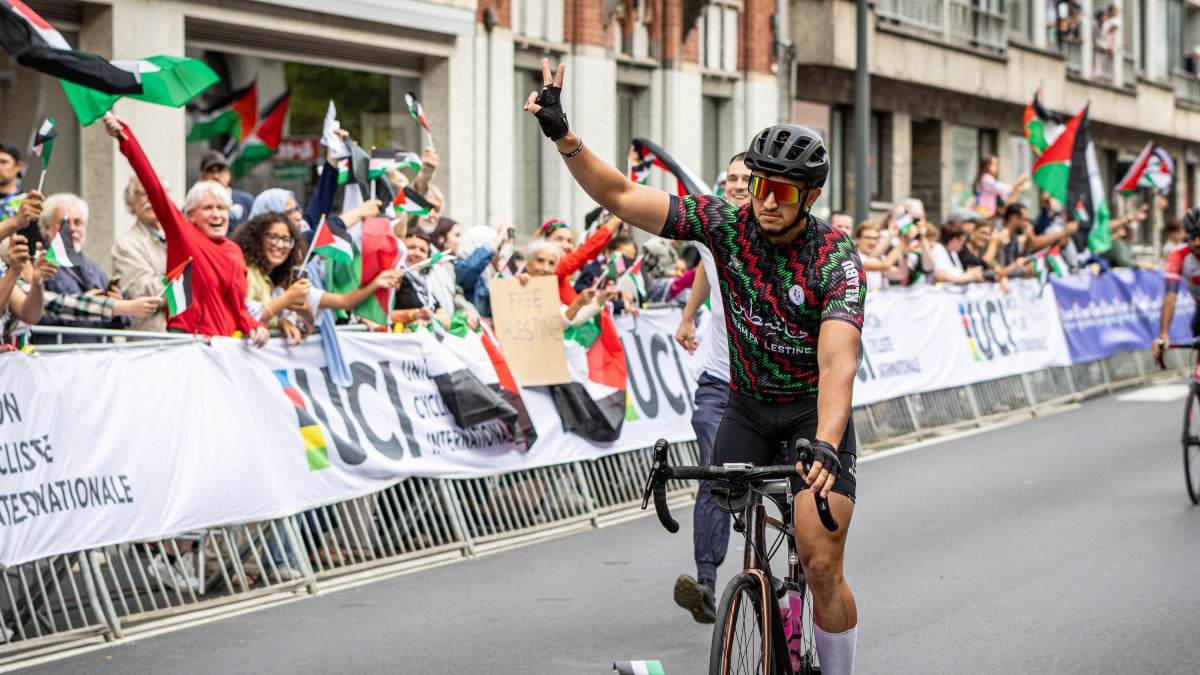
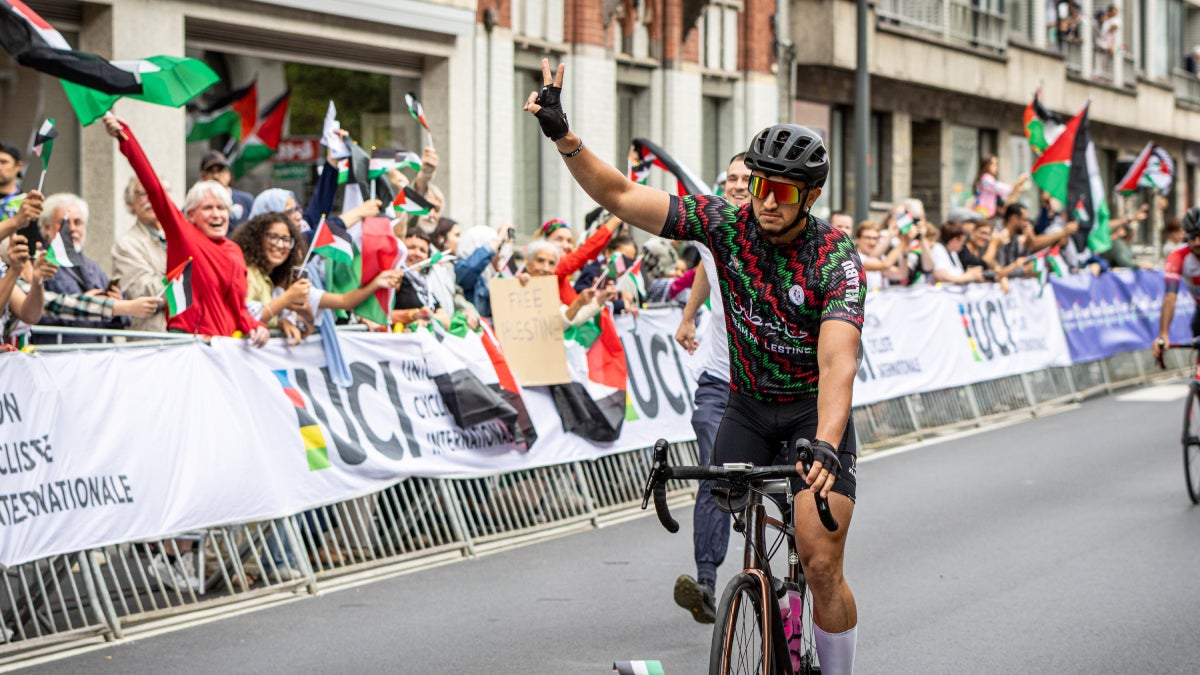
On Sunday, August 31, 2025, Alaa al-Dali and Mohammed Asfour of the Gaza Sunbirds rode past a crowd of people waving Palestinian flags on the streets of Ronse, Belgium. In that crowd, numbering in the hundreds, there were children with faces painted black, red, and green. There were hands outstretched, flashing peace signs. There were keffiyehs adorning necks. There were smiles, too. And mostly, there were cheers—loud, boisterous, and in support of al-Dali and Asfour as they finished 16th and 17th in the UCI Para-Cycling World Championships. On those cobbled streets of cycling lore, the two men were 2,000 miles from Palestine, the place they called home. And on each of their jerseys, they wore the image of a bird in flight, wings outstretched. And below their right hips, there was an empty space where each of their legs used to be.
Seven years ago, Alaa al-Dali was an able-bodied cyclist, living in Gaza and training for the 2018 Asian Games in Jakarta. Though he was a successful local racer, he tried and failed countless times, due to border closures and Israeli blockades, to secure a visa to travel out of Palestine to compete. Then, he attended one of the protests of the Great March of Return, hoping to demand his right to represent Palestine on the international stage. He was wearing his cycling gear. He even brought his bike. While al-Dali was protesting, Israeli forces shot him in the right leg. He lost that leg and joined, in that moment, a tragic and growing demographic. Palestine has consistently had a tremendously high rate of amputations due to Israeli violence. Between 2018 and 2019, during the Great March of Return, the World Health Organization reported that the 6,872 gunshot wounds suffered by Palestinians resulted in 121 amputations, noting that “the biggest cause of permanent disability is amputation.”
It took grit, some donated bikes, and a whole lot of willpower, but two years after al-Dali’s amputation, he founded, alongside Karim Ali, the Gaza Sunbirds: an organization of cyclists with amputations who have committed to riding for Palestine. It has since morphed into a community of mutual aid that continues to support ongoing relief efforts in Gaza. I spoke with al-Dali and Ali, who is now the International Coordinator of the Sunbirds. They told me about the difficulty of those early years. They had few resources. They were not allowed to leave the country to compete. Ali said, “We had limited access to bicycles. We had no helmets, no water bottle cages. We didn’t have cleats. The guys would tie their shoes to the pedal with strings.”
There was, throughout our conversation, a wry grimness to Ali’s tone, as if he knew the world was a morbid and sick joke that he still, as if through magic, could summon some hope and joy out of, like smuggling the thrill of a bike into the heart of some suffering place. And it was joy I noticed first when I began talking to both al-Dali and Ali. Within minutes, al-Dali, upon finding out I was a teacher, smiled and asked me to help him learn English. By the end of the call, the two of them wished me a blessing, hoping to meet me stateside when they fulfilled their dream of competing in the Paralympics in Los Angeles, California, in August 2028. Ali and al-Dali were an ocean away, their video feed sometimes cutting out, but I never felt anything less than at peace with them; it was like we were—the three of us—sitting on a living room floor.
Since 2020, the Gaza Sunbirds have been a beacon of hope amidst a landscape of violence. In the early years, the 19 original members of the Sunbirds trained under oppressive conditions with very few resources, dreaming always of leaving the country to compete on the international stage. In the meantime, they held group rides for people in Gaza, spreading their love of cycling throughout the region. When you watch them ride, as one video from 2024 shows, you see nothing but joy, a kind of forever-boyhood that feels as close as anything might feel to flight. “Honestly,” al-Dali says in that video, “I felt like there was no war, because of how happy and content I was.”
All 27 of the Sunbirds are athletes with amputations, and all of them lost their limbs as a result of Israeli attacks on Palestine. At the end of 2024, the United Nations reported that Gaza “has the highest number of child amputees per capita in the world.” The youngest Sunbird is 12 years old, and the Sunbirds hold children at the heart of their mission. One of their press coordinators told me, “For children in Gaza with amputations, it is vital for their rehabilitation and future development that they are shown that loss of limbs does not have to mean loss of life.” I thought of this when Ali told me, with a kind of solemn care: “You know, every athlete has a challenge. Every athlete has a mountain that they need to climb. It’s not our fault that ours happens to be a genocide.”
It wasn’t until last year that al-Dali was able to fulfill his dream of competing on the world stage. After evacuating Palestine, he became, in Zurich, the first Palestinian to compete at the UCI Para-Cycling World Championships. Now, al-Dali lives in Belgium, “trying to get my wife and two children out from under the bombs,” which means securing family reunification papers for the three of them. “I’ve not really had a normal day or day-to-day life,” he told me. “My life is constantly on the move. Things are always changing.”
Many of the Sunbirds are currently scattered between Gaza, Belgium, and Egypt. Some have managed to evacuate Gaza, where they are in danger daily. One of them, Ahmed al-Dali, Alaa’s cousin, was killed in Israel’s ongoing genocide. Mohammed Asfour’s brother, not long before the recent World Championships, was shot in the arm by an Israeli tank. He is just 12 years old. He is almost certainly, by Ali’s account, going to lose that arm. Every day, al-Dali toggles between managing the stress of wondering if those he loves are alive. He does this while offering coaching advice to various Sunbirds, helping organize relief efforts in Gaza, and keeping up with his own training. “Inshallah,” he said often during our call. God willing.
Both Ali and al-Dali speak daily with the 19 Sunbird athletes and 5 Sunbird staff members left in Gaza. At the outbreak of the Gaza War, the Sunbirds turned their motley crew of bicycles into a roving community of mutual aid. Their work now is entirely based on staying alive and helping others stay alive. On the ground in Gaza, members of the Sunbirds coordinate the constant aid efforts that ramped up, in earnest, seven days after October 7, 2023. Since then, the Sunbirds have distributed 520,000 pounds of aid throughout Gaza. None of the Sunbirds in Gaza trains anymore, but they do ride. They have distributed most of this aid via bicycle. Tons and tons of it. Along Salah al-Din Road, from Rafah to Beit Hanoun, and everywhere in between. They do not plan to stop. “We’re going to continue to do aid,” Ali told me, “Until life goes back to normal, which could take a very, very long time. We think our communities are always going to need that support.”
There is a dream that the Sunbirds have, though. Imagine this. First, imagine peace. There it is: the silence of it. The bombs have stopped falling. And then: the laughter of it, the joy. Gaza is being rebuilt. Alaa al-Dali, Karim Ali, Mohammed Asfour, and countless others are home, back in Palestine, in safety. There’s construction happening, right there, right in front of you. It’s a new building. Glass windows. It’s shining. You can see your reflection and the reflection of so many others. They come walking toward it, some still wounded from gunshots, airstrikes, the forces of oppression. Someone is putting letters on the building. It reads: Gaza Sunbirds Rehabilitation and Sports Center. There are stationary bikes inside. Outside, Alaa is teaching someone how to ride a bike. There are smiles all around. Someone who lost a leg years ago is moving faster than they ever thought possible. That’s Mohammed riding beside him—Mohammed Asfour, top-20 finisher in the World Championships, just back from his competition at the 2028 Paralympics in Los Angeles. There’s a whole peloton of riders. They’re heading out for a ride along a road that is no longer scared of bombs. It never stops, the recovery. But there’s joy in it now. There’s a bird outstretched on everyone’s chest.
Donation Links
The post Birds in Flight: The Gaza Sunbirds Para-Cycling Team appeared first on Outside Online.