








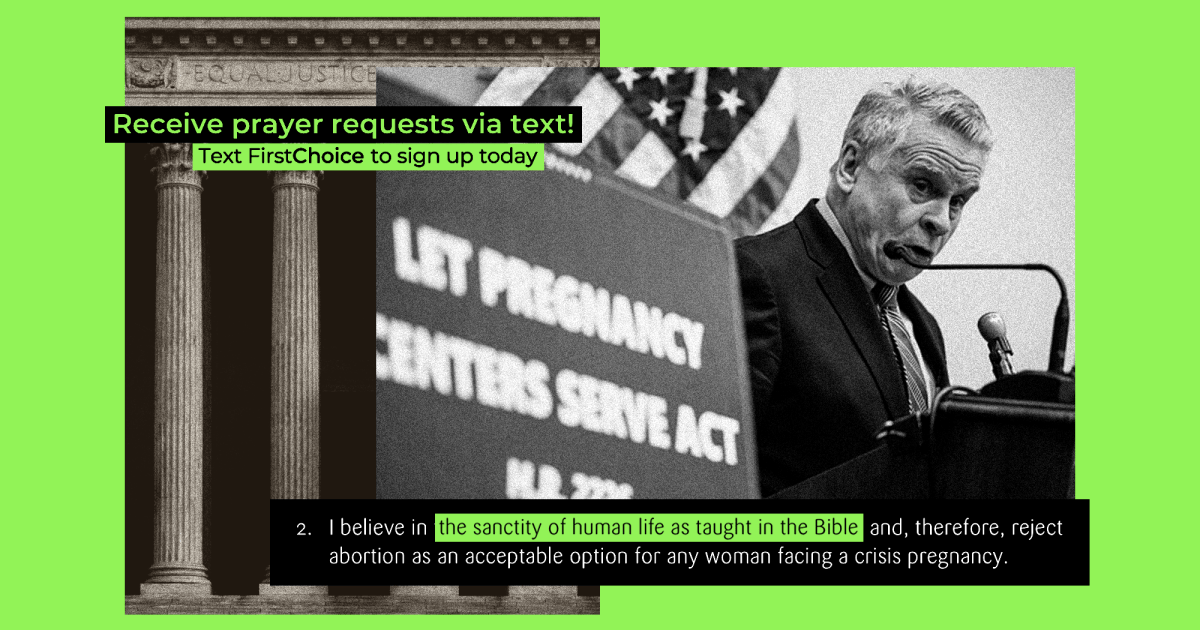
Even if you have no idea what a crisis pregnancy center is, the donor website for the First Choice Women’s Resource Centers chain in northeastern New Jersey offers plenty of clues: Prominent logos for the anti-abortion groups Heartbeat International and CareNet. A home page banner proclaiming “Sanctity of Human Life Sunday 2026.” An agreement for prospective volunteers that states, “I openly acknowledge my personal faith in Jesus Christ as my Lord and Savior,” and “[I] reject abortion as an acceptable option for any woman.”
That’s what appears on the website directed at First Choice’s donors. The chain also has two websites targeted at potential clients—pregnant women who might be seeking an abortion but end up on the crisis pregnancy center website instead, where First Choice is less clear about its religious ties and anti-abortion mission. “Learn more about the abortion pill, abortion procedures, and your options in New Jersey,” one site urges on its home page. “We specialize in pre-termination evaluations,” another site says, with services that include “free and confidential Abortion Information Consultation” and “post-abortion support.” On most pages, it is only at the very bottom that the qualifier, First Choice “do[es] not perform or refer for” abortions, appears.
Websites that tell anti-abortion supporters one thing and pregnant women something else are common among the country’s 2,500 crisis pregnancy centers, or CPCs—part of a well-documented history of using misinformation and deception, as well as free ultrasounds and other services, to deter women from having abortions. Some of the best-known strategies include opening “fake” clinics near real abortion clinics, misstating the purported harms of abortion and emergency contraception, and pushing the unproven medical procedure known as “abortion pill reversal.”
Blue states have repeatedly tried to rein in CPCs. But as faith-based organizations, pregnancy centers have a powerful shield—the First Amendment.
Blue-state lawmakers and attorneys general have repeatedly tried to rein in CPCs. But as faith-based organizations, these pregnancy centers have a powerful shield—the First Amendment. When states try to regulate them, CPCs invariably claim that these efforts violate constitutional protections for free speech, religious expression, and freedom of association. In a landmark 2018 decision, the US Supreme Court sided with the CPC industry, blocking a California law that would have required pregnancy centers to inform patients about state-funded family-planning services, including abortion.
That decision chilled state and local efforts to curb CPCs’ more controversial practices, creating what one legal scholar has called “a regulatory dead zone.” Meanwhile, since the fall of Roe v. Wade, the number of CPCs has grown—boosted by a surge in state funding and private donations—and reproductive rights supporters have renewed their push for greater oversight, this time focusing on consumer protection.
On Tuesday, the Supreme Court will hear arguments in its latest CPC case, this one involving New Jersey’s efforts to investigate whether First Choice may have misled consumers. The question before the court is technical: Can CPCs run directly to federal court to fight an attorney general’s subpoena, as First Choice did, or must they first go to state court? As reporters Garnet Henderson and Susan Rinkunas recently wrote in Mother Jones and Autonomy News, the answer could have sweeping consequences for the $2 billion-a-year CPC industry:
Boring as this procedural quibble may seem, a favorable decision would be a significant win for CPCs. They have a much better shot at winning any case in the Trumpified federal courts than they do in state courts that may be more supportive of abortion rights. What’s more, the ability to use friendly federal courts as a shield from state regulation would set pregnancy centers up for success in other lawsuits making their way to the Supreme Court—ones that could eliminate states’ ability to crack down on [abortion pill reversal] and other questionable practices entirely.
But the case has also raised concerns among groups aligned with progressives that the same type of subpoenas issued by New Jersey against First Choice could be weaponized against humanitarian groups, journalists, and protesters. “The problem is bipartisan,” the ACLU wrote in one amicus brief. While New Jersey focuses on crisis pregnancy centers, “Florida’s attorney general pursues restaurants for hosting drag shows,” and Missouri’s attorney general investigates chatbots “to find out why they express disfavored views about President Trump.”
In another brief, lawyers for Annunciation House, a Texas nonprofit that has been targeted for providing shelter and support to immigrants, wrote, “Nonprofit organizations—which rely heavily on volunteers—bear the heaviest burdens when faced with…state investigatory demands.” The stakes, the brief said, “can be existential.”
The case dates from November 2023, when New Jersey Attorney General Matthew Platkin—an abortion rights supporter and CPC critic—issued a subpoena against First Choice as part of an investigation into whether the pregnancy chain was “misleading donors and potential clients into believing that it was providing certain reproductive health care services,” Platkin’s office states in a brief. The subpoena was broad, seeking 10 years’ worth of emails, videos, handbooks, the identities of many of its donors, and other information about First Choice’s ads and solicitations, its services and staff, and its claims about medical procedures, including abortion pill reversal.
State and federal agencies have been using similar subpoenas to investigate potential violations of the laws they enforce for over 150 years, Platkin’s brief points out. Such subpoenas are not “self-executing,” meaning that Platkin’s office didn’t have the power to enforce them. Instead, in New Jersey and the rest of the country, the long-accepted procedure for enforcing or challenging a state agency’s subpoena is to seek relief in state court. If First Choice disagreed with the ruling from a New Jersey court, it could then plead its case in federal court.
But First Choice’s attorneys—the conservative legal behemoth Alliance Defending Freedom—cried foul, saying the CPC had done nothing wrong and accusing Platkin of “selectively target[ing] the nonprofit based on its religious speech and pro-life views.” Pregnancy centers “have been subject to a shocking level of violence and intimidation,” ADF asserted in one court filing. “First Choice is concerned that if its donors’ identities became public, they may be subjected to similar threats.”
“We haven’t forced those services on anyone. We haven’t charged any women for the services we provide…. Yet Platkin calls this kind of caring ‘extremist.’”
The lawyers also pointed to a 2021 Supreme Court precedent blocking California’s efforts to force charities and nonprofits in the state to report the identities of their major donors. According to ADF, the Platkin subpoena was so concerning that First Choice should be able to seek immediate relief in the federal courts, rather than having to expend time and resources litigating the issue first in state court. The ADF team—including Erin Hawley, wife of Missouri GOP Sen. Josh Hawley—compared Platkin’s investigation to Southern states’ attempts to force the NAACP to produce member lists in the late 1950s and early ’60s.
In an op-ed for NJ.com, First Choice’s executive director, Aimee Huber, noted that in 2022 alone, CPCs throughout the US provided 500,000 free ultrasounds, 200,000 STI tests, 3.5 million packs of diapers, and 43,000 car seats to women and families in need. “Over the last 40 years, First Choice has been privileged to offer crucial resources to more than 36,000 women across our state. We haven’t forced those services on anyone. We haven’t charged any women for the services we provide…Yet Platkin calls this kind of caring ‘extremist.’”
But courts repeatedly ruled that the case wasn’t ready—or “ripe”—to be litigated in federal court. A state judge, meanwhile, ordered Platkin and First Choice to negotiate to narrow the subpoena’s scope. The first time First Choice asked the Supreme Court to weigh in, back in February 2024, the justices declined. But when ADF tried again, this past spring, the court took the case.
Most of the amicus briefs siding with First Choice are from a predictable collection of anti-abortion and conservative or libertarian groups, including red-state attorneys general, Republican members of Congress, the Second Amendment Foundation, and the Koch-funded American Legislative Exchange Council, or ALEC. But the CPC chain also received support from some unexpected quarters, including animal rights activists, the Reporters Committee for Freedom of the Press, and the Foundation for Individual Rights and Expression, represented by the ACLU.
In its brief, the humanitarian relief group Annunciation House described being hit with an investigative subpoena by Ken Paxton in 2024 demanding that it immediately turn over thousands of documents about immigrants and refugees it has helped—including sensitive medical and personally identifiable information—or face being shut down. The subpoena touched off a grueling, costly fight in state courts, with the Texas Supreme Court ultimately siding with Paxton.
“The chilling effect impacts not only the targeted nonprofit, but also the broader nonprofit community, as organizations may avoid lawful speech or actions out
of fear that they will lead to investigatory scrutiny,” the Annunciation House lawyers write. “Left unchecked, the [subpoena] process becomes the punishment.”
In an interview with Mother Jones, Grayson Clary, a lawyer at the Reporters Committee, raised similar concerns. “Well beyond the context of this crisis pregnancy center, we have seen more state attorneys general trying to use their consumer protection authorities in new and potentially troubling ways, including to investigate news organizations,” he said, pointing to a Missouri case targeting the left-leaning Media Matters. “Saying, ‘We’re not after the journalism—we’re just protecting the consumers’ is often a fig leaf for efforts to control the content that a news organization is putting out.”
“In practical terms,” Clary said, “what’s at stake in this question is how much of a tax does a state attorney general get to place on you for speaking, or for publishing news that they might disagree with, before you get a chance to ask a court to put a halt to it? And that question really can, in practical terms, be life or death, especially for a smaller or nonprofit news outlet,”
On the abortion-rights side, what is most surprising about the amicus briefs is that they are nonexistent. But one group paying close attention to the case is Reproductive Health and Freedom Watch, a CPC watchdog. “If the Court finds in favor of this pregnancy center,” executive director Debra Rosen says, “I worry that it’s going to chill further scrutiny into this massive [CPC] industry.”
Instead, amicus briefs in support of keeping the First Choice case out of federal court come from agencies that routinely issue investigative subpoenas, including blue-state attorneys general and state medical boards. The consequences of adopting First Choice’s argument would be “far-reaching,” Platkin’s office argues, “turning every quotidian subpoena dispute into a federal case.”
The Supreme Court is expected to rule in the case by next summer.