





Cooking is, technically, energy transfer. Doing it outdoors over live fire, you get intimate with the process of combustion that unlocks energy stored in wood or charcoal and releases it as heat. You rely on your senses to monitor the physical and chemical changes that heat produces in your food. Without getting too woo-woo about it: you’re fully present.
Turns out, the same is true of making ice cream outside. This I learned thanks to a recent spate of viral videos documenting a recipe called Snow Ice Cream, Canadian Ice Cream, or Sheer Yakh, depending on the source. As January’s Winter Storm Fern hit the Eastern U.S., many tried their mittened hands at plunking a bowl in the snow and whisking cream until it alchemized into soft-serve.
No ice-cream machine required. Anyone with a bowl and a whisk can do it. Beyond that, you depend entirely on the elements and your own muscle. It’s the thermodynamics of cooking in reverse, as heat transfers from the ingredients in the bowl to the snow below.
Reader, I tried it. It’s a fun way to get outside in winter and gain a new appreciation for the cold. Plus, you’re rewarded with a sweet, frosty treat. What’s not to like?
The Basic Recipe
Call me a crank, but I did, at first, find something not to like.
I began with the recipe I saw everywhere online: 1 pint heavy cream, ⅓ cup powdered sugar, and a splash of vanilla. Some recipes use snow as an ingredient, but where I live the precipitation contains more heavy metals than I like to consume in a frozen dessert. To make my Snow-Day Ice Cream, I used a method employed today by many TikTokers and for millennia by Afghan makers of the frozen confection Sheer yakh.
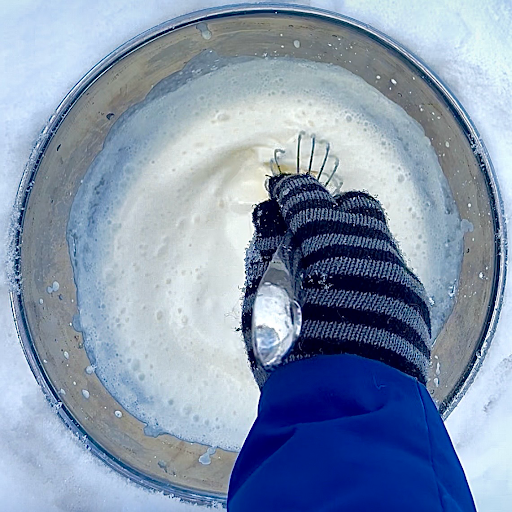
On a bracingly cold afternoon, I wiggled a big metal bowl into deep snow. Into the divot left by the bowl, I shook a generous amount of salt. Food-grade rock salt or kosher salt will work here to lower the freezing point of the snow, which draws heat from the bowl as it melts. There’s your energy transfer.
Cream alone would freeze rock-hard. The powdered sugar lowers the freezing point and softens the result. Constant whisking causes smaller ice crystals to form as the water, fat, protein, and sugar emulsify and freeze. The smaller the ice crystals, the smoother the ice cream. As you whisk, you’re also introducing air–known in the ice cream biz as overrun–to the matrix of ice and cream, producing a scoopable ice cream.
I found it took about 20 minutes of bicep-numbing whisking to get to the soft-serve stage. (If you have children or other willing hands in your household, make this a group activity.) The first bite was delightfully ice creamy. But after a few more, I realized my scoop was actually somewhere between frozen whipped cream and frozen butter. It coated my mouth with a thick, fatty film. It tasted like nothing.
A Major Upgrade
To come up with something tastier, I called on Meredith Kurtzman, pastry chef emerita of the Manhattan restaurants Esca and Otto, who gained a fervent following for her olive-oil gelato and other desserts distilling the taste of seasonal produce at its peak.
Kurtzman wasn’t surprised that my all-cream ice cream fell flat. “Fat coats your palate,” she said. “The fattier the ice cream, the harder it is for the flavor to come through.” Her gelato base contains more milk than cream, plus a little condensed milk, which has a low water content and a fair amount of sugar to keep things smooth. “It sits lightly on the tongue,” she promised.
Though fruit desserts are Kurtzman’s signature, I wanted to develop a chocolate Snow-Day Ice Cream. We reminisced about the delicious hazelnut hot chocolate served at Otto–a painstaking labor of love, Kurtzman recalled–but I wanted to keep this recipe as simple as possible. “Why not try Nutella?” she suggested.
On the stove, I stirred up a hot chocolate with 1 cup Nutella, 3 cups whole milk, and a big pinch of salt, then stowed it in a heatproof container in the fridge. Out in the snow, 2 cups of that chilled Nutella-milk base went into the bowl first, followed by ⅔ cup heavy cream, ½ cup condensed milk, and another ¼ teaspoon salt. This time, instead of whisking by hand, I gave my biceps a break with an electric hand mixer.
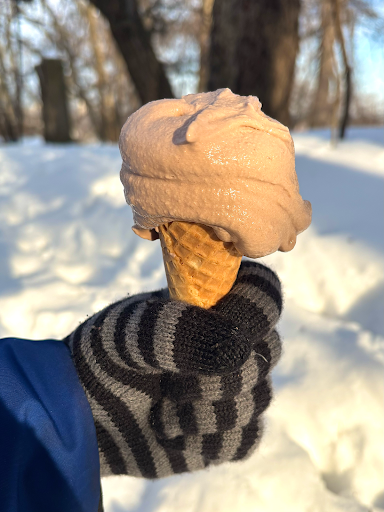
If you’re making it with or for kids, this is exactly the lush, lightly chocolaty soft-serve you want, the nostalgic stuff of roadside stands. For a grown-ups-only variation, I added ⅔ cup high-quality cocoa powder to the Nutella hot-chocolate base. That ice cream was intensely chocolaty and even smoother and denser in consistency.
I might have stopped right there, had I not thought of one of my favorite cookbooks from last year: Pooja Bavishi’s “Malai: Frozen Desserts Inspired by South Asian Flavors”. Bavishi is the founder and CEO of the Malai ice cream shops in Brooklyn, Philadelphia, and Washington, DC; a Manhattan location is set to open this spring. Her signature style combines the best elements of high-butterfat American-style ice cream and South Asian kulfi, a denser frozen treat with no air churned in. “We have a low overrun because it’s a really satisfying mouthfeel,” she said.
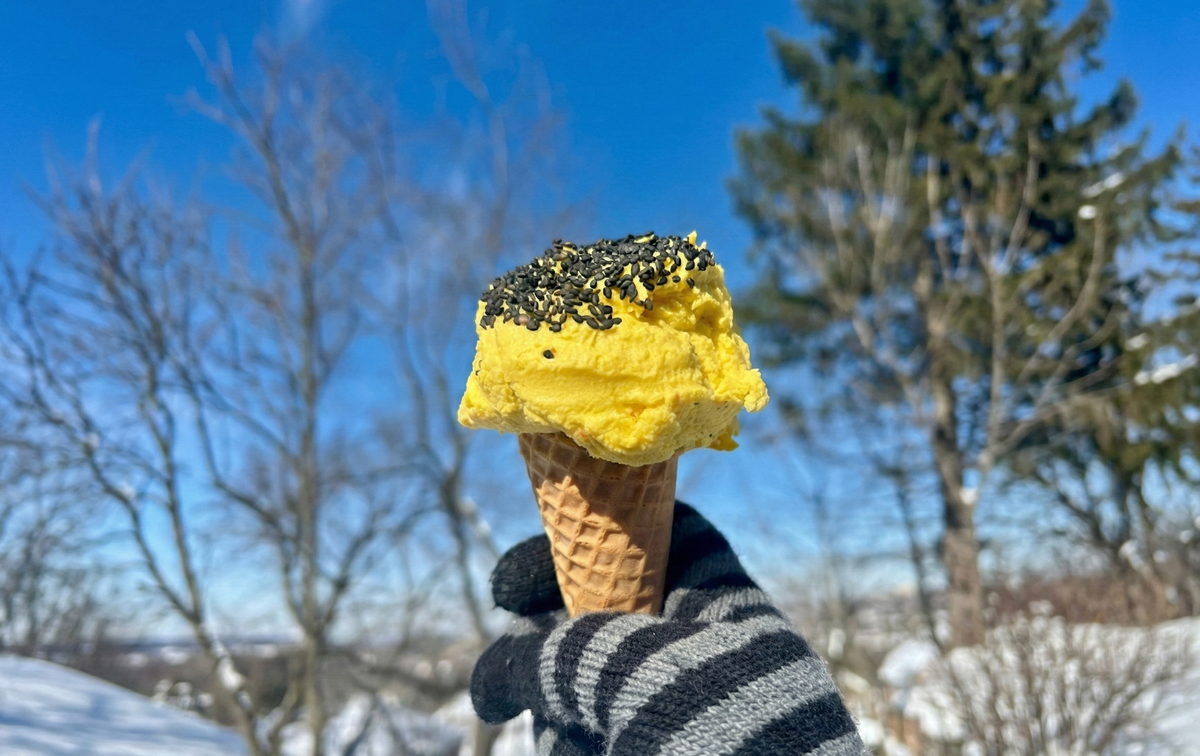
For a dairy-free Snow-Day Ice Cream, Bavishi’s recipe for Coconut Saffron Kulfi Ice Pops seemed like an excellent starting point. The base is just coconut milk, condensed coconut milk, and evaporated coconut milk; ¼ teaspoon saffron steeped in 2 tablespoons boiling water lends a honeyed floral depth and an electric orange hue. Just ¼ teaspoon salt makes the flavor pop.
When I made the ice pops last year, I had to order the evaporated coconut milk online, and it brought a nice, toasty cooked-milk flavor. Now I was determined to stick to ingredients readily available at the supermarket. Bavishi suggested popping a can of coconut milk in the fridge, letting the cream solidify on top, and skimming that off to use as a low-moisture replacement for the evaporated coconut milk.
It worked beautifully. Sure, 20 minutes of whisking in the snow introduced more overrun than is strictly kulfi-like, but I wasn’t complaining. The texture was decadent, and the color was sunshine. The pure coconut flavor got a subtle floral lift from the saffron.
All three ice creams held up very well in air-tight containers in the freezer. After 24 hours, they were more like hard ice cream but still very scoopable, smooth, and, crucially, light on the tongue.
The post Why You Should Be Making Ice Cream Outside This Winter appeared first on Outside Online.