








Last fall, an informational sign vanished from a patch of grass across from Chevy Chase Circle in Northwest Washington, DC. The placard—installed in 2022 by the National Park Service after much discussion—described the career of Sen. Francis Newlands, who represented Nevada in Congress for a quarter century and championed irrigation projects in the American west.
In early November, without any announcement from the Park Service, neighbors noticed that the sign was gone. “It just disappeared one day,” said Stephanie Rigaux, a local historian whose Facebook post about the removal is one of the few records of the incident.
The Interior Department, which runs the National Park Service, wouldn’t answer my questions about what happened to the sign. But the mystery doesn’t seem hard to crack. It was evidently a casualty of Donald Trump’s campaign to bar the government from presenting American history in “a negative light.”
“It just disappeared one day.”
The timeline is instructive. In 1932, Congress approved naming a fountain in the circle, which sits on federal land, after Newlands. Ninety years later, in the wake of a nationwide racial reckoning, the Biden administration’s National Park Service installed the offending sign in an effort to add some context regarding Newlands’ legacy. It noted that in addition to his legislative accomplishments, Newlands was a white supremacist who advocated denying citizenship and voting rights to people of color.
Then last March, President Donald Trump issued an executive order instructing government agencies to purge “improper ideology” and “divisive narratives” from federal lands and museums and to ensure that those sites are “uplifting.” The Trump administration appears to have determined that the Newlands sign violated that policy.
Chevy Chase Circle is far from alone. Last May, Interior Secretary Doug Burgum moved to implement Trump’s order, directing the Park Service to scrutinize more than 400 national parks, monuments, battlefields, and historic sites—as well as federally controlled DC green space—for insufficiently patriotic material. The Park Service is removing and altering signs, exhibits, and other media deemed to be “non-conformant” with Trump’s wishes. So far the department has reviewed more than 2,000 pieces of media, according to a person with knowledge of the effort, and has ordered the removal or alteration of at least a few hundred signs and exhibits.
The Interior Department is keeping the precise figures under wraps, and it declined to provide specifics about why the material being targeted is objectionable. “Because this work is still underway, there is no finalized or comprehensive list of changes, and it would be premature to speculate about specific wordage, images, or exhibit content that may or may not be revised,” a spokesperson said.
The Trump administration, that is, is attempting to remove public information in secret.
“It’s left everybody who is concerned about this in the dark,” Alan Spears, senior director at the non-profit National Parks Conservation Association, told Mother Jones. “There is no transparency. We don’t know where these sign removals are going to happen.”

As Trump’s clandestine censorship campaign proceeds, displays that focus on persecution and environmental degradation have become particular targets. But the Park Service is also planning to remove signs that merely acknowledge the existence of controversy or conflict.
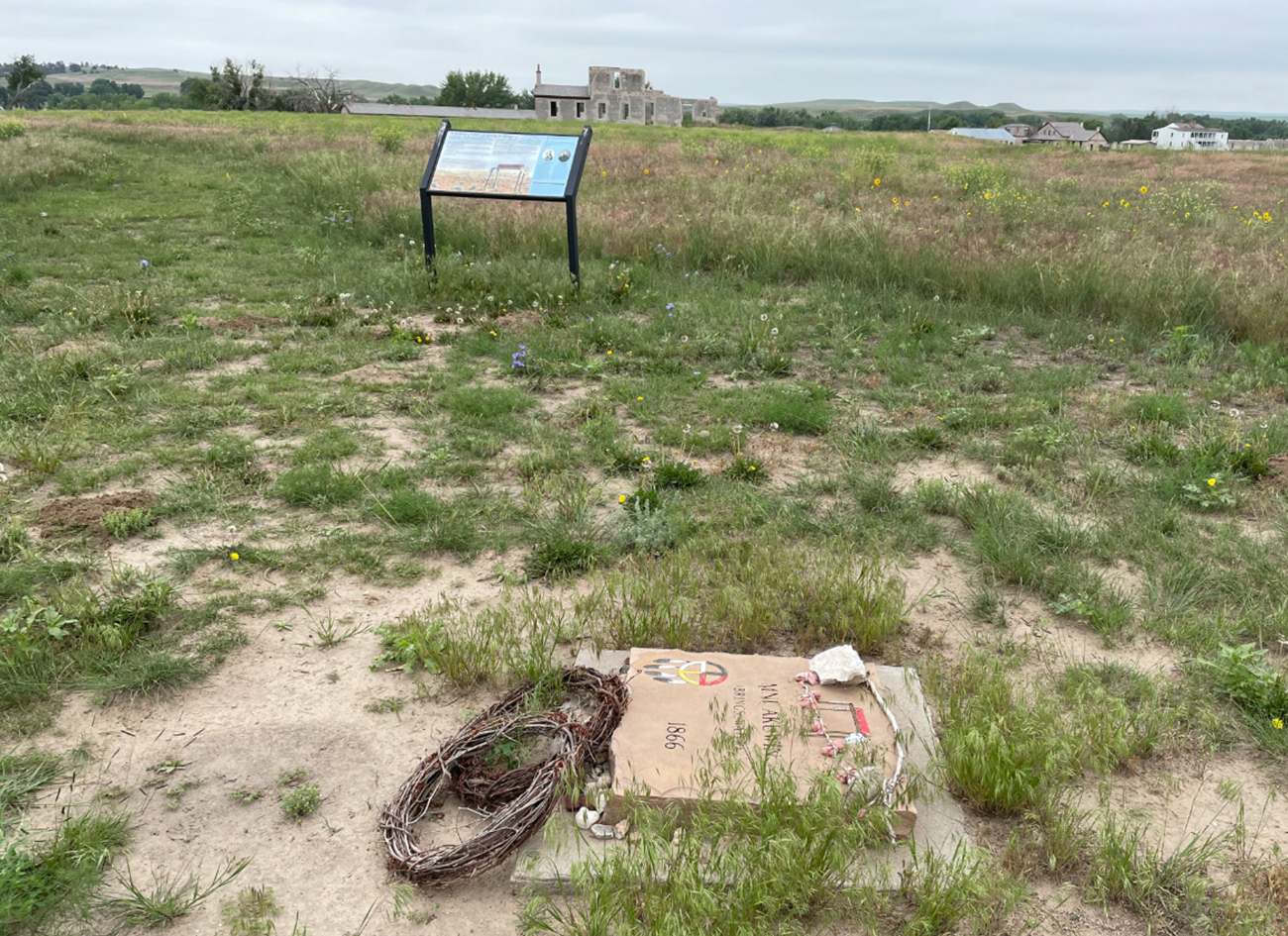
At Fort Laramie National Historic Site in Wyoming, the National Park Service plans to alter or remove a sign, titled “A Father’s Grief … A Soldier’s Honor,” that sits alongside a burial marker for Mni Akuwin, the daughter of Lakota chief Spotted Tail. The placard consists mostly of quotes from Army Colonel Henry Maynadier describing a funeral service he arranged at the fort for Mni Akuwin, who had died a few months earlier. The elaborate funeral, which Maynadier reported had moved Spotted Tail to tears, likely helped secure a peace deal with the tribe.
A Park Service official told me that the sign had been flagged by the Interior Department due to a line it quotes from a letter Maynadier sent his wife. Maynadier wrote that after the funeral service, “I can never be willing to see these people, swindled, ill-treated and abused as they have been.” (You can read the full text of the sign here.)
“How stupid can we get?”
Charles Rankin, a longtime editor and historian of the American West who has written about Mni Akuwin’s funeral, finds the decision galling. “That signage celebrates the fact that these people, over her grave, came together,” Rankin said in an interview. “It celebrates reconciliation. How stupid can we get?”
At Montana’s Glacier National Park, the Park Service is preparing to remove signs telling visitors why the eponymous glaciers are shrinking, as well as placards about declining air quality. The agency has taken down a season of a podcast, called Headwaters, that was produced by park employees. And Interior has ordered employees to remove or alter a film about the park shown to visitors. Written guidance from the department said the changes are necessary due to “scientific inaccuraries [sic]” in the film, but it did not specify what is supposedly incorrect.
Glacier is also removing a sign that attributes a sharp increase in wildfires in the American west to “hotter and drier conditions,” as well as a sign that describes the “controversy” over the hunting of wolves. The department did not explain those decisions.

The department was more forthcoming with its reasoning for replacing a different sign at Glacier. That placard, titled “Blame It on the Grain,” describes the construction of a dam that created a reservoir in the eastern part of the park to support farming. “Rename it something else,” Interior guidance sent to the park says. ”’Blame’ has negative tone to it, when the actual reality is the dam was created to help support American Agriculture and feed America’s growing population.”

Some of the administration’s efforts to implement Trump’s order—such as the removal of exhibits in Philadelphia about people enslaved by George Washington and of panels citing the effects of climate change at Acadia National Park and Fort Sumter—have already drawn attention and outrage. On February 16, federal District Court Judge Cynthia Rufe ordered the Park Service to restore the Philadelphia exhibits. Rufe said the removal violated agreements requiring the city’s consent, and compared the Trump administration to the Ministry of Truth in George Orwell’s 1984. (After restoration began, a federal appeals court gave the administration a partial stay, freezing the exhibits as they are while the court considers the case.)
Still, NPS is moving ahead with sign removals at an industrial scale. The process, launched with Trump’s executive order in March, accelerated in May when Burgum issued a memo implementing the president’s plans at the Park Service and other Interior agencies. The memo instructed NPS to “remove content” that “inappropriately disparages Americans past or living (including persons living in colonial times).” Burgum also ordered the removal of information regarding natural features of the American landscape if it “emphasizes matters unrelated to the beauty, abundance or grandeur of said natural feature.”
Burgum did not elaborate on that latter instruction. But current and former parks employees described it as ill-advised, and baffling, since applying it literally would require removal of many signs providing basic scientific information. At Muir Woods National Monument in California, for example, the agency recently covered a sign explaining how carbon emissions harm redwoods. And Big Bend National Park in Texas plans to remove signs related to geology, prehistoric times, and fossils, according to the Washington Post.
What remains might not be especially enlightening. “You don’t really need an exhibit at a historic viewpoint to say, “Hey, that really looks good,” said Bill Hayden, Glacier’s former head of interpretation.
In June, Park Service staffers across the country were instructed to post QR codes and signs encouraging visitors to report any material they felt should be altered. Burgum also ordered the heads of national parks units to submit for review their own lists of signs or other media that might run afoul of Trump’s executive order. The Interior Department sent back decisions in September and then made additional rulings in January.
Current and past parks employees derided these commands. “I think it’s stupid,” said Hayden. “The goal was to explain the nature and cultural resources to the visiting public—and a lot of those concepts and ideas are not just readily apparent to someone stopping on the side of the road and looking at something.”

Responding to widespread criticism, an Interior spokesperson said that the department’s review “is not about removing history or advancing any single political ideology. It is a collaborative process designed to ensure that the full and accurate history of America is presented, grounded in professional standards and inclusive of multiple perspectives, including those of tribal nations.”
But Park Service employees, who spoke to Mother Jones on the condition of anonymity, described this process, as it has played out nationally, as haphazard, top-down, and far from collaborative.
“It’s childishly unprofessional,” said one current NPS employee involved with producing public material. “It’s not like a serious engagement with the process, or an attempt to educate the public about science or our world.”

Employees said the Interior Department’s instructions are vague, leaving senior career officials, who in many cases are worried about their jobs amid mass firings of government workers, to decide how much self-censorship to engage in.
The department’s demands “paralyzed a lot of the parks, because there was no guidance,” one employee said.
According to material obtained by Mother Jones, some park units, like Yellowstone, submitted few or no signs for review by Interior Department officials in Washington. But some other park superintendents generated extensive lists of potentially non-compliant signs. Department officials designated many of those submissions for removal, often without explaining their reasoning, park employees said.
Mother Jones obtained a spreadsheet summarizing the Interior Department’s review of submissions from 33 sites in NPS’ Intermountain Region, which includes some of the most-visited parks. Of 81 submissions, the department said 46 should be altered or removed. The document does not include the department’s reasoning beyond declaring the items to be in “non-conformance” with Burgum’s order. Those include the signs slated for removal at Glacier, the Fort Laramie sign, the Big Bend signage related to dinosaurs and geology, and a panel at Wyoming’s Grand Teton National Park describing the role of a cavalry captain who explored the region in an 1870 massacre of Blackfeet Native Americans.
“We are being undermined by a clown show of greedy billionaire priorities that are not of service to the parks or country.”
Park service employees described the sign removals as part of a string of interference from Washington that has crushed NPS morale.
“We are being undermined by a clown show of greedy billionaire priorities that are not of service to the parks or country,” one employee said.
A former NPS employee who was laid off last year characterized the department’s management style as “bullying and demoralizing,” carried out “in an idiotic and not thought-through way.”
The Park Service had lost around a quarter of its workforce by July of last year, due to firings and other causes, according to the National Parks Conservation Association. And attrition continues as the agency struggles to replace departing staff, employees said.
The Interior Department meanwhile is moving to increase its control over various park service communications. The department has shifted hundreds of employees in public outreach jobs into what it calls a “Consolidated Office of Communications.” Last month, it imposed “a strategic pause” on website updates by NPS staffers as it installed a system in which department officials sign off on new online content. And it recently announced that the department’s press staff will review publication of all social media produced by national parks, according to employees and internal material shared with Mother Jones. “Social media needs to be reviewed and published by someone trained and educated and aligned with NPS and the department as a whole,” Elizabeth Peace, a senior public affairs specialist at the Interior Department, said during a January 15 call with Park Service employees.
NPS employees have even received directions on how to respond to questions about sign removals. Internal guidance instructs them not to “reference media stories, leaked documents or internal reviews”; suggests they “redirect calmly and consistently”; and says that they “do NOT need to engage in conversation about individual signs or parks, which signs are from [Burgum’s order] vs weather or damage. The comms team will take those.”
The department’s communications team did not answer my questions about individual signs and parks. In response to a detailed list of queries, a spokesperson wrote: “Mother Jones is a failing liberal blog that has this story completely wrong. This blog is too small and insignificant to waste our time correcting them when we are focused on implementing the agenda of President Trump – the most iconic and accomplished President in the history of our great nation.”
The iconic president’s war on park signs isn’t slowing down. Many of the removals the Interior Department has ordered in colder locations will not be executed until spring. In guidance sent to NPS employees in January, Burgum said the department is still reviewing material and instructed parks “to work with regional offices to review next steps for their non-conformant media items.” Interior Department officials have recently visited sites throughout the Park Service’s Washington, DC, region, according to an NPS employee, generating worries they will demand additional alterations.

This chaotic process, current and former agency employees said, contrasts with the deliberative efforts through which the signs and exhibits were originally created. The Newlands sign, for instance, was installed in 2022, the culmination of a multi-year project. Its design and brief narrative were influenced by an expert group convened in 2020, following nearly a decade of debate over public calls to rename the fountain.
The sign disappeared, however, without notice. The removal came during the government shutdown last year, when federal employees were furloughed, raising the question of who actually dislodged it. An NPS employee told Mother Jones that Frank Lands, the Park Service’s deputy director for operations—the top career employee at the agency—personally removed the sign to comply with White House wishes.
Lands, whom I contacted directly, didn’t respond to my questions about this claim. An Interior Department spokesperson said only that the agency “does not comment on specific personnel,” and wouldn’t even confirm that the department was responsible for the sign’s removal.
That is how the United States government is implementing a presidential directive to “restore Federal sites dedicated to history.” The administration appears to have removed a carefully created piece of public information—with no announcement or explanation for why Americans should not be informed that a prominent US senator was a racist.
Now, where the sign once stood, all that remains are two small holes in the ground.