





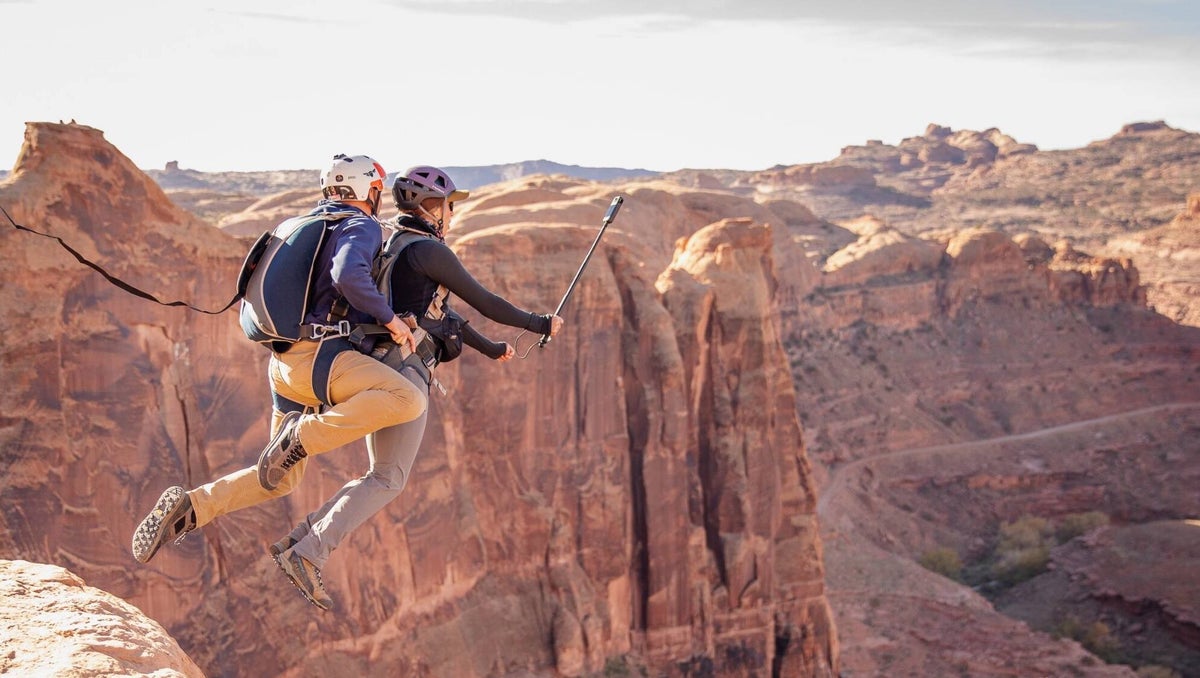
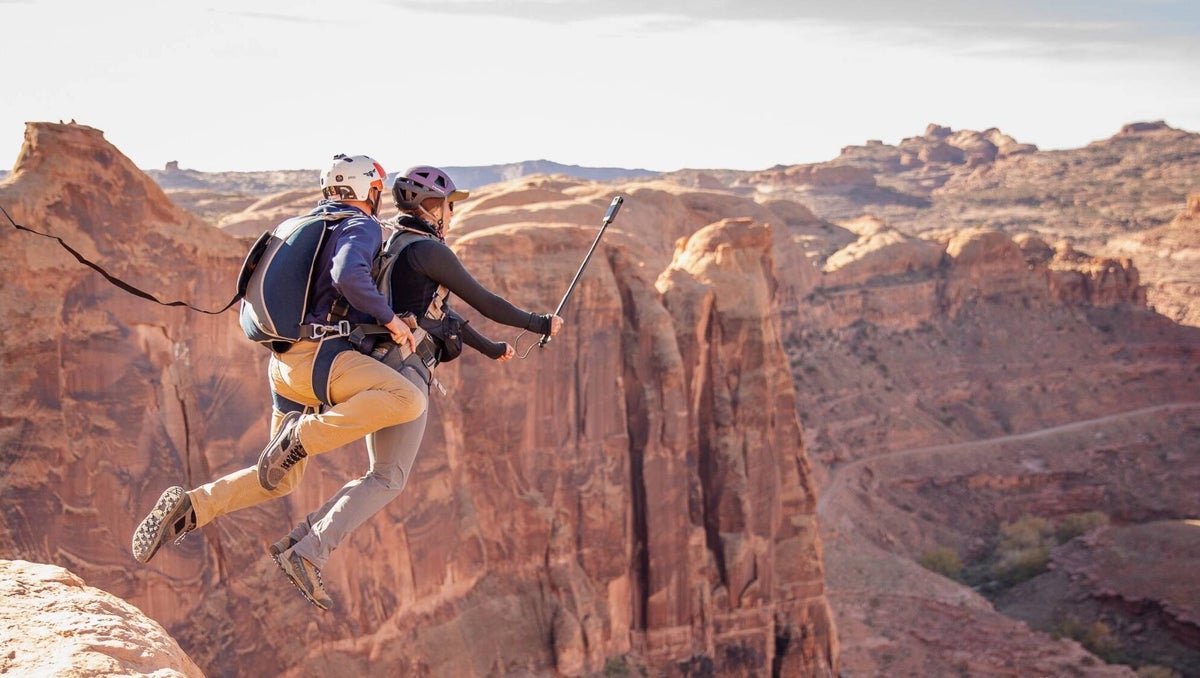
You are standing at the edge of a cliff. In a few moments, you will jump. Once you take that step off solid ground, you will experience a fleeting free fall until—if all goes to plan—the parachute inflates, delivering a reassuring jolt. Your movement slows through the air.
But before you jump, time protracts as your hyper-awareness stretches each second that passes. Back on the ground, ecstasy fills you. Water pools in your eyes as serotonin saturates your nervous system. It feels like nothing will ever be quite the same—or at least that’s how the pursuit of BASE jumping has been described by those who’ve done it.
The promise of a transformative, life-affirming experience like this may be what attracts people to tandem BASE jumps in the first place. (Note that the acronym BASE stems from a list of the things you can jump from: Building, Antenna, Span or bridges, and Earth.) While some jump for fun, many are looking to cope with trauma. Others jump to mark—or spark a personal sea change.
“Everyone has a story,” Matt LaJeunesse, the founder of Tandem BASE Moab in Utah told Outside. By that, he means that many of the people who reach out to his adventure outfitter company are going through something. That might be trauma, divorce, or the journey to sobriety. It could be a recent diagnosis, a disability, or becoming cancer-free.
“I get a lot of people who have experienced recent loss, meaning the death of a loved one or a child,” he says. “People who are struggling with addiction, meaning they’re in the sober portion of their battle and seeking new things that are exciting and come with positive rewards. Divorce, first responders, military …”
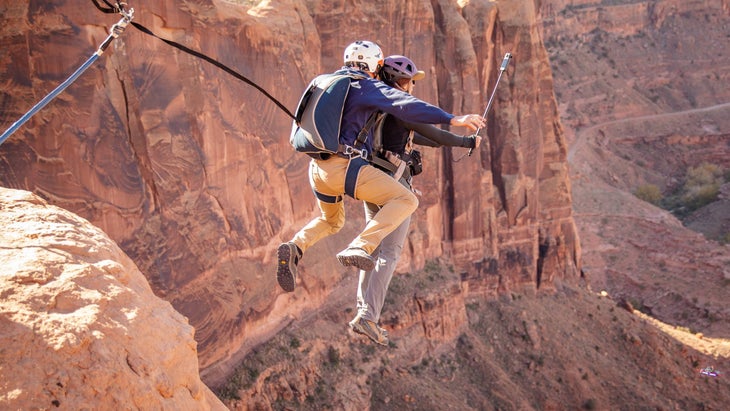
One story that will stick with LaJeunesse forever? A woman in her thirties called him on a Thursday to book a jump for the following Tuesday. As they were walking toward the cliff, she told him that she had just found out she had an inoperable tumor on her brain stem. She only had six to eight weeks to live—but she hadn’t yet told her son or husband. She didn’t know how.
Did La Jeunesse have any ideas about how she could share this impossible news?
“In a million years, I could never have imagined someone asking me this on a BASE jump,” he recalls. When they landed, they hugged and he says that she seemed incredibly calm. Then she said something to the effect of, This gives me the strength to have the conversation I need to have. The woman texted LaJeunesse after finally telling her family the news; she passed away soon after.
Loaded Tandem BASE Jumps
What is it about tandem BASE jumps that attracts people with so much trauma. “They’re trying to navigate their circumstances,” LaJeunesse explains. Through a jump, people may seek perspective and process difficult experiences. Or find a way to physically manifest the intensity of an experience that’s been largely psychological or emotional.
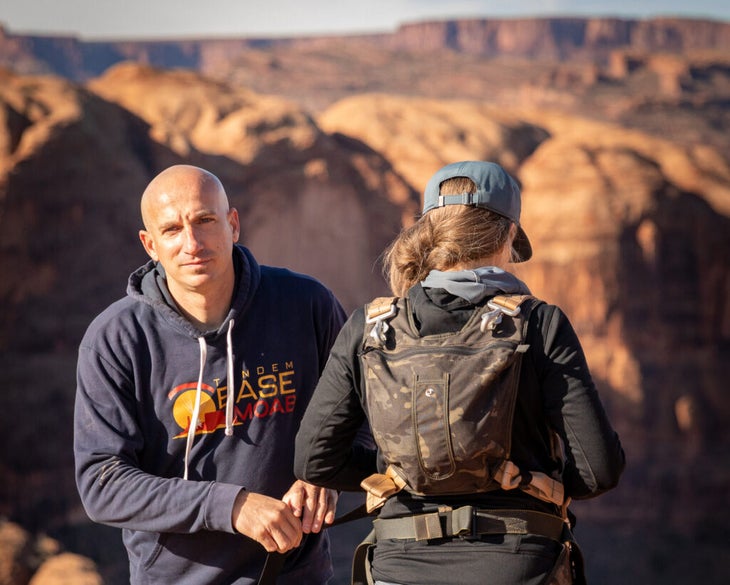
It turns out there’s a technical term for that: corrective experience.
“You’re entering something that would spark a physiological response like trauma, but you’re doing it in a way where you have a lot more choice,” explains licensed Utah therapist Jess Shade. “It might be a stretch to say BASE jumping is a controlled environment, but you’re signing up for it.”
But why BASE jumping, as opposed to other adventurous activities?
“Perhaps because for some people who are experiencing something really heavy, it feels fitting, apt, or equal measure, perhaps,” Shade says. She adds that for some, it might not be so complex. Someone with a terminal illness, for example, might have always been curious about what it was like to jump off a cliff. Others might have had BASE jumping on their bucket list.
While Shade has never BASE jumped herself, she understands how adrenaline-inducing experiences can be therapeutic. As a high-altitude ski mountaineer based in Salt Lake City, she estimates that over half of her clients at Altura Counseling and Coaching are deeply embedded in the outdoors, whether they work in the outdoor industry or are just passionate about adventure.
Cliffside Confessions
Since establishing his BASE jump guiding company in 2022, LaJeunesse has leaned into the hardships some of his clients want to face. He estimates that up to half “have a story” behind their jump. Others, meanwhile, might just be looking to conquer a fear or gain an adrenaline rush.
Tandem BASE jumpers with a story often choose to reveal it to LaJeunesse or their guide on the hike up to the cliff. But sometimes, they share it with the world, too. Before a jump, using an Insta360 camera, Tandem BASE Moab guides will ask the jumper how they’re feeling. In many instances, video shows the jumper looks around at the red rock scenery as they consider the question—scared, stoked, grateful. Often, Tandem BASE Moab guides its jumps from a cliff called “Tombstone” located in Kane Creek Canyon.
Then the guide asks the person strapped to them if they have anything “heroic or inspirational” they want to share. Some jumpers holler “holy f*ck” or inspirational platitudes. Others seem too nervous to utter much of anything at all. But a few folks share their stories—the why behind their jump.
On the company’s Instagram, these pre-jump moments are shared. With tears and fragments of personal narratives, this footage often digs deeper than some might expect for a sport derided as the domain of adrenaline junkies indifferent to the law.
“I just feel like I need a reset,” one jumper says, peering across the canyon a bit anxiously.
“Old life behind,” another woman declares as she shuffles toward the cliff’s edge.
Many leap to celebrate birthdays, retirements, or other milestones. Others see it as a way to mark new chapters in their lives, or delineate fresh starts.
“The experience I offer tends to put people deeply present in the moment,” LeJeunesse explains. “When you’re standing on the edge of a cliff thinking about your life and where you are, all the other things—bills, relationships—none of that matters.”
But the unthinkable act of jumping off a cliff also allows people to feel intensely alive and “just be them,” as LaJeunesse explains.
Shade agrees that an intense experience like BASE jumping can make people feel more alive. “We will all die. But our whole society is organized around being not aware of that fact,” Shade explains. “What are the ways in which we’re engaging with our world fully awake?” For some, she elaborates, BASE jumping could represent an existential touchpoint of sorts.
Recently, LaJeunesse took out a guy named Tim, who had been diagnosed with ALS (amyotrophic lateral sclerosis, also known as Lou Gehrig’s) in October of 2024. Shortly before his jump, Tim signed a death with dignity contract so that he—and his wife of over 40 years—wouldn’t have to endure the extremely advanced stages of the disease.
“Tim approached me as part of his ‘farewell tour,’” LaJeunesse recalls. “On the surface, that probably sounds sad, but if you met Tim, he didn’t let you feel bad for him.” A tandem BASE jump, funded by the Team Gleason Foundation that supports people with ALS, was one of the things Tim wanted to fit into the remaining timeline of his life. After the parachute opened, Tim hollered, “I am not dead yet!” LaJeunesse reflects that it felt like a declaration made “in both celebration and defiance.”
Meeting People in the Moment
When push comes to, well, jump, LaJeunesse wants to make the life-affirming experience of tandem BASE jumping accessible to anyone, whether they have a disability, a terminal illness, or just a personal battle. LaJeunesse may not have a background as a therapist that would make him adept at dealing with emotionally intense encounters. But he does bring some of his past experience to bear. Formerly, he worked as a fifth-grade school teacher and as a firefighter. “Those two roles really let me know what it’s like to work with the general population—a real community,” he explains. He also divulged that he’s been quietly battling health issues of his own since his business has grown.
Of course, LaJeunesse isn’t the only guide at Tandem BASE Moab. But he says the people he hires have also gone through something. Perhaps that’s what draws them to the sport in the first place. Their backgrounds often help them identify with their clients. “Everyone I work with has a story, too,” he says. “No one on our team hasn’t been through hard times. It helps us meet people in that moment.”
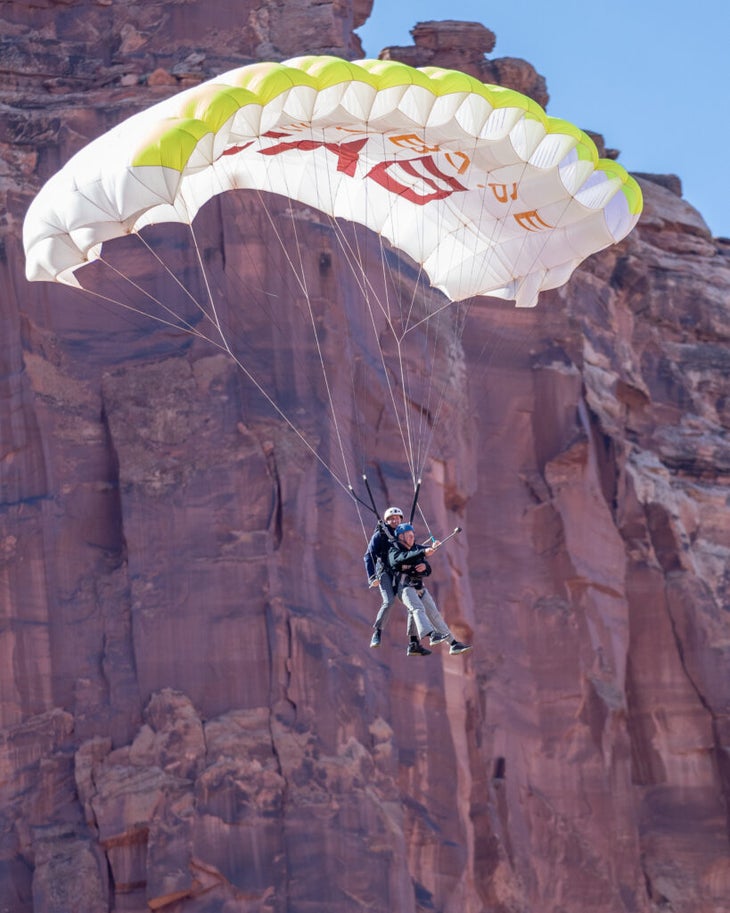
Shade notes that for guides routinely working with clients who have endured trauma or have mental health issues, education around psychological first aid can be profoundly helpful. She serves as a member of the clinician hub of the Responder Alliance, an organization with the University of Colorado Boulder, that offers a course in the subject. This sort of training can be helpful for everyone from search-and-rescue team volunteers to tandem BASE jumping guides.
Before he started focusing on tandem BASE jumping, LaJeunesse also spent 22 years as a skydiving instructor. He estimates he took some 11,000 tandem skydives. Some clients had disabilities, including vision impairment, hearing impairment, prosthetic limbs, and various medical conditions. In his current role, he hosts an annual retreat for veterans and first responders suffering from PTSD or traumatic brain injuries.
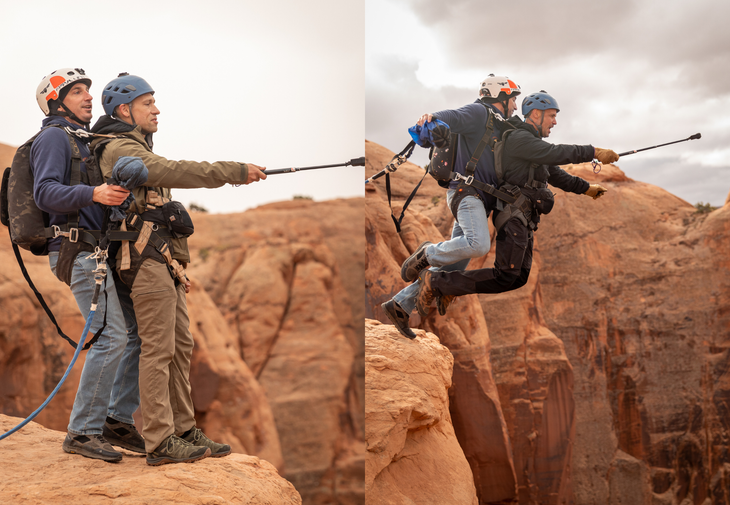
“As I gained experience, it became obvious that these people wanted to pursue their dreams and bucket list items,” he says. “I was one of the people that could offer it to them.” So it became a sort of passion project—his own “why” for his career in tandem jumping.
Another story LaJeunesse will never forget? A 24-year-old woman who listed no medical conditions on her waiver. Then, on the hour-long hike up to the cliff, she turned to LaJeunesse. “I need to tell you something,” she said. Since she was 17 years old, she’d been fighting cancer, spending most of her final high school years at a children’s hospital.
Her doctor had advised against a tandem BASE jump. But soon, she would die of leukemia.
“I had to meet her in the moment,” LaJeunesse recalls. “Someone is facing the hardship of their life, and I’m the person they’re reaching out to to experience something positive. It’s a strange role to play.”
There is a cliche about the moment before death: Your life flashes before your eyes. But if you simulate the feeling of the imminent end, could you still gain a bird’s eye view in a flash of your time on this planet? Will you suddenly see—with startling clarity—what’s really important?
“There is something about waking up at least for a few moments,” Shade reflects. “BASE jumping forces that presence.”
Maya Silver is a contributor to Outside and the editor-in-chief of Climbing. Her travels are usually inspired by mountain bike trails, classic crags, and whatever is happening in the sky. As a Utah resident of nearly a decade, she recently reported on extreme adventures becoming more accessible in Moab, and reflected on some of her past trips in a guide to the best surreal destinations to escape to in 2026.
The post People Facing Trauma and Terminal Illness Are Turning to BASE Jumping for Therapy appeared first on Outside Online.