

I’m not nervous at all until Snejana presses the button, turning on the machine. “This is the part,” she says, “where kids sometimes start to cry.”
With a slight jolt, the ground starts sliding beneath me. I bend my knees, trying to remember everything I learned about downhill skiing back in high school, 20 years ago, which was the last time I gave it a try. Stay loose. Make a pizza. For a split second, I feel myself dragged uphill. Then my feet start gliding, and I burst into a grin. I’m skiing! Really skiing!
Never mind that it’s 60 degrees, indoors, and I’m not gliding on snow but on a white astroturf-like carpet that Snejana Stoyanova, the facility’s owner, has just drenched with water from a pressure sprayer to make it slippery. And that I’m not on a mountain, but in a nondescript brown building in the Chicago suburbs, tucked between an auto repair shop and a Red Lobster. Or that I’m one wobble away (I imagine) from the worst rug burn in the history of the world.
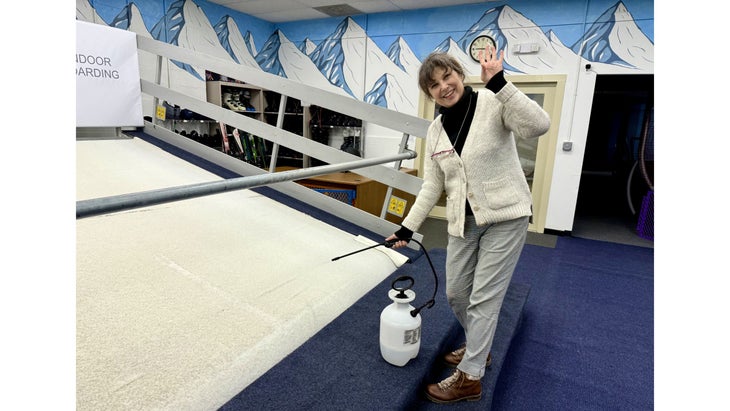
I’ve come to Snowlike Studio, an indoor ski training facility in Schaumburg, Illinois, to try my hand at indoor downhill skiing—a phenomenon that, unlike, say, indoor ice skating, has never really taken off in the United States. For one thing, simulators are wildly expensive; this treadmill costs around $75,000, and Snowlike’s second machine, a carving simulator in the next room, costs $114,000. For another, while ski simulators are relatively popular in Europe—according to SkiMachine, the makers of this treadmill, the Netherlands has over 50 facilities alone—most Americans simply don’t realize they’re an option. When we want to ski, we go outside, or else we simply don’t ski at all.
Snejana, who’s teaching my practice today, is almost astonishingly sweet and earnest. She’s petite, wearing plaid pants and a cardigan, her glasses on a string; she turns 60 next month, and her name, she says, means snowy. She started Snowlike two years ago with her husband, Ventislav Gigor, after they moved here from Bulgaria. He was a ski racer; she was a skier and professional artist; and they used to run an art school for kids. When they got to the United States, they realized there were a lot of art classes available, but not many indoor ski facilities. “We decided to make this because it’s different,” she tells me. “We think it could be useful.” (Snejana didn’t leave her art behind; she’s painted mountain murals on the facility’s walls, and in a little studio next door, she teaches kids’ art classes in Bulgarian.)
The ski treadmill offers some real benefits, especially for kids and beginners. For one thing, Snejana can stand right in front of me the whole time, giving direction and correcting my form; when she tells me to lean into my inner edges, I respond instantly, and soon feel stable enough on my footing to try turning left and right. New skiers can set their own speed; they can learn with a friend; they can stop by for an hour after school. The goal is never to stay on the treadmill long term; skiers build muscle—and muscle memory—that they can use when they finally hit the slopes. But if they’re preparing, say, for their first big ski trip out of state, treadmill practice can help them build confidence before they’re actually on a hill.
You’d think another benefit would be that simulators can run year-round, but when I mention this, Snejana laughs and shakes her head. She has way fewer clients in the warmer months. “In the summer,” she explains, “people want to think about swimming. Beach.”
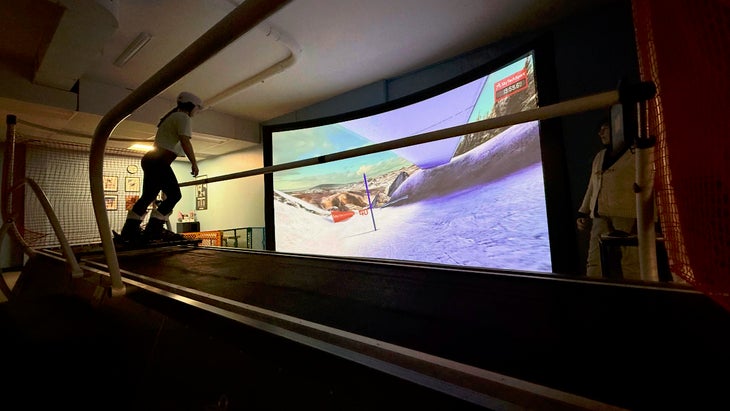
Some of Snowlike’s clients are competitive skiers who want to get an edge. In the next room, there’s a woman on the carving simulator who’s been going for 50 minutes straight, an athletic feat I fail to appreciate until I try it myself. It’s a massive machine, more than 20 feet across, that allows her feet to slide right and left, together, as if she’s carving sharp turns down a hill; a wall-sized screen before her completes the illusion of scenery whooshing past. The woman, Noelle, is a serious skier who travels to resorts several times a winter; she’ll be leaving for Winter Park, Colorado, in a few days. She started coming to Snowlike after she broke her knee on the slopes last winter. Her boyfriend, a snowboarder, bought her lessons to build her confidence once she recovered, and she loved them so much that she’s continuing on.
Noelle makes the carving look easy, and after getting the hang of the treadmill, I’m eager to try something more advanced. The moment I step onto it, though, the machine pulls my legs sideways; when I yank them back under me, they swing out the other way. Snejana turns on the screen, and suddenly I’m rushing down a ski hill, swerving past bluffs and trees and cheering crowds. “Turn!” Snejana commands. “Turn! Turn! Faster! Turn!” The trick, I think, is to forget about the machine; when I stare down the slope before me, imagining the wind, I can carve more easily around the bends.
The carving simulator is a great workout; after 20 minutes, I feel muscles burning that I didn’t know I had. The next day, I can barely walk. But something funny happens, too. As sore as I am, I can’t stop thinking about skiing. I find the closest ski hill, a little rope-tow slope with 100 feet of elevation, and head over there on a Tuesday night. There are a few of us, learning alone; a man from Singapore who never saw snow til this week, and memorized ski tips from TikTok; a woman with a live dog in her backpack, who’s clearly having the time of its life. The air’s cold, and the snow’s too icy, but I can’t remember the last time I had this much pure fun, and I start thinking about longer slopes in the future. The simulator was so convincing that it got me back to the real thing. What more could you possibly want?
The post The Surprising Benefits of Indoor Ski Training appeared first on Outside Online.