








The concept of an e-ski isn’t new. U.S. patents date back to 1950 with the most recent filing in 1972. Fast forward to late last year: while scrolling Instagram, I saw a post declaring “Swiss company unveils first electrically assisted touring ski.” E-Skimo, as it’s called, is being dubbed the e-bike of winter, and the post claimed the new technology, rightly or wrongly, is revolutionizing ski mountaineering by making it more accessible. I immediately thought of my friend Kathrin in Zürich, an avid ski tourer for ten years, and shared it with her adding, “Maybe now I can keep up with you!”
I’ve been alpine skiing since I was 13 months old—I literally learned to walk and ski at Mount Norquay in the Canadian Rockies simultaneously. But hiking uphill on skis? Hard pass for me. Until now.
Still, as I booked my trip to test E-Skimo with founder Nicola Colombo, questions nagged at me: Was this an accessibility breakthrough, or a compromise of a sport built on the principle of earning your turns? If motorized skis could get someone like me into backcountry terrain with minimal effort, the implications felt bigger than a curiosity—safety, environmental impact, and how accessible the backcountry should be.
E-bikes faced similar scrutiny when they first pushed into wilderness areas, accused of undermining the human-powered ethos that defines backcountry experience. Would E-Skimo spark the same backlash?
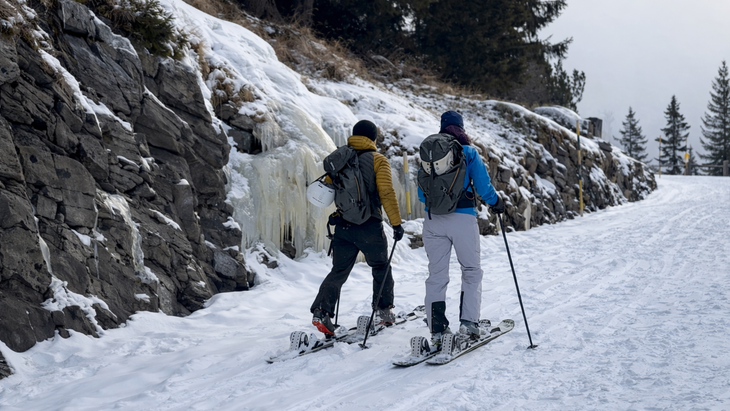 Skiing with an extra boost. Testing the E-Skimo with its founder. (Photo: Courtesy of Kendall Hunter)
Just days after launch, freshly 60 and slightly unsure what I’d gotten myself into, I met Colombo and Kathrin at E-Outdoors headquarters in the alpine village of San Bernardino, in the Swiss Canton of Graubünden. The day before, on January 10, the first batch of e-skis had been delivered to buyers in Switzerland, Austria, Italy, France, and a pair to Utah.
For now, at least, E-Skimo isn’t a grab-and-go rental; it’s a guided experience. This winter, four experience centers in Switzerland and Italy (San Bernardino, Verbier, Saint Moritz, and Sansicario) offer instruction and half-day guided tours. The timing felt significant: competitive ski mountaineering—skimo—debuted at the Olympics at Milano Cortina 2026, less than two hours from where we stood.
Is This the E-Bike Moment for Skiing?
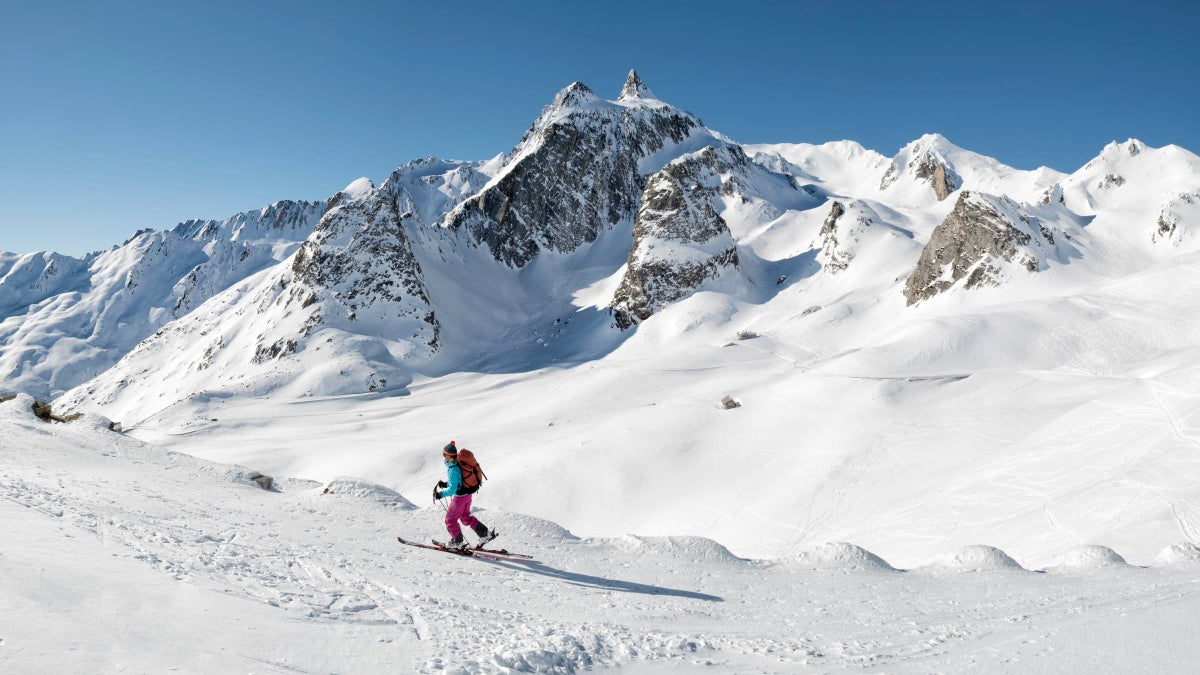
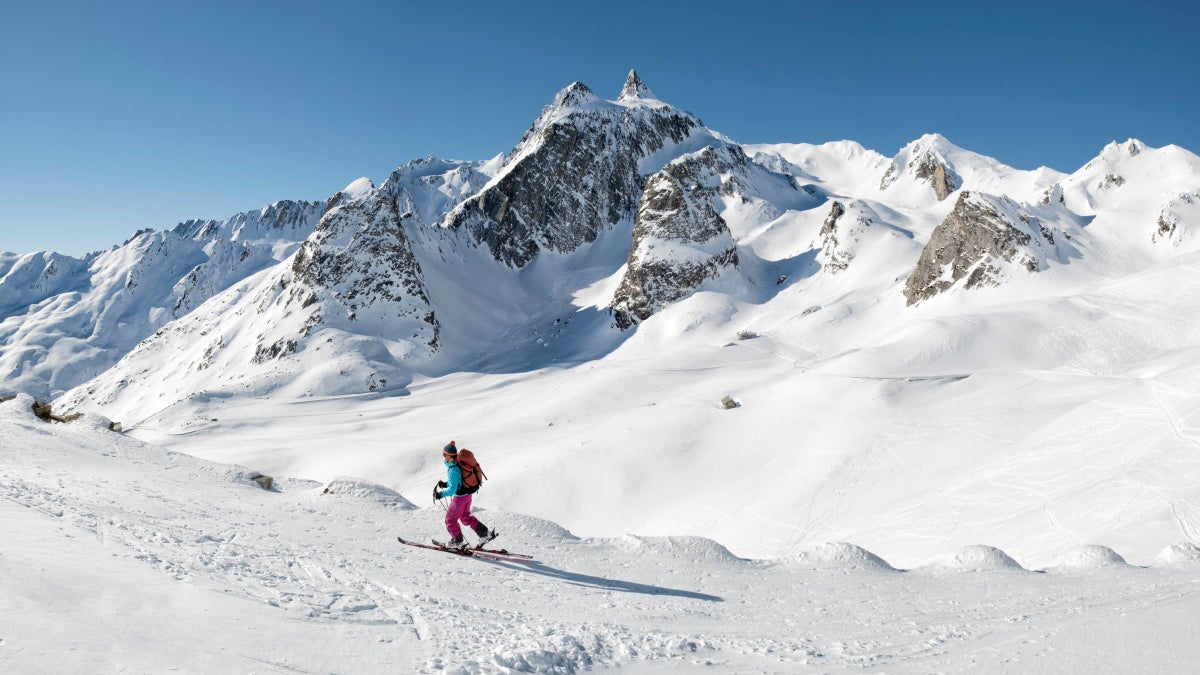
I’d watched videos of athletes competing in traditional skimo, gripping slopes with climbing skins, sometimes running uphill with skis strapped to their backs, pushing themselves to the absolute limit. I couldn’t help but wonder—for anyone inspired by the Olympics this winter, could E-Skimo, with its unique electric assist, offer a more accessible, and hopefully toned down, entry point into the sport?
Colombo held the Guinness World Record for the longest electric motorcycle journey from Shanghai to Milan until American Timothy Marchinda broke it in 2022. While living in China, fueled by a passion for motorcycles, he decided to build an electric one after seeing e-bikes everywhere. He kept the patent from the motorcycle business he created, Italian Volt, and brought the technology along with the company’s CTO Ivan Mura.
But skis presented a new set of obstacles.“The main challenge was designing an electronic system that could work reliably in snow and ice, while people are literally walking on top of it,” Mura explains.
During development of the e-ski, they collaborated with the Tecnica Excellence Center in Austria to integrate the technology into Blizzard Skis. According to Mura, the collaboration was crucial: “We needed to cut openings in the ski to fit the technology, which could have weakened the structure or changed how it performed on the snow. Their expertise helped us avoid those problems.”
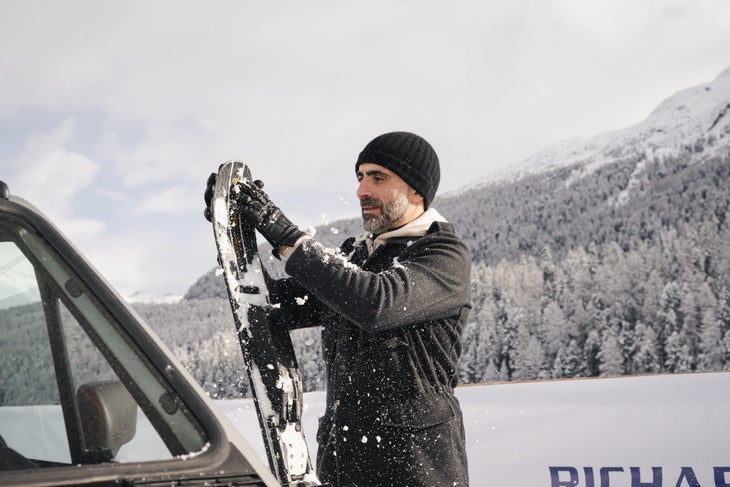
A short drive outside the village, Colombo laid out our skis at the base of the San Bernardino Pass Old Road, a historic route with spectacular alpine scenery connecting two valleys, Hinterrhein and Mesolcina. Fresh powder clung to the higher elevations, but the newly revitalized ski area was waiting for enough snow to open. San Bernardino has received major investment, transforming it into an emerging year-round mountain destination. Fortunately, we were touring; so we could chase the snow wherever it was, and the route ahead didn’t look too intimidating.
E-Skimo technology is sophisticated, though I didn’t fully appreciate this at first. What I noticed immediately was the weight—at 14.5 pounds per ski, noticeably heavier than the roughly 6 pounds of a typical freeride or touring ski they otherwise resembled, thanks to the battery, motor, and belt mounted on each one. The tech driving my first clumsy steps included a six-axis inertial measurement unit (IMU) and GPS sensors monitoring each ski’s position and the weight and angle of my heel.
Learning How to Skimo—With an E-Ski
E-Skimo promises to cut the grind by 30 percent, meaning 30 percent less of a muscle workout—while boosting speed by 80 percent, potentially extending range fourfold. In the moment, I felt the motors kick in as each ski slid forward. My initial inclination was to lift the skis rather than trust the technology to work for me, but once I did, the climb felt surprisingly, and maybe a little too easy as I focused on the sensation under my feet rather than the route ahead.
Remote control buttons built into the poles let me choose between modes—eco, climb, and boost. There’s a learning curve, no doubt. I relied on Colombo to choose the modes and reactivate the system when we stopped along the way, while I focused on the new sensation of skiing uphill with bursts of energy beneath my feet. An app can also control modes and track real-time data—recording trips via GPS, monitoring performance metrics, and adjusting power output to help maintain a target heart rate.
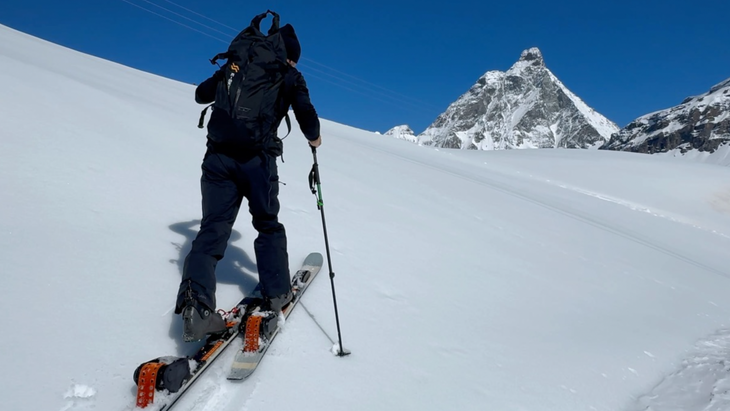
Initially, I found the motor’s hum somewhat distracting. Colombo says they’re working on a quieter version for the next iteration. Still, the steady climb gave us time to assess how the skis actually performed.
As we hit our first winding turn, my friend Kathrin wasn’t entirely won over. The skis were harder to maneuver, and she couldn’t picture them handling the steep alpine terrain she was used to. She tours the high Alps five to eight times a year—technical routes where agility matters. But as we settled into the rhythm, something clicked. By the time we reached open terrain, she was genuinely impressed. E-Skimo shines primarily where traditional ski touring would feel like overkill—gentle slopes, forest trails, rolling terrain.
These skis won’t replace my friend’s lightweight setup, but she saw the bigger picture. “For now, I’ll still do traditional ski tours in the high mountains, but I can see E-Skimo as a way to keep enjoying the quiet winter landscape when I want something less demanding.” It’s worth noting: Kathrin is part of Switzerland’s startup ecosystem. This European country consistently ranks as one of the most innovative and leads in deep tech. Her verdict on the system? “It’s genius.”
If You’re New to Ski Touring, E-Skimo Makes Terrain Accessible
Before we knew it, we’d gone almost three miles and ascended 1,300 feet of elevation, emerging from the forest into open alpine terrain with dramatic views of the Lepontine Alps peaks. Piz Uccello’s distinctive pyramid-shaped peak rose into view as we hit our turnaround point and watched Colombo prepare our skis for the descent.
The batteries, motor, and belt, are all removable. The opening where everything attached is filled with a 3D-printed plug. So once everything was packed in my backpack and I’d clicked toe and heel into my bindings, it felt like I had my own downhill skis on. All I had to do was get used to the weight on my back and enjoy a gentle cruise down.
For me, new to ski touring, the appeal was immediate but somewhere along the way, doubt crept in. E-Skimo removed the uphill grind, but what exactly was I gaining access to?
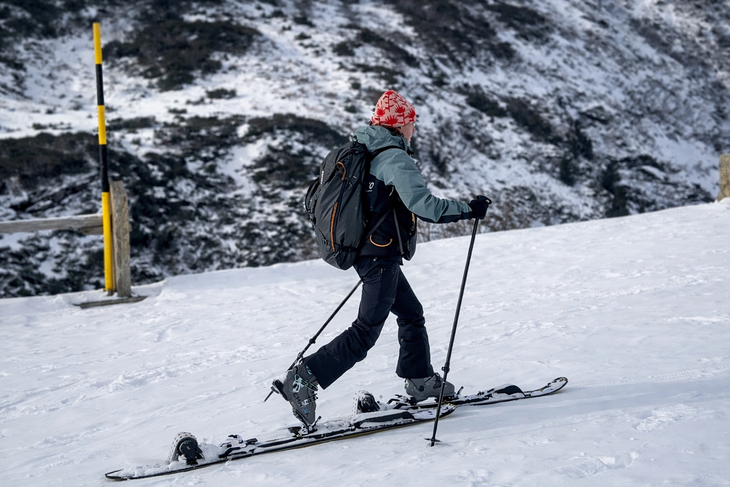
What became apparent is that this technology suits gentle slopes and forest trails, not the steep alpine terrain where real adventure lives. When my descent didn’t deliver pristine powder or the thrill of dropping into truly remote terrain, I felt genuine disappointment. But there’s the rub: with E-Skimo, expectations had to be managed. I was a dilettante to the sport, wanting a taste of touring without serious safety risks or physical demands. I wanted to feel like a mountaineer for a few hours, and, in a sense, I did. But it’s not ski touring as the sport defines itself. Whether that’s innovation or dilution depends on what you’re looking for. It’s ideal for visitors wanting a taste of alpine touring without the same safety risks or technical and physical demands.
For those wanting an even gentler entry point, Experience Centers now offer skis with universal bindings (similar to those on snowboards) for use with personal footwear on flatter terrain, so no downhill skills are required. While the E-Skimo system can be purchased for roughly $5,700, Colombo explains their current focus is B2B expansion—integrating their technology into existing ski brands, much like Bosch and Shimano do in the e-bike sector.
The comparison is telling: those companies didn’t succeed overnight, but they transformed the industry. They also faced fierce resistance. When e-bikes first expanded into backcountry areas, critics warned motorized assistance would bring underprepared users into fragile environments. E-Skimo’s guided tour model on gentle terrain seems to sidestep such concerns, for now. But if the technology takes off and moves beyond experience centers, will users remain within safe boundaries?
As for me, E-Skimo answered the question those skimo videos raised: What if backcountry skiing didn’t require serious fitness?? At 60, discovering there’s still new terrain to explore—literally and figuratively—feels significant, but is that the “right kind of revolution” for the sport itself? That remains to be seen.
Where to Try E-Skimo
Currently, exclusive E-Skimo half-day guided tours can be booked through the E-Skimo website. Or enquire directly with Mountain Air in Verbier, Ski Service Corvatsch in Saint Moritz, FullSki School in San Bernardino,and Couloir in Sansicario in Italy. The cost per person for a half-day tour starts from €235 per person up to €500 ($278 up to $591) depending on location and group size. At this time, only guided tours are offered.
In San Bernardino, stay at the newly renovated Brocco and Posta, part of the village’s ongoing revitalization.
The post I Tested the World’s First E-Skimo. Could This Be the E-Bike Moment for Skiing? appeared first on Outside Online.