







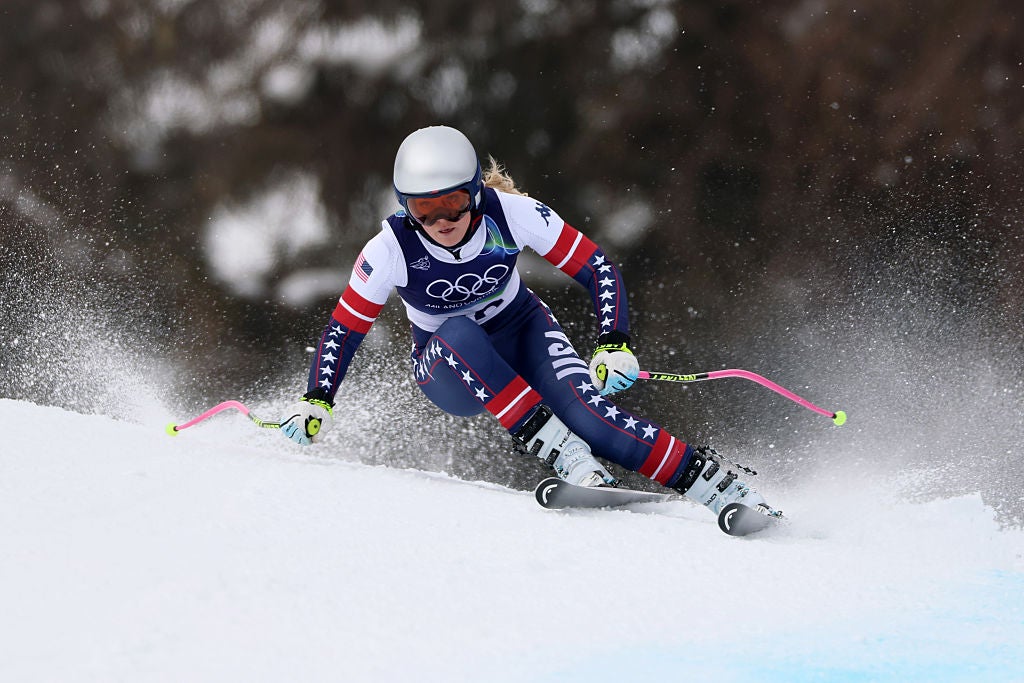
I had a plan: sit my daughters down on the couch, pour myself something warm, and give them a lesson in triumph. I’d point at the screen—at Lindsey Vonn, 41, titanium knee, freshly torn ACL, somehow still upright in the starting gate at Cortina—and say: See? This is what it looks like when someone refuses to quit.
Parents do this. We curate the world for our kids. And here, children, you will observe a lesson about perseverance! I am guilty of this constantly. Lindsey Vonn is exactly the kind of story you want to hand someone you love, whole and shining.
But the mountain, as it often does, had different ideas.
Thirteen seconds. That’s how long the story I had planned lasted.
Thirteen seconds into her run, Lindsey hooked a gate. Five inches off her line—not feet, not yards, five inches, the width of your hand —and everything changed. The bow came undone.
And what I ended up teaching them that night was messier than anything the podium could have offered. But a lot more powerful.
We put Lindsey on the cover of Outside in our Winter 2025 issue and called it her wildest comeback, though as I wrote in my editor’s letter, that word was a bit of a misnomer. A comeback implies you’ve been somewhere else. But Lindsey Vonn never wandered. She was always exactly here, in this sport, at this altitude. “I have nothing to prove,” she told us. “This isn’t about records.” She wasn’t returning to something she’d lost. She was continuing something she loved, through whatever the body offered and whatever the mountain took.
In the nine days before Cortina, the mountain took quite a lot.
She’d torn her ACL in a World Cup crash in Switzerland—not metaphorically, not almost, but actually, completely. She held a press conference with her chin up and said, “I’m not letting this slip through my fingers. I’m gonna do it. End of story.” Then she stood in the starting gate on a torn ligament, clear-eyed about every inch of the risk, because she still believed. Because she loved it.
When she fell in Cortina, the world saw a tragedy. But if you read her words afterward, you see something else entirely.
“Yesterday my Olympic dream did not finish the way I dreamt it would,” she wrote from her hospital bed, where surgeons were preparing to address a complex tibia fracture. “It wasn’t a storybook ending or a fairy tale. It was just life.”
It was just life.
I read that line three times. No self-pity in those four words, no performance of stoicism either—just the clean arithmetic of a life lived at full speed. She knew the gate was close. She knew the danger was real. “Racing was a risk,” she wrote. “It always was and always will be an incredibly dangerous sport.” And then, the line I keep coming back to: “Knowing I stood there having a chance to win was a victory in and of itself.”
We spend so much of our lives trying to turn “just life” into a curated masterpiece, avoiding the risks where the ending isn’t guaranteed, hedging against the fall. But Lindsey reminded us that the victory isn’t the medal. It’s the audacity to be in the gate in the first place.
We don’t use the word valor enough. We’ve cheapened it—pasted it over so many highlight reels and halftime speeches that it’s gone faded and thin. But in its oldest sense, valor means the willingness to attempt something worthy, knowing the cost might be everything, doing it anyway out of love for the thing itself. It’s not about what you win. It’s about who you are on the way to finding out.
By that measure, Vonn’s thirteen seconds at Cortina were the most valorous of her career. More than Vancouver gold. More than any of her 80-plus World Cup victories. Because this time there was nothing to hide behind. No youth, no statistical likelihood. Just love, and will, and the possibility of five inches of bad luck. And she stood in that gate anyway.
At Outside, we’ve spent decades documenting people who push themselves to the edge of human capability. Usually, we celebrate the summit. But the deeper truth—the one Lindsey just gave us in its purest form— is that the most courageous thing a human being can do is dare greatly when they already know they might fail. Her crash wasn’t a failure of her age or her reconstructed knee. It was the margin of error that comes with living at full throttle.
Her post-crash reflection was a masterclass in integrity: “We dream. We love. We jump. And sometimes we fall. Sometimes our hearts are broken. Sometimes we don’t achieve the dreams we know we could have. But that is also the beauty of life; we can try,” she wrote in her post.
So here is what I told my daughters—the revised lesson, the one the mountain gave us instead of the one I planned:
You don’t have to win to be worth watching. You just have to be the kind of person who, when the world says you’re too old or too young or too broken or too long a shot to bother, has the heart to say: I’m doing this because I love it.
Victory is a fleeting thing. The medal rusts. The record gets broken.
But valor, the kind that lets you lie in a hospital bed with a shattered leg and write, without self-pity, declare you have no regrets—is permanent.
“I hope if you take away anything from my journey,” Vonn wrote, “it’s that you all have the courage to dare greatly. Life is too short not to take chances on yourself. Because the only failure in life is not trying.”
She tried. She dreamt. She jumped.
And even in the fall, she showed us exactly how to live.
The post What Lindsey Vonn’s Crash Taught Us appeared first on Outside Online.