








As a young 20-something living in San Francisco, I had the good fortune of having friends who worked for snowboard binding company Switch. They got me gear—a used Rossignol board, and Switch boots and bindings—and we’d all head up to the Lake Tahoe ski resorts on weekends, where they taught me how to snowboard.
Back then, switch bindings were the original “step-in” (now called “Step On” and “Clicker”) system. They utilized a flat metal plate with two attachment bars on the sides of the binding, and worked only with Switch boots that had bars on the sides to lock them into the bindings. There was no hard plastic high back on the binding; that was sandwiched between foam layers in the Switch boots (referred to as an “Internal High Back”). The bindings had no straps whatsoever. Riders relied on the boot’s construction—and the connection between boot, binding, and board—for control.
The beauty of the Switch system was that, if you were coordinated and practiced, you could slide off a chair lift and click into the bindings without slowing down, and be quickly on your way to powder stashes and tree runs. There was no threading of ratchet straps into buckles as with traditional bindings.
Since I’d never ridden any other types of bindings or boots, I had no idea how Switch step-ins compared to two-strap bindings in terms of control. I only knew that the people sitting in the snow ratcheting bindings were suckers without friends who worked at Switch.
Around 2015, after a ten-ish year break from the slopes—a couple moves, a lot of adventure racing, two babies—I got back into snowboarding. My old Switch boots no longer fit, and I couldn’t find a new pair anywhere on the internet to work with my beloved Switch bindings. Switch had long since been bought by Vans, and Vans phased them out.
The first generation of step-in bindings from other brands, like Shimano, K2, and Burton, had also phased out, and everyone was riding two-strap bindings. My main goal at the time was teaching my then-six-year-old how to snowboard, and I ended up investing in traditional two-strap bindings and a pair of standard boots. They were fine. The boots (Ride Cadence) were more comfortable than my old, stiff Switch boots (although still on the stiff end of the spectrum, which I like for performance). But I always missed being able to step in quickly like I used to on my Switch set-up.
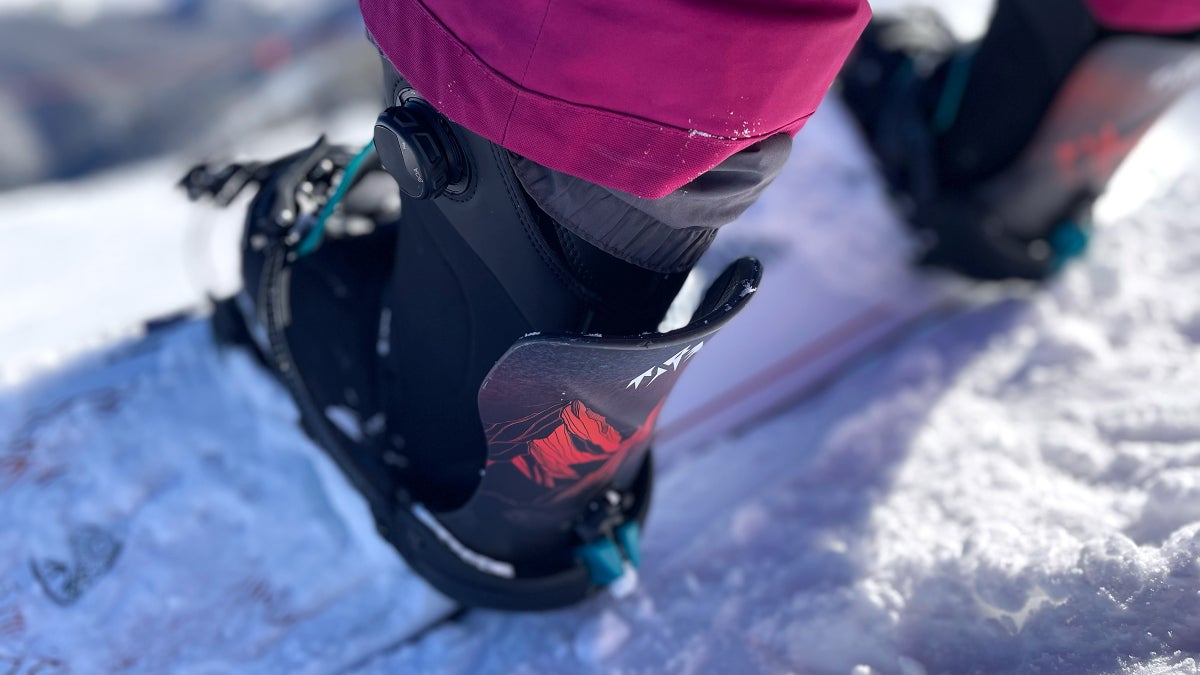
Recently, however, there have been a lot of new developments in snowboard binding technology for quick entry/exit systems. One in particular piqued my interest: the FASE (Fast Entry) system bindings, which are available on Nidecker group bindings—Jones, Rome, Bataleon, and ThirtyTwo (Nidecker-branded bindings use the similar—but different, with no ratcheting—Supermatic technology). The FASE snowboard binding system utilizes two straps like a traditional binding and boots, but allows quicker stepping in and stepping out. The ankle strap has a built-in mechanism that keeps the strap connected so there’s no threading required upon stepping in. The toe strap comes undone, but riders can keep it connected, fully adjusted, and ready to go. With the FASE bindings, you simply step your boot into the toe strap and ratchet down the ankle strap—which can be done with one hand.
Excited by the prospect of cruising off a chair lift and into a binding quickly—without having to buy expensive new snowboard boots—I got myself set up with the Jones Mercury FASE snowboard binding system earlier this winter. Here’s how it went down.
The post FASE Snowboard Bindings Are (Almost) as Great as My 30-Year-Old Step-Ins appeared first on Outside Online.