






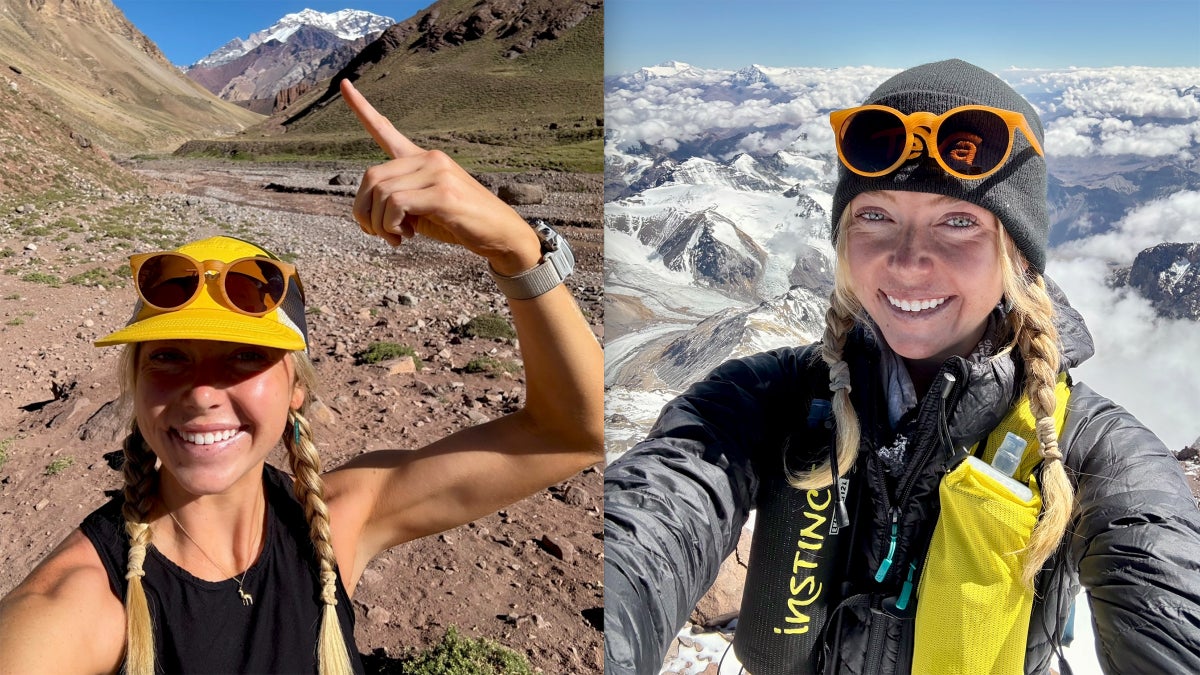
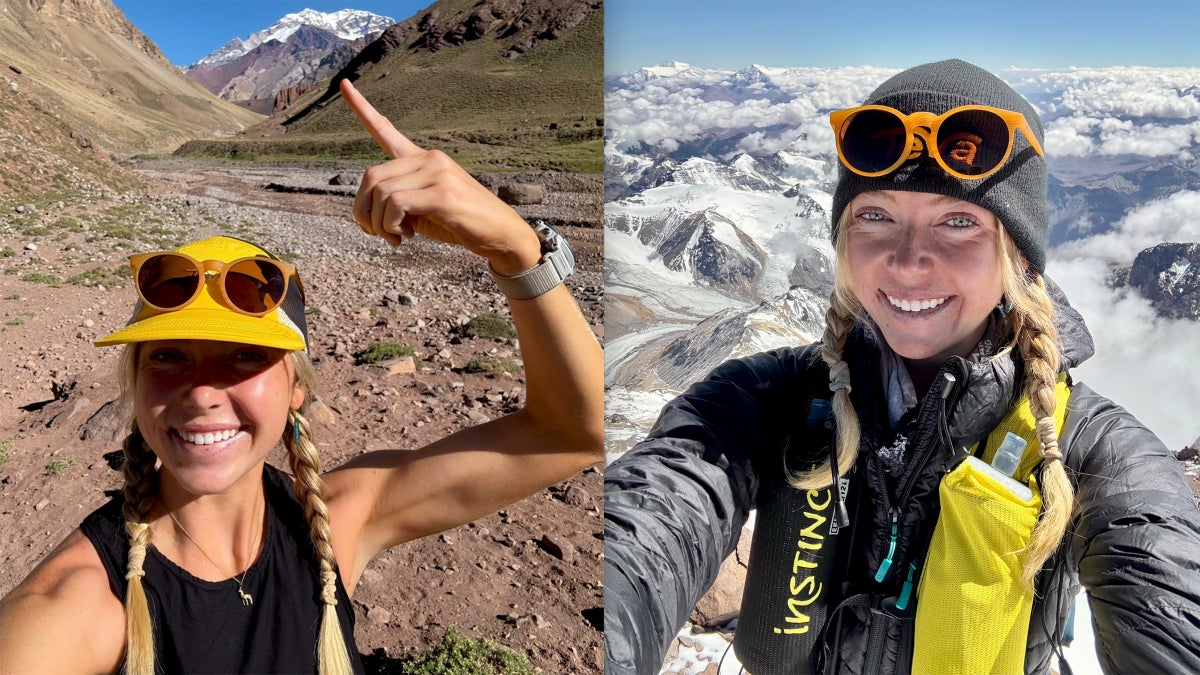
On January 28, trail runner Erin Ton set a new speed record on 22,837-foot Aconcagua, the tallest peak in the Americas. Ton, 29, completed the 9.5-mile round trip from the peak’s Base Camp at Plaza de Mulas to the summit and back in 6 hours, 33 minutes, shaving 1:44 off of the previous record, set by Slovakian climber Lenka Polackova in 2025. Ton told Outside what it was like to speed up and down the peak.
The toughest part of the adventure was actually on the descent. When conditions are dry on Aconcagua, you can bomb down the scree field that’s just below the summit traverse, which sits at about 20,000 feet. There was a ton of snow when I came to this section, and I was post-holing the entire way. The snow was hardpack on the surface, but my feet would punch through and hit this sugary layer underneath.
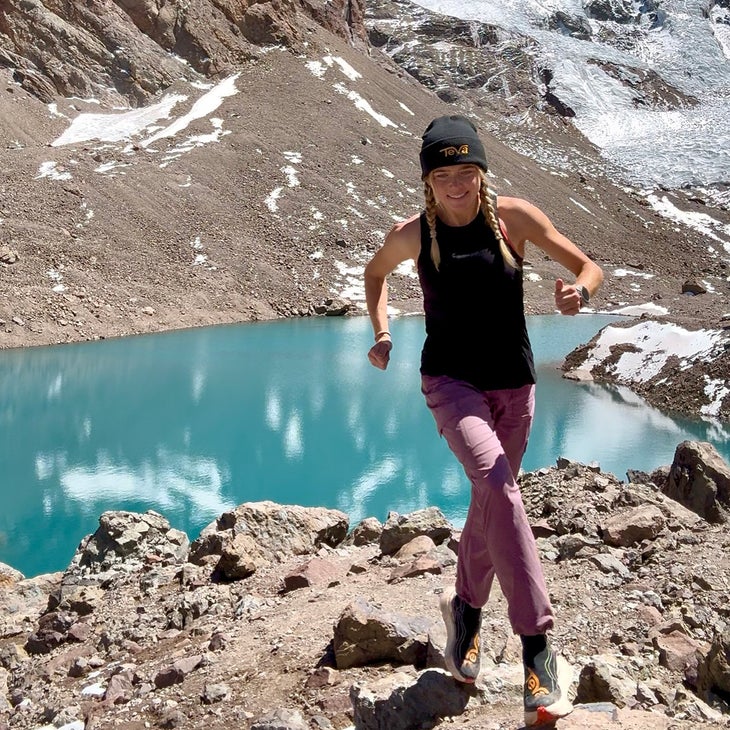
By that point it was the late afternoon, and the sun was hitting the snow and radiating off. I was still ahead of the FKT, but I started to get extremely hot and uncomfortable. I just told myself this is what you signed up for. This is what you’re here to do. I’d been in situations like it on Pico de Orizaba in Mexico and some peaks in the Himalayas. So I knew in the back of my mind I could keep going fast on this snow texture and not twist an ankle.
The Logical Next Step for an FKT Chaser
The idea to chase the FKT on Aconcagua originated in 2024 after I climbed Ojos del Salado in Chile, which at 22,615 is the second-tallest mountain in South America. Nobody knows Ojos, but everybody knows Aconcagua because it is one of the Seven Summits. I got the record on Ojos, so Aconcagua seemed like the logical next step.
I reached out to Tyler Andrews, who has the men’s record on Aconcagua, and he put me in touch with the guiding company Grajales Expeditions, which arranged my logistics. That was great advice.
I saw Tyler in Quito, Ecuador, before traveling to Argentina, and he gave me another piece of advice. I told him that my original plan was to climb the mountain three times: once to familiarize myself with the route, then another time to get the FKT on the so-called “short” route from base camp, and then a third time to get the long route, which starts at the entrance of the park.
Tyler told me I should skip the first climb. “You know exactly where the route goes on Aconcagua,” he told me. He said that doing a reconnaissance climb would only tire me out. Your permit for the mountain lasts 14 days, and I would risk losing my weather window if I had to recover. That ended up being really good advice.
Running Uphill at Extreme Altitude
The biggest challenge for speed records on Aconcagua is the wind. You can get 80-mile-per-hour gusts on the summit on bad days. I lucked out. I work with a meteorologist named Chris Tomer, and he told me when to climb. He was spot on. I had a bluebird day and there was only a light breeze at the top.
For most of the ascent I’d characterize my pace as speedy power hike versus actual running. I started at 6:30 A.M. and made really fast progress to Camp II at 18,000 feet. I was doing a running trot up to that point. Once I hit 20,000 feet the altitude became very real. I wasn’t running anymore. My focus was on hiking efficiently and not stopping or pausing for breaks. That’s where people lose a lot of time.
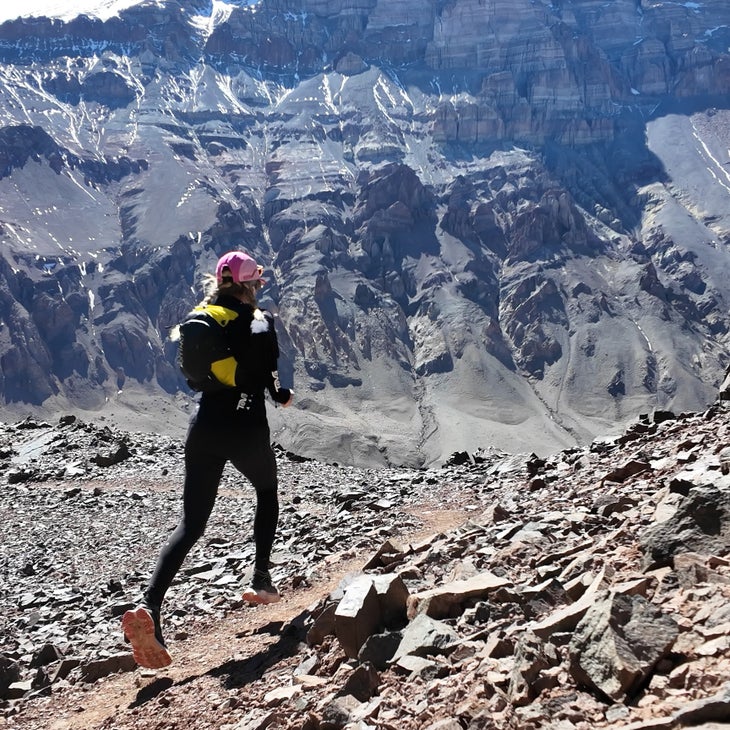
I started off listening to music. For an FKT I listen to a lot of eighties hair metal that my dad brainwashed me on, bands like AC/DC, Scorpions, Guns N’ Roses. But my AirPods died about halfway up. I had charged them the day before but I think the cold air killed them.
It was OK because I was focused. I compartmentalize climbs like that into pieces. I had vague splits in my mind of the time I wanted to hit at Camp II , and then to the traverse, and then to the summit. I just thought about getting to the next checkpoint.
It was such a beautiful day and I encountered a lot of other climbers on the trail, especially at the snowy traverse. Most were extremely friendly and they let me skirt around them. It was hard to communicate at that elevation, but when I was back in Base Camp. I got a lot of very friendly messages from climbers telling me that my effort was inspiring.
Once I got back to camp, some folks from Grajales Expeditions were at the finish point cheering for me. I had a nice lunch, and for dinner I had a couple of glasses of Malbec from the region. It was great. I passed out after that.
After One Record, Could Everest Be Next?
I spent two days recovering and then wanted to go for the FKT on the long route up Aconcagua, which is about 40 miles round trip. I got up past Camp II and there was so much new snow that it made things really challenging. I was post-holing, my toes were freezing, and at some point the winds kicked up to 50-mile-per-hour gusts. I turned around. I’m always my harshest critic, and there was part of me that was really bummed. I know it was the right decision. But I am happy to get the record on the short route, and I know I can go much faster on it. I spent about ten minutes at the summit snapping photos.
Prior to Aconcagua I didn’t think the Seven Summits were feasible for me, mostly because of funding. Mount Everest and Mount Vinson are extremely expensive mountains to climb. Aconcagua was a way for me to dip my toes into chasing a speed record on the Seven Summits, and a proof-of-concept to myself and others that I’m capable.
Now that I’ve done it I would like to pursue the women’s speed record on Kilimanjaro. I already have a handful of records in the Himalayas: Island Peak, Mera Peak, Lobuche. So for the future, it really comes down to the mountains and projects that inspire me. I’d love to climb an 8,000-meter peak without oxygen. But I’ll take these challenges on one step at a time.
As told to Frederick Dreier. This interview was edited for space and content.
The post I Just Broke the Speed Record on 22,837-Foot Aconcagua. Here’s What It Was Like. appeared first on Outside Online.