








This story was co-published with The Trace, a nonprofit newsroom covering gun violence in America.
On December 31, in the waning hours of 2025, the Washington Post reported on an internal ICE document that concerned the agency’s “wartime recruitment” strategy, or rather its attempt to expeditiously swell its ranks of deportation officers. The memo, according to the Post, had in mind a pool of ideal candidates who lead a “patriotic” lifestyle and have an interest in “military and veterans affairs,” “physical training,” “gun rights organizations,” and “tactical gear brands.”
The memo’s logic was easy enough to understand, since what it described, if you read between the lines, was an informal paramilitary that was waiting to be tapped. Over the last month—as a violent federal occupation has unfolded in Minneapolis, where veteran immigration agents brutally killed two American citizens, Renee Good and Alex Pretti—both the memo and the new recruits it would draw into the fold began to take up outsized space in my mind. For a long time now, the gun rights movement has been animated by the promise of a violent reckoning, a sentiment nurtured by the groups that represent it and Republican politicians, who seek to channel a wild, truculent energy into votes and profits. It seemed the promise was being fulfilled in Minneapolis, like the fatal denouement of a production that had one harbinger after another.
“Any mission, any condition, any foes, at any range.”
During the 2016 election cycle, when as a reporter I attended my first National Rifle Association annual meeting, I began to see that the promised reckoning could not be delayed forever. At the convention, in Louisville, Kentucky, there was the tradeshow floor, akin to a medieval arms bazaar and containing some 520,000 square feet of guns and tactical accessories. There were seminars covering “Defensive Shooting Skills Development,” “Methods of Concealed Carry,” “Current and Emerging Threats,” and “The Bulletproof Mind For The Armed Civilian.” And there was a line of some 7,000 people, leading into an arena called “Freedom Hall,” where there would be speeches by the emerging Republican presidential candidate, Donald Trump, and Mark “Oz” Geist, a member of the Benghazi diplomatic compound’s security team that had come under siege in 2012.
Three middle-aged white men stood in line in front of me making confident assertions about Barack Obama and “government cover-ups.” One informed the others that Obama, still president, had purchased a “$10 million mansion in Saudi Arabia,” where he and his family would flee after leaving the White House to “evade charges.” Trump would of course chase him down, the man assured everyone, while the United States reembraced frontier justice and flourished under his rule.
The line then moved inside, 7,000 people took their seats, and the Republican presidential candidate promised them: “I will never let you down.” Based on the ecstatic response from the crowd, it seemed to me that the message Trump had transmitted was about power—raw power—and who would wield it during his administration.
Going back to at least the early nineties, when President Bill Clinton, a Democrat, was in office, gun rights organizations, led by the NRA, and various prominent Republicans pushed an argument for the Second Amendment that was disguised as a historical one. The right to bear arms, they said, was intended to be unfettered because its purpose was to provide citizens with the means to fight a tyrannical government that had turned against its own people. Federal agents, under Clinton, were “jack-booted government thugs,” according to a notorious fundraising letter signed by former NRA CEO Wayne LaPierre. These thugs, he said, had the power to “take away our Constitutional rights, break in our doors, seize our guns, destroy our property, and even injure or kill us.”
It was often implied that such arguments, which grew in prominence during Barack Obama’s tenure, applied only to the Democratic Party, which posed a vague yet persistent threat to “freedom,” while the Republican party would preserve it. Republican values were antithetical to tyranny, whereas Democrats were inherently tyrannical, and therefore any actions taken by the former were in service of saving the country from the latter.
In 2016, while sitting in “Freedom Hall,” I began to feel a sense of alarm that I’d never before felt. Under Trump, this contingent would feel it had permission to act against the enemy. The carrot that was dangled during each election cycle—in fundraising pitches by gun rights groups and the sale of military-style firearms to civilians—was finally being fed to the horse. There would be no more “couch commandos,” as gun industry executives referred to their most enthusiastic customers in the years after 9/11. This was the period in which soldiers were in American streets, and the industry, en masse, had seized on a marketing opportunity to blur the line between soldier and civilian.
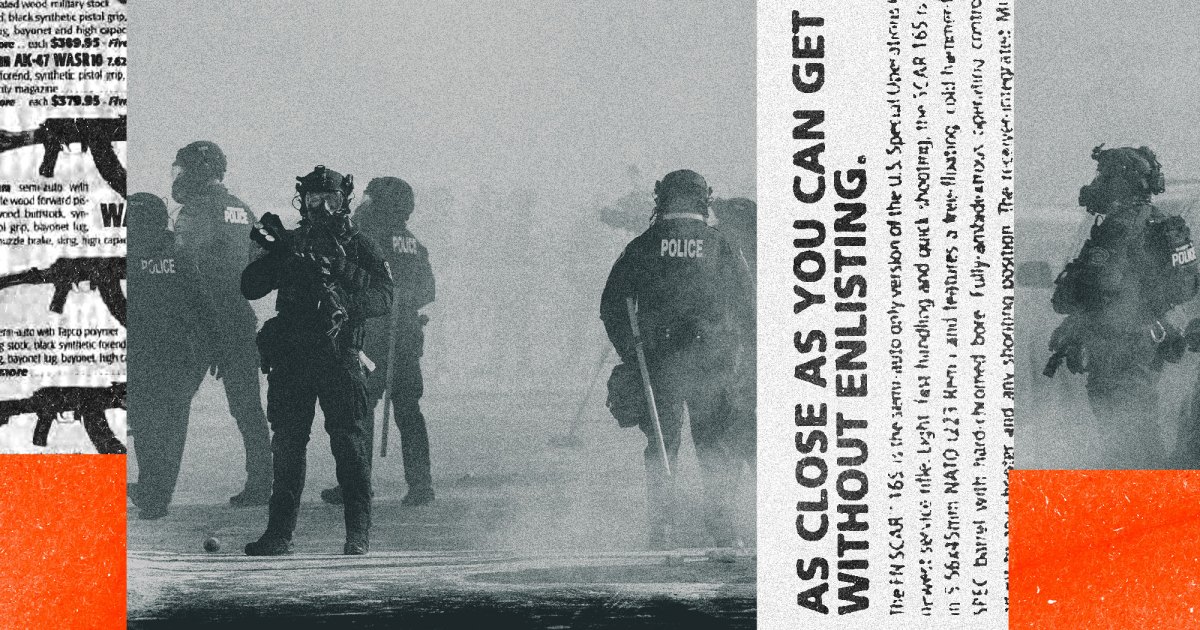
What the industry was selling was theatrical participation, the thrill of COSPLAY, except the props were real. “As close as you can get without enlisting,” one gun company, in 2010, boasted as it advertised its “semi-auto only version of the U.S. Special Operations Command’s newest rifle.” “Any mission, any condition, any foes, at any range,” said another manufacturer about its latest assault weapon. In the ad it was equipped with a scope and propped on a tripod, as if intended for a sniper, which of course was the point. Companies were selling military-style weapons with a “combat-proven design,” that provided “versatility on the range or during patrol,” and were a symbol of “bravery on duty.” To enhance the feeling of a simulated combat experience, manufacturers of AR-style firearms cut product placement deals with video game designers. An executive at the gun company Sig Sauer told authors Cameron McWhirter and Zusha Elinson, who co-wrote the book American Gun, that featuring the weapons in games was tantamount to “seed planting.”
Buying a gun had become a way to serve at home, and serving at home came to mean preparing for Democratic tyranny. In 2015, for instance, while Obama was still president, the Pentagon prepared for a training exercise across the American Southwest called Jade Helm 15. It was here that the performative, paranoid politics of the right during the Obama years reached something of a fever pitch. Conservative bloggers and commentators created widespread hysteria by alleging that the exercise was a veil for imposing martial law, confiscating firearms, arresting dissidents, and taking over Texas. The state’s Republican governor, Greg Abbott, called on the Texas State Guard to monitor developments. It was “important,” he said, that Texans know their “rights” and “liberties” would not be “infringed.” The last word did not seem like an accidental allusion to the Second Amendment.
For conservative elites, the preservation of power requires giving those beneath them a taste of it, without actually surrendering anything substantial, such as higher tax payments. In the meantime, they have created a shadow army, empowering them not with wealth but with the alluring prospect of crushing their opponents. A few months after the 2016 NRA convention, Trump said at a rally that Hillary Clinton “wants to abolish” the Second Amendment. “If she gets to pick her judges, nothing you can do, folks,” he went on. “Although the Second Amendment people, maybe there is.” Trump for much of his career had been the paragon of vapid wealth, but unlike other leaders of the right who came before him, he was signaling that he would take the army off standby, out of the realm of theater, and move the violent plot forward.
The 2020 anti-lockdown Covid protests were a stark indicator of the new paradigm under Trump, who directed blame for restrictions toward Democrats such as Michigan’s governor, Gretchen Whitmer. After state lawmakers voted to extend her state of emergency, a large group of men carrying assault rifles packed the Michigan Capitol rotunda and attempted to barge into the legislature, where a line of police guarded the doors. They screamed in the faces of the officers, who looked on impassively.
The lurid fantasy at the heart of the gun rights movement is playing out, but the leading roles, as they were previously imagined, have been reversed.
As the year wore on, Trump told the Proud Boys during a televised presidential debate to “stand back and stand by.” His loss to Joe Biden then set into motion the January 6 insurrection. Oath Keepers stashed an arsenal of weapons at a hotel in Arlington, Virginia. One member imagined a scenario in which “millions die resisting the death of the 1st and 2nd amendment.” A week later, a middle-aged white man named Ian Rogers, a California resident and proud NRA member, was arrested with his best friend for planning to attack the state’s Democratic headquarters. He owned roughly 50 firearms, including four illegal automatic weapons, and had stockpiled 15,000 rounds of ammunition. Writing to me from prison last year, he said that the Democratic Party was “the greatest threat facing the United States today.” He went on, “Just as Rome was brought down by enemies within, we have such traitors amongst us now,” adding, “These people fundamentally hate the country and they will do anything to impose their vision on the nation.”
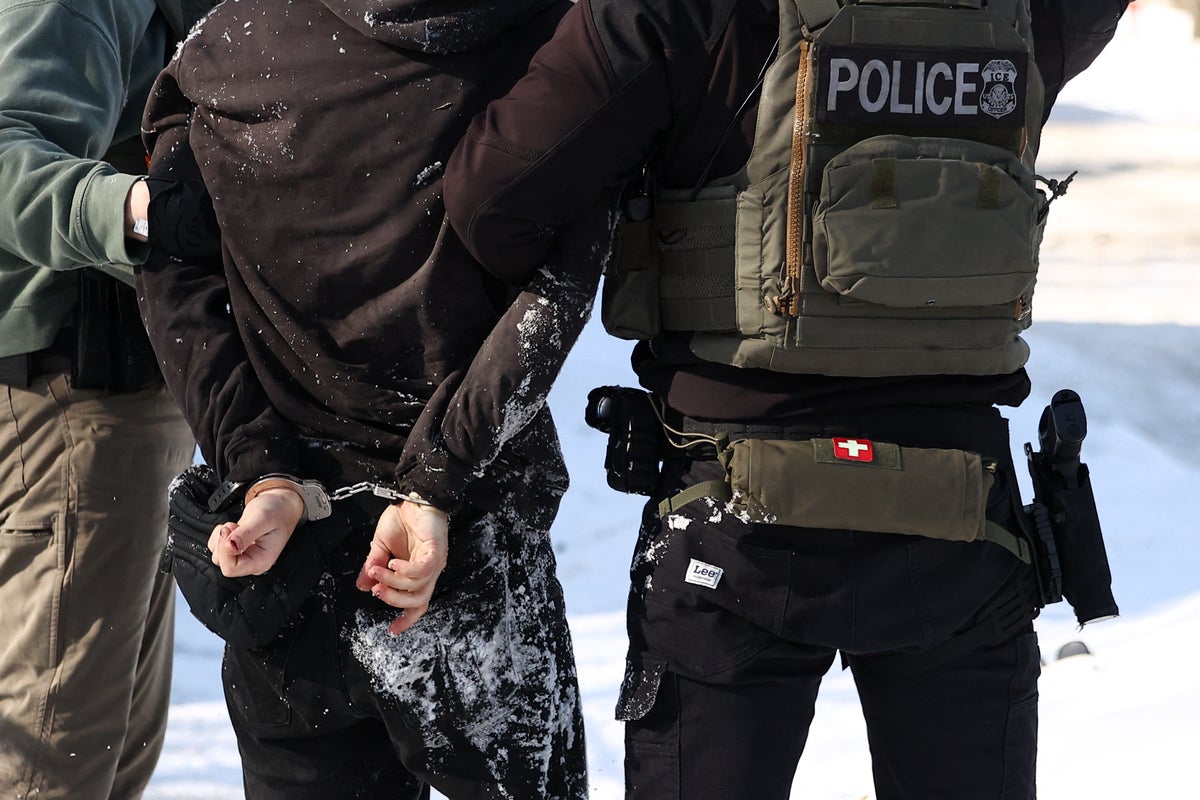
Now, in Minneapolis, masked federal agents, dressed as soldiers, have fatally shot two American citizens. Both were victims of an occupation, in which the Trump administration has unleashed a savage campaign of terror against civilians. The lurid fantasy at the heart of the gun rights movement is playing out, but the leading roles, as they were previously imagined, have been reversed. The party in power is not a Democratic regime, but a Republican one, prompting accusations of hypocrisy against gun rights organizations, who have had little to say and have not called on their followers to face down tyranny in Minneapolis.
Following the merciless second killing, of Alex Pretti, a 37-year-old nurse, federal officials, led by Stephen Miller and Department of Homeland Security Secretary Kristi Noem, concocted a false narrative alleging that Pretti had murderous intentions. Pretti had a sidearm on his waist, and they shamelessly pointed to it as evidence, even though the gun was holstered, he was legally carrying it, and agents shot him after they had removed the weapon.
Officials also tried to argue that, owing to the firearm’s presence, Pretti’s death was justified. This assertion presented an existential quandary for gun rights organizations, which have spent decades working to dismantle carry restrictions. One by one, the groups issued statements about how a holstered handgun did not give law enforcement the right to kill a person. That was the wrong message, the groups said, but the tyranny of the occupation itself was treated as legitimate. Gun Owners of America stated that “the Left must stop antagonizing @ICEgov and @CBP agents who are taking criminals off the streets and play a crucial role in protecting communities and upholding the rule of law.” The NRA similarly declared, “For months, radical progressive politicians like Tim Walz have incited violence against law enforcement officers who are simply trying to do their jobs.”
What is happening now, in other words, is a reminder that the argument about government tyranny was always a canard. Beneath it lurked what was really at stake, which was the right to assert control through force. Over and over, conservatives and Second Amendment stalwarts have claimed that right as their own, with Minneapolis being the latest example. The story they have told for decades is a binary one—good versus evil. In that framing, they are righteous and have but one job: Vanquish the enemy. Hold power. Save America.
The same day Pretti was shot, video surfaced of federal agents pointing their weapons at civilians. “It’s like ‘Call of Duty,’” someone could be heard saying, referencing the blockbuster military-style video game series. Since then, Trump has suggested he will deescalate in Minneapolis. But whatever happens, the players have had a taste of the real thing, and there’s no going back.