









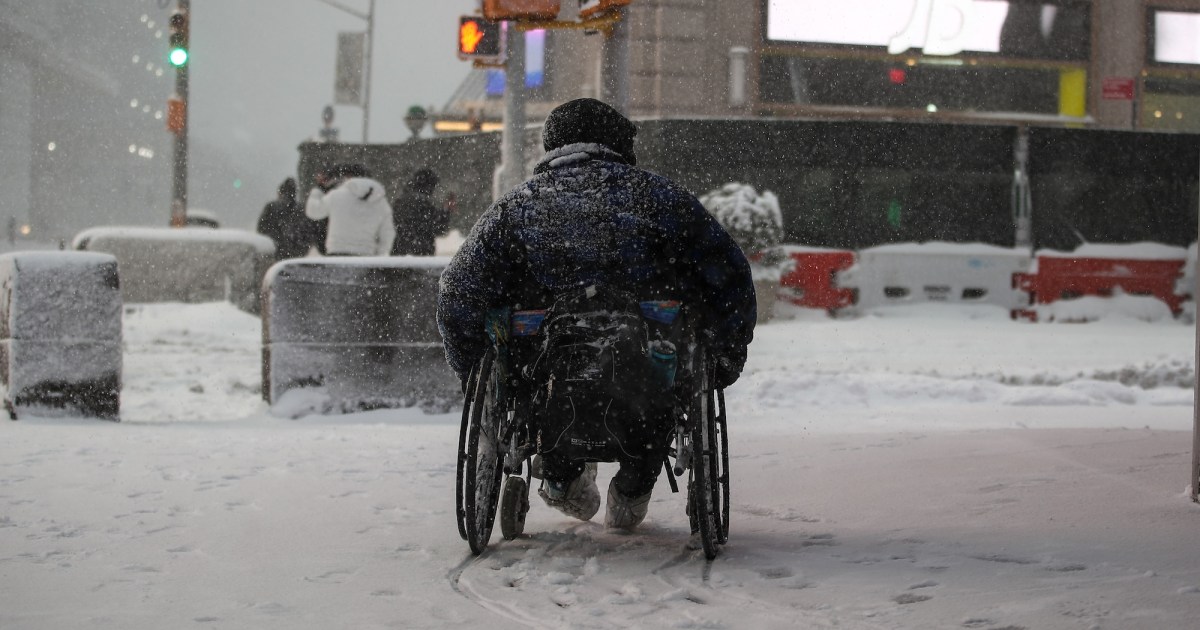
It took over a week for Mia Ives-Rublee, a wheelchair user and senior director of the Center for American Progress’s disability justice initiative, to be able to move more than a block past her home after one of the country’s most extensive winter storms in years hit her home of Washington, DC, at the end of January.
“Living in a city that you know has the resources, and still dealing with these issues, shows just how poorly cities are ready to deal with accessibility issues,” Ives-Rublee told me.
When sidewalks in her area were cleared, she said, the snow was moved into curb cuts, making it practically impossible for people with mobility devices to cross the street.
Disabled people are uniquely impacted by climate events, including that system of snowstorms, which impacted more than half the United States. The failure of even some of the best-resourced cities to adequately clear snow so that disabled people with mobility devices can safely get around is both an infrastructure failure and a policy choice, leaving those people stuck in one area and stripping them of their autonomy.
“People with a range of disabilities need clean sidewalks for safe mobility, and many in the disability community experience restricted access to food and healthcare when public infrastructure becomes unusable in the aftermath of extreme weather events,” sociologist Angela Frederick, the author of Disabled Power, told me. “For community members with disabilities, the impact of extreme weather can go on and on, even after life has returned to normal for others.”
A 2015 study published in the Archives of Physical Medicine and Rehabilitation looked at the challenges that Canadians with wheeled mobility devices faced during the winter months. More than 90 percent reported that their devices got stuck in the snow, that they slipped on the ice, and that they had difficulty using ramps. 99 percent said that using sidewalks and roads became problematic.
Living in Arkansas, Bailey Hunter, a wheelchair user, is less used to dealing with the snow. Hunter has not always used a wheelchair, and January’s snowstorm was the first time she had to be out and about with one in winter weather. She was unable to go to work for five days because the snow was not properly cleared.
“You have no autonomy, because you can’t physically move on the snow,” Hunter told me. “You can’t push yourself, you can’t do anything.”
And while losing access to the community can be burden enough, being snowed in can also be dangerous for disabled people.
“This isn’t just about us being able to get outside, but it’s actually a safety hazard,” Ives-Rublee continued. “If I need to go to the hospital, or if I need to go to the doctor’s office, I can’t do that with the snow being how it is.”