









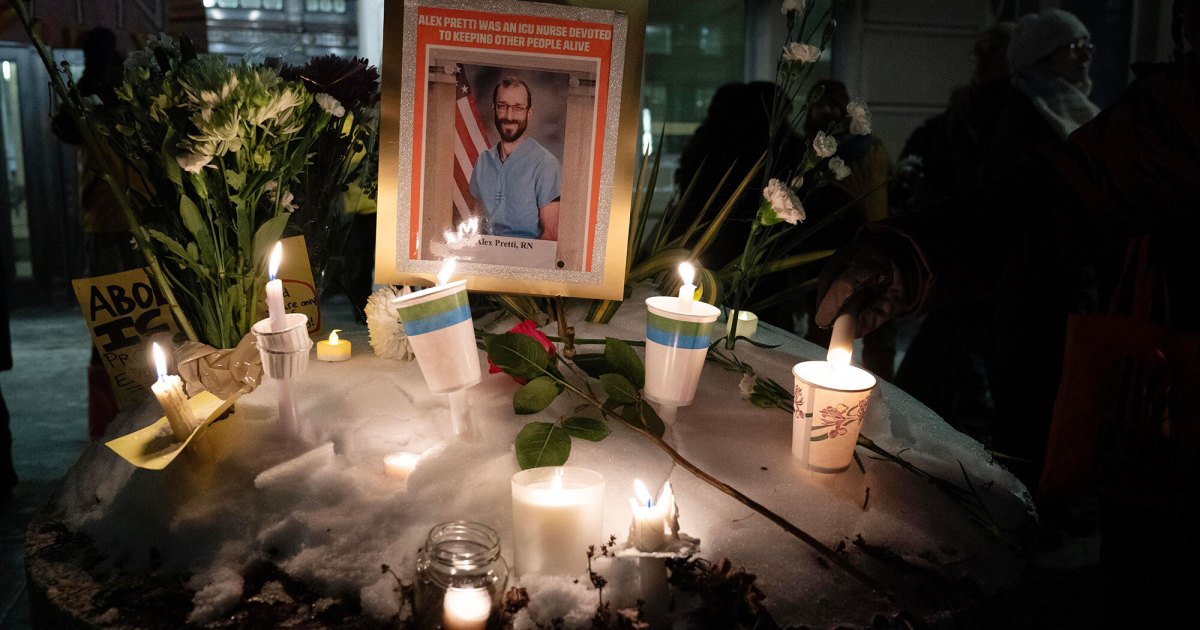
“Alex Pretti was one of us,” an NIH worker who asked not to be named told me over the phone.
That’s a phrase I’ve been hearing a lot since Saturday, when the 37 year-old Veterans Affairs nurse was assaulted and then fatally shot by federal agents in Minneapolis.
The circumstances of the killing—called an execution by many observers—has rattled government workers. They’re distraught for the same reason many Americans are. There were numerous witnesses, for one. Donald Trump and his minions Stephen Miller and Kristi Noem thoughtlessly disparaged the victim. Ample video evidence directly contradicted the government’s narrative. And it was the second killing in a month by federal agents in Minneapolis, adding to DHS’s recent death toll—including many more who have died in ICE custody.
But to many federal workers, Pretti also was a colleague. The civil service was generally fragmented prior to Trump’s reelection. But his administration’s ruthless assault on the rights and livelihoods of career government employees has strengthened ties among workers from completely unrelated agencies, who have banded together to organize protests and share resources.
“There’s been so much fear being a federal employee about saying anything, but now the fear is going away.”
“I didn’t know Alex personally, but it does feel like a lot of federal workers right now are standing in solidarity with one another, and have been over the last year,” says Anna Culbertson, a former NIH employee who was terminated in the DOGE onslaught.
It’s not hard for civil servants to imagine what Pretti might have been going through over the past year. “The large majority of us have been suffering a great deal under this administration,” notes Justin Chen, an EPA employee and union president.
The already chronically understaffed VA lost more than 30,000 workers in 2025, about 10 percent of them nurses like Pretti. Those still there “walk around the hallways and it’s doom and gloom,” says Doug Massey, who works at the VA central office and serves as president of his union. He’s seen an uptick this past year in hostile work environment complaints—the animosity fueled by VA Secretary Doug Collins, who has so far said nothing to his staff about Pretti’s death, conciliatory or otherwise.
“That could have been me,” Massey told me, noting how Pretti was killed after he tried to help a woman the amped-up agents had shoved to the ground. “I like to think I’d be someone who stepped in.”
Of course, the Customs and Border Patrol (CBP) agents who shot Pretti were also federal workers. “In theory, these two people should be driven by the same oath, which is to the Constitution,” says Jenna Norton, an NIH employee who was put on administrative leave after criticizing Trump—both then and now she was speaking in her personal capacity.
Under Trump, a chasm has widened between the majority of federal workers and ICE/CBP personnel. While most agencies are scraping by on diminished budgets, Congress promised ICE $75 billion without restriction, and its leaders appear willing to hire just about anyone with very little scrutiny. Immigration enforcement officers spent 2025 in a parallel universe, one with minimal training and $50,000 sign-on bonuses, while other agencies hemorrhaged veteran employees in the name of “government efficiency.”
The American Federation of Government Employees (AFGE), the largest federal workers’ union, has been one of the most vocal entities in combatting the firing of civil servants. But when one of its own was shot to death, the union’s initial statement was rather muted. AFGE leadership acknowledged that Pretti’s unnamed killer might be in the union as well. (It now appears that two CBP agents shot Pretti.) This revelation has led to calls, including from VA workers, for AFGE to ditch CBP on the grounds that the union cannot advocate for its members while representing people who are harming them. “That’s an internal conversation we need to have,” says Chen, whose union chapter, along with Massey’s, is part of AFGE. “Right now, we’re mourning.”
Individual AFGE chapters have made strong statements about Pretti’s death, calling for a response from Collins, and for ICE to leave Minnesota. “There’s been so much fear being a federal employee about saying anything, but now the fear is going away,” Massey says. “It’s being replaced by anger.”
Other federal workers are taking aim at ICE’s funding. A bill headed to a Senate vote on Friday lumps together funding for Health and Human Services (HHS)—which includes the NIH, the CDC, and the FDA—with yet more money for ICE and CBP. Norton and Culbertson were among the current and former HHS employees urging Congress to reject the bill.
“Obviously no one wants the government to shut down, but it’s deciding which is the lesser evil,” says the NIH worker who requested anonymity. “As health care providers, it’s our duty to make sacrifices.”
HHS employees have joined the nation’s largest nurses’ union in calling ICE a public health crisis. “If the administration were so concerned about making America healthy again,” the NIH employee says, “they’d be with us.”