









About a decade ago, when Doris Tyler was 76, she still had her eyesight. She’d quit driving, but she could see well enough to cook, do laundry, and clean her Central Florida home. But when the treatment for her macular degeneration stopped working, she began exploring other options. Stem cell therapy—whereby patients receive injections of their own stem cells, usually sourced from fat or bone marrow—isn’t approved by the Food and Drug Administration (FDA) for her condition, but it sounded “promising,” she says. Representatives at a clinic in Georgia assured her, according to court documents, that injecting stem cells into her eyes would be safe and might even save her vision. After pulling together $8,900 for the procedure, she made an appointment for September 2016. “We were hopeful and very excited at that point,” she recalls. “Until things began to fall apart.”
Within a month of the treatment, Tyler woke up unable to see in one eye—her retina had detached, a doctor would confirm. Soon after, the other one did, too. She tried several surgeries to fix the problem, but by December, she was permanently blind. “I don’t see any shapes or anything,” Tyler, now 85, told me. “All I see is blackness.”
“It’s completely changed my life. And I don’t want this to happen to anyone else.”
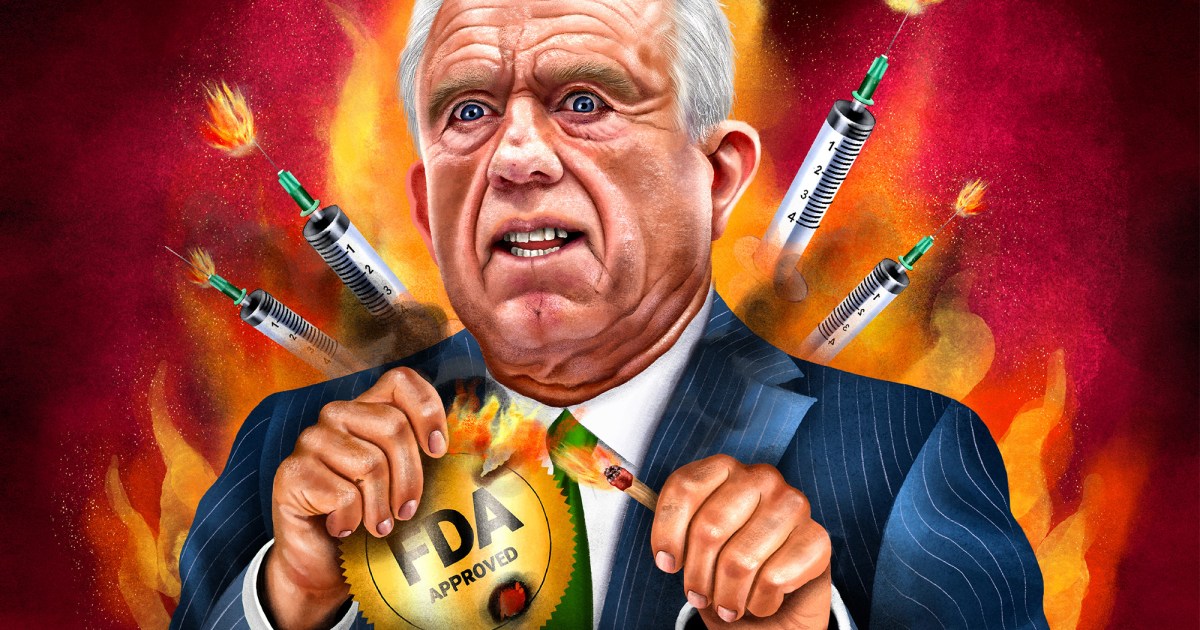
The clinic, part of the Cell Surgical Network, is one of thousands that have cropped up across the United States over the last two decades, touting stem cell treatments for a wide range of conditions: Alzheimer’s, autism, erectile dysfunction, Covid, joint pain, and more. While some stem cell therapies—like bone marrow transplants—are proven, many clinics, experts say, operate in a legal gray area, jumping ahead of the current science. Rather than rein them in, Health and Human Services Secretary Robert F. Kennedy Jr. has pledged to end the FDA’s “war” on alternative medicine, which may include unapproved stem cell treatments. (Tyler sued Cell Surgical Network and eventually settled out of court. The company did not respond to a request for comment.)
Some stem cells are like a wild card in the game Uno; the embryonic ones can develop into any tissue type (blood, heart, nerve, etc.), whereas nonembryonic “adult” stem cells are limited by the tissue in which they reside—blood stem cells, for example, produce only red blood cells, white blood cells, or platelets. It’s “a very promising field,” notes Sean Morrison, who chairs the Public Policy Committee of the International Society for Stem Cell Research, but scientists are still striving to understand stem cells and evaluate their potential as therapies. “We can’t just skip over the process of testing in clinical trials,” he says. Paul Knoepfler, a professor of cell biology and human anatomy at UC Davis, has read “encouraging” stem cell studies involving Type 1 diabetes, spina bifida, Parkinson’s, and age-related macular degeneration like Tyler’s. But clinics “are prematurely marketing stuff that’s not really ready for primetime yet.” And they are proliferating.
In 2016, Knoepfler and a colleague tallied 570 clinics nationwide offering stem cell treatments. By 2021, there were more than 2,700, with hotspots in California, Florida, and Texas—many promoting stem cells for things like pain relief, sports medicine, and general wellness. That same year, Pew Charitable Trusts identified 360 reports of bacterial infections, blindness, cardiac arrest, organ failure, tumors, and other “adverse events” related to unapproved stem cell and regenerative medicine procedures from 2004 through September 2020. Toronto resident Srini Subramaniam told me he spent $28,000 at a Florida stem cell clinic to treat retinitis pigmentosa, a hereditary eye condition, to no avail: “It was just that money down the drain.”
How is this even allowed? Well, the FDA covers drugs, but regulation of medical practice—licensing, exams, surgical procedures—falls to the states. In 2018, the Trump administration sued clinics in Florida and California, along with the Cell Surgical Network, arguing that stem cell treatments are drugs and should be regulated as such. The case made it to the US Supreme Court, which effectively sided with the FDA.
But under RFK Jr., the FDA seems less eager to crack down. Last May, Kennedy told a podcaster—the biologist and wellness influencer Gary Brecka—that he didn’t want to see a stem cell “Wild West,” but added that “charlatans” and “bad results” are an inevitable risk of medical freedom. “If you want to take an experimental drug,” he said, “you ought to be able to do that.” He himself had gone to Antigua for stem cell therapy to treat spasmodic dysphonia, a neurological voice condition, and it helped him “enormously,” Kennedy said.
Several states, including California, now require clinics to disclose to customers when therapies aren’t FDA-approved. And a few state attorneys general have sued clinics for deceptive marketing. But several other states, as Knoepfler wrote in Stat last July, have introduced “right to try” bills that would allow clinics to offer biologically derived drugs like stem cells, and let the buyer beware. That’s not such a healthy policy for experimental medicines. Tyler told me that she never would have agreed to stem cell injections had she known the risks. “I grew up in the time when you went to a doctor, you expected them to tell you the truth,” she says. “And you trusted them. And that’s not true anymore.”
As for RFK Jr., “if he thinks it should be approved,” he should talk to patients like her first. “It’s completely changed my life,” Tyler says. “And I don’t want this to happen to anyone else.”