









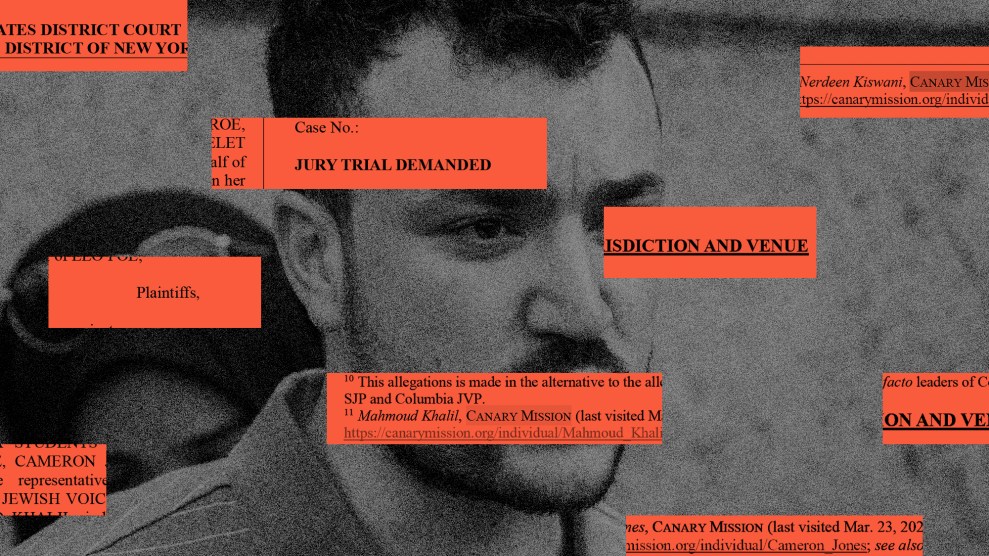
Documents unsealed by a federal judge this week confirm the federal government’s attempts to target, arrest, and deport students for pro-Palestine speech on college campuses last year. The court records also make clear the methods of investigation. The government looked to unverified accounts shared on social media and utilized Canary Mission—a shadowy online blacklist created by anonymous authors to smear pro-Palestine activists—to gather evidence against student protestors.
The documents were unsealed only after sustained pressure from journalists and press-freedom groups. News organizations, including the Center for Investigative Reporting, challenged the government’s efforts to keep large portions of the record secret, arguing that the public had a right to understand how speech was being scrutinized and punished. In unsealing the documents, US District Judge William G. Young sharply rebuked the Trump administration and called the government’s actions against pro-Palestinian speech an unconstitutional attempt to twist laws to intimidate students.
The new materials confirm previous accounts and reporting about the Department of Homeland Security’s targeting of students. In 2025, after Mahmoud Khalil and Rümeysa Öztürk were taken into custody by Immigration and Customs Enforcement officials, speculation spread quickly among advocacy groups that government officials were collecting names by looking at pro-Israel monitoring websites like Canary Mission.
The documents unsealed provide the clearest timeline of how this happened. And they make clear how quickly a case escalated, with Canary Mission’s help. Öztürk’s case is indicative. In March of 2024, Öztürk was one of four names published as part of a campus op-ed that criticized the Tufts University administration for failing to honor three student-led resolutions that had recently passed, including one calling for recognition of genocide in Gaza and another for divestment from the state of Israel.
Almost a year later, a profile of Rumeysa Öztürk appeared on Canary Mission. A month after that, according to the documents, government officials compiled a report on Öztürk. A week later, on March 25, 2025, Öztürk was arrested by United States Immigration and Customs Enforcement officials.
The new records make clear what happened: Öztürk’s participation in the op-ed was cited as the cause for her removal. (DHS and ICE did not show Öztürk had participated in any antisemitic activity.)

The documents show that federal agencies, such as Homeland Security Investigations (HSI) within the Department of Homeland Security, relied on “publicly available information,” including social media posts and third-party websites, to assess students’ eligibility for visas and residency.
And they confirm previous public testimony. In July 2025, Peter Hatch, an ICE official who was part of HSI’s division that compiled background reports on students, testified during the lawsuit’s hearings that “the direction [for his team] was to look at the website [Canary Mission].” Hatch says his team compiled more than 100 reports from a list of 5,000 names.
“Many of us have long been trying to raise alarm bells about the dangers of privately-funded, hate groups such as Canary Mission,” said Nadia Abu El Hajj, an anthropology professor at Barnard and Columbia University. “As testimony at the trial and the trove of newly released documents clearly demonstrate, Canary Mission’s blacklist has serious, material consequences: they have played a central role in providing names of Palestinian and pro-Palestinian students to the federal government, calling for their deportation.”

Internal reports also show that social posts; news articles from sources like the New York Post; and unverified information from Canary Mission were used to justify the deportation of Khalil, Öztürk, and a slew of others, including Mohsen Mahdawi, Badar Khan Suri, and Yunseo Chung. The files for Khalil, Öztürk, and Mahdawi all specifically cite Canary Mission. The reports also include posts from X accounts like @CampusJewHate, which describes itself as an account to “put pressure on academic institutions to oppose Jew-hatred by exposing toxic anti-Israel climate on their campuses.”
“Secretaries Noem and Rubio and their several agents and subordinates acted in concert to misuse the sweeping powers of their respective offices to target non-citizen pro-Palestinians for deportation primarily on account of their First Amendment-protected political speech,” wrote Judge Young in his court order. “Moreover, the effect of these targeted deportation proceedings continues unconstitutionally to chill freedom of speech to this day.”
The State Department, in a statement, was unapologetic. “The Trump Administration is using every tool available to get terrorist-supporting aliens out of our country,” a spokesperson said. “A visa is a privilege, not a right. We abide by all applicable laws to ensure the United States does not harbor aliens who pose a threat to our national security.”
The documents have been released as the US pushes once again to deport Khalil. Earlier this month, a US Appeals court overturned a lower court decision that blocked the Columbia former graduate student’s deportation. Following that ruling, a DHS Assistant Secretary Tricia McLaughlin went on NewsNation and promised to send Khalil to Algeria.
In a statement, McLaughlin told the Center for Investigating that “there is no room in the United States for the rest of the world’s terrorist sympathizers, and we are under no obligation to admit them or let them stay here. The framers of our Constitution and its Bill of Rights never contemplated a world where foreign citizens could come here as guests and hide behind the First Amendment to advocate for anti-American and anti-Semitic violence and terrorism.”