









This story was originally published by Canary Media and is reproduced here as part of the Climate Desk collaboration.
California lawmakers are considering two bills that would slash red tape for households looking to add certain types of clean tech.
Earlier this month, Democratic state Sen. Scott Wiener, whose district includes San Francisco, introduced legislation that would make it easier for individuals to adopt all-electric, super-efficient heat pumps (SB 222) and plug-in solar panels (SB 868).
“The cost of energy is too high,” Wiener told Canary Media. “We want to lower people’s utility bills; we want people to be able to participate in the clean energy economy; and we want people to be able to take control of their energy future. And that’s what these bills do.”
The proposals come as Americans are in the grip of a worsening cost-of-living crisis—of which energy is a key driver.
“We should empower people to use this technology. And right now, it’s too hard.”
Electricity costs have grown at about 2.5 times the pace of persistent inflation, and home heating costs are expected to surge this winter. In California, which has the second-highest electricity rates in the nation, the problem is particularly pressing. Heat pumps and plug-in solar panels could help.
Heat pumps—air conditioners that also provide all-electric heat—are about two to five times as efficient as gas furnaces without those appliances’ planet-warming and health-harming pollution. Even in California, where gas is relatively inexpensive compared with electricity, a heat pump’s high efficiency can enable households to save on their energy bills, especially when tapping the sun for cheap, abundant power.
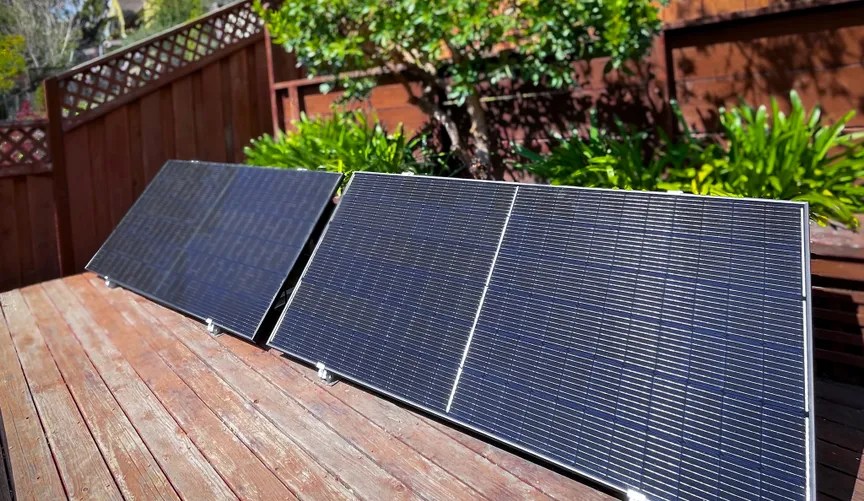
Enter portable, plug-and-play solar panels. These modest systems, which users can drape over balcony railings or prop up in backyards, allow renters, apartment dwellers, and others who can’t put panels on their roofs to harvest enough of the sun’s rays to power a fridge or a few small appliances for a fraction of the day. A connected battery can save solar energy for use at night.
The tech is booming in Europe. In Germany, for example, where people can order kits via Ikea, as many as 4 million households have hung up Balkonkraftwerke, or “balcony power plants.” There, households can cover as much as one-fifth of their energy needs using these systems.
In the US, an 800-watt unit for $1,099 can save a household as much as $450 annually in states with higher electricity prices like California, according to the Washington Post.
But unlike those in Germany, US households typically need to apply for an interconnection agreement with their utility before they can install these systems—just as they would for adding a rooftop solar array. That process often requires fees, permits, and an inspection, and it can take weeks to months. Only one state allows residents to install plug-in solar without a utility’s permission: deep-red Utah.
Permitting in some cities “is way too lengthy and onerous and expensive.”
Lawmakers elsewhere are now stampeding to make plug-in solar available to their constituents.
Besides Utah and now California, legislatures in more than a dozen states want to unleash the tech: Hawaii, Illinois, Indiana, Maine, Maryland, Missouri, New Hampshire, New Jersey, New York, Pennsylvania, South Carolina, Vermont, Virginia, and Washington have all introduced bills, according to Cora Stryker, co-founder of plug-in solar nonprofit Bright Saver, which has been advising some states on their proposals. Based on conversations the organization has had with state representatives, Stryker said she expects a whopping half of US states to introduce bills this year.
“We should empower people to use this technology,” Wiener said. “And right now, it’s too hard. The idea that you have to get an interconnection agreement with the utility to put…plug-in solar on your balcony—it makes no sense.”
Administrative hurdles are also holding back heat pumps. “The current permitting process is difficult,” Aaron Gianni, president of Larratt Brothers Plumbing in San Francisco, told state policymakers on January 6. “As a contractor dealing with more than 109 different building departments in the Bay Area, we must navigate the nuances of each: different inspectors, changing paperwork requirements, high fees, and strict setbacks [that] sometimes make installation impossible.”
The situation can be even worse when a customer lives in a unit governed by a homeowners association, Gianni said. “Many HOAs have outright prevented new electric equipment from being installed.”
Wiener, who is running for US Rep. Nancy Pelosi’s seat and boasts a tongue-in-cheek MAGA fan club, put it bluntly. Permitting in some cities “is way too lengthy and onerous and expensive.”
“The [heat-pump] bill creates a streamlined path to be able to get a quick, automatic permit,” he explained. It would also loosen restrictions on equipment placement, cap permit fees at $200, and make it illegal to ban heat pumps.
Wiener’s heat-pump legislation, which has some industry detractors as well as grassroots supporters, has already passed out of the California Senate’s housing and local-government committees.
The plug-in solar bill has yet to come up for any votes. Still, with energy affordability shaping up to be a decisive issue in the 2026 midterm elections, both proposals “have, I think, a real possibility of passing,” Wiener said.
“These technologies are a win-win-win, and enabling access to them is simply good government.”