








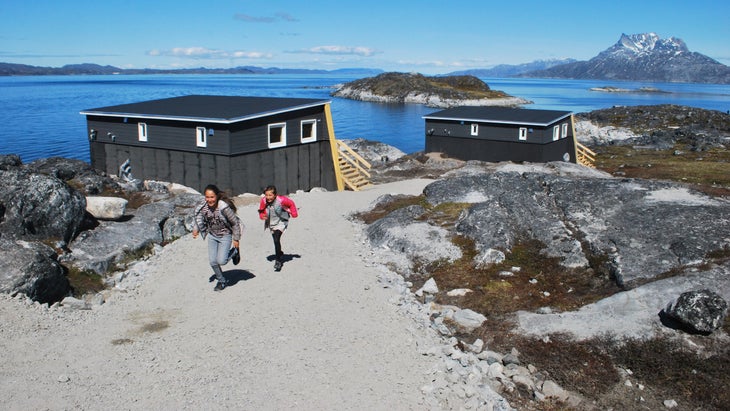
It’s been more than a decade now, so some memories are foggy, but I do remember the taste: sharp, sour, like eating a leafy, green mineral. I remember the place, too. We were on a gravel path between Itilleq and Igaliku, one a harbor, the other a village. It was June, the high Arctic light falling softly across the weathered hills. I knelt in the grassy tundra along Greenland’s Tunulliarfik Fjord, while my friend Barbara plucked a tiny plant growing among the rocks.
“It’s dog sour,” she said, placing the tiny purple flowers and dark green leaves into her mouth. She handed me a piece. I popped it into my mouth.
“Whoa.”
“Tasty, eh?”
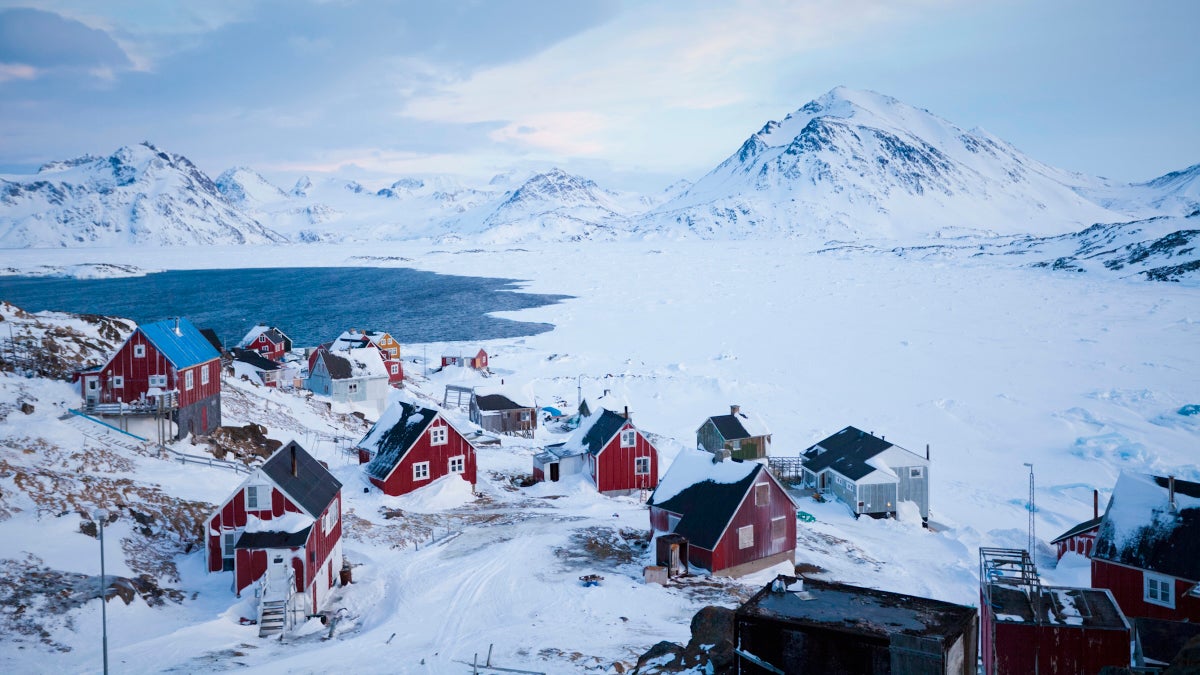
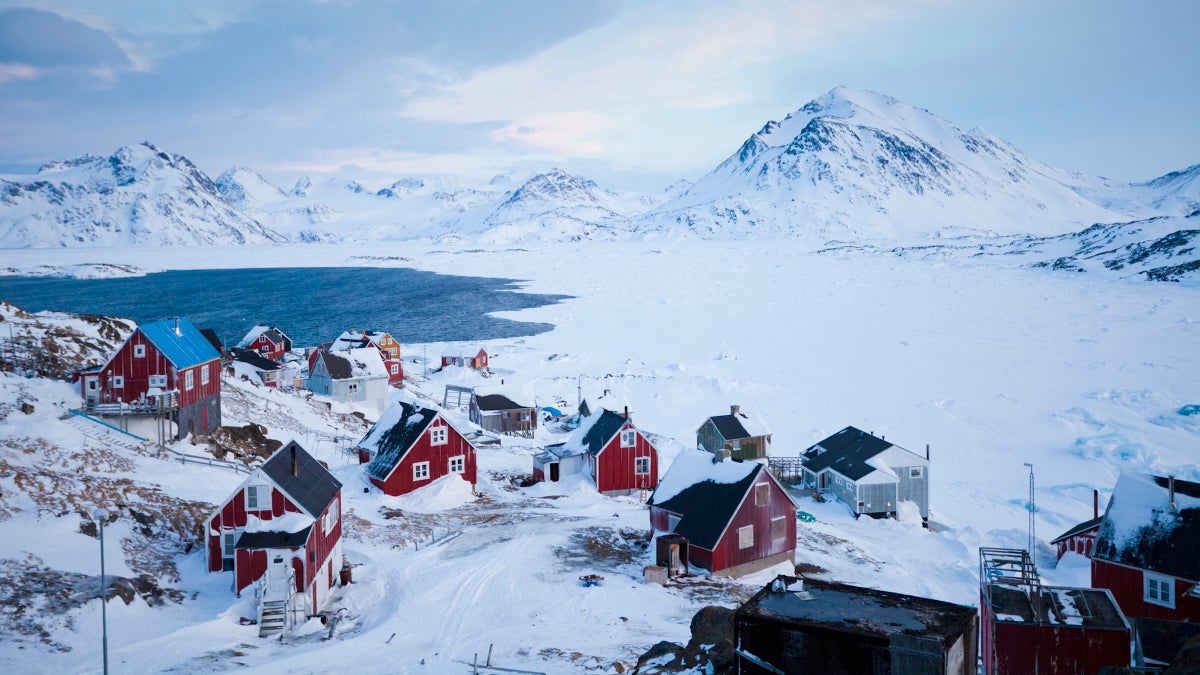
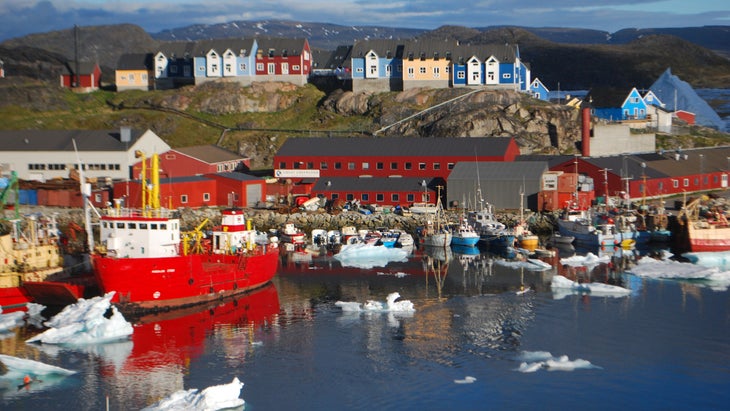
Barbara wore an olive green vest over a lime green fleece with a camera around her neck. As a director of “new trip development” for Wilderness Travel, she had convinced me to join her in Greenland, where some local operators had put together an itinerary to show her just how special the world’s largest island really is. The plan was to spend about a week tooling along Greenland’s more forgiving southwest coast, a place where you can hike among tumbling fjords, fish for Atlantic redfish the color of sunsets, and contemplate historical sites tucked among Lego-like villages with homes painted like Skittles. The operators knew what they were doing. They knew Barbara could inspire people to see Greenland, too.
She had sensed an early trend that now plenty of people are aware of. Today, travel to Greenland is booming, with new, larger airports offering direct international flights, including from New York. Routes 360, a platform for airline network planners and route-development professionals, noted a surge, perhaps as high as 40 percent, in travelers arriving in Greenland over the past two years. Much of that traffic is driven by an emotional sense of urgency in the face of climate change—the “last-chance” crowd.
“Tourists want to witness the spectacle—before it changes forever,” Routes proclaimed last summer.
At 836,000 square miles, Greenland is nearly 80 percent ice, a frozen leaf dangling in the far North Atlantic with dramatic, ragged edges, impossibly sheer cliffs that dwarf even El Capitan, and a massive ice sheet as thick as 11,000 feet.
Barbara instinctively knew this, and the world, better than anyone. She had taken travelers to witness elephant migrations in Botswana and Zimbabwe and groups to spy on snow leopards in Ladakh. She could tell stories in German, French, and Tibetan. She and I had met in person only a few years earlier riding bikes in the dusty, warm air of Namibia. There we bonded over gravel roads and a love for big, wild places, the ones that are so mind-bogglingly beautiful and remote that they’re almost always a one-shot deal. Trips of a lifetime, she might say, but she meant it.
About six of us signed up to join that trip, and soon we were gathered in Narsarsuaq, a settlement of 150 people in South Greenland that had prop service from Reykjavik. I think we ate red deer and nougat parfait that night, which wasn’t night at all. Feeling goofy, I stepped outside at midnight wearing sunglasses to read a book.
It didn’t take long for any of us to realize what a culturally rich, supremely wild, and magnificent part of the planet we were in. At 836,000 square miles, Greenland is nearly 80 percent ice, a frozen leaf dangling in the far North Atlantic with dramatic, ragged edges, impossibly sheer cliffs that dwarf even El Capitan, and a massive ice sheet as thick as 11,000 feet. Many of us have only marveled at it through the porthole of a Dreamliner flying back from Europe. Even from way up there you can sense with spine-tingling clarity how breathtakingly mythical it must be.
On the ground, the scale of Greenland and its wilderness is impossible to fathom, like trying to gauge the weight of a planet. All told, the island is about 25 percent bigger than Alaska but with around 56,000 people—one-thirteenth the population of our largest, wildest state—with one seven-hundredths of a person per square mile. That’s a bit misleading since nearly all of Greenland is ice and 100 percent of its people live along its coastal fringes. Even so, there are no real roads in Greenland, at least none that really go anywhere, and so we traveled on a boat well known to pretty much every Greenlander: the M/S Sarfaq Ittuk, a working coastal ferry built to shuttle people, palletized groceries, medicines, and mail between colorful hamlets scattered all along a 1,000-mile stretch of coast. Her red and white hull seemed long and low, probably better to brave the waves.
Barbara seemed to know so much about Greenland from the start, but the operators could wow even her with their tidbits. We learned how its fjords are among the deepest and longest on the planet. We motored through Nuup Kangerlua, a 100-mile-long gouge that cuts so deeply into the land that the inland ice creates its own weather. Whales (were they humpbacks?) cruise these waters and are such familiar creatures that at least one of them, Whale No. 1, with its white fluke and deep scar below the dorsal, had been photographed regularly since 1992—and not just here but in the Caribbean, too. Whale No. 9 had been a regular for at least 30 years.
There was a certain timelessness to the wilderness here, probably because it was too vast for the mind to bottle with context. Parts of Greenland’s bedrock are among the oldest pieces of the planet, a 4-billion-year-old foundation that you can run your hand along on a hike in the Kapisillit fjord. Even the name Greenland taps into antiquity thanks to Erik the Red, who was banished here in 982, found a sheltered, green fjord to call home, and named the place Greenland, an embellishment to lure other Norsemen west. It wasn’t far from his settlement where Barbara plucked the dog sour. It was also not far from here that Erik the Red’s son, Leif Erikson, sailed west to reach North America half a millennium before Columbus.
Like any place, Greenland is not just a land but a people deeply tied to it. We stopped in villages with names like Qaqortoq, Qeqertarsuatsiaat, and Qassiarsuk. The Inuit fed us wild berries and narwhal. On the ferry, I found local people to be gracious, proud, and forgiving, as I made small talk and gently probed for clues about their lives. A group of high school graduates stood near the stern dressed in their mesmerizingly intricate kalaallit atisai, a national, traditional costume decorated with glass beads and worn with white sealskin boots. I took pictures while a Greenlandic flag snapped in the breeze.
From the Norsemen to the Danes and now us, Greenland has often been framed as an empty, available, and strategically vulnerable place. But I’d like to think that Powell, well-versed in Greenland’s geopolitical importance and natural wealth, also saw it as a lived-in, storied place.
In 2004, Colin Powell, then the U.S. Secretary of State, visited Igaliku, the village on the far end of the King’s Road where Barbara, the group and I were walking among the tundra. The ruins of one of what was once the northernmost bishopric sat nearby. About 20 people lived in Igaliku when Powell was there, which really hasn’t changed, and still underscores how even the smallest pieces of this great place fit inside a much larger political picture. A dozen villagers sang for Powell. One of them gave him a beautiful rock. “It will remind me of my great visit to your town,” Powell later wrote in a thank-you note. “I wish the people of Igaliku every success as Greenland, Denmark, and the United States strengthen our friendship and cooperation.”
From the Norsemen to the Danes and now us, Greenland has often been framed as an empty, available, and strategically vulnerable place. But I’d like to think that Powell, well-versed in Greenland’s geopolitical importance and natural wealth, also saw it as a lived-in, storied place. I, for one, flew home with a deep appreciation for these increasingly rare places where sovereignty and wilderness are intertwined like wool bracelets made from muskox.
I saw Barbara at least once every year after that trip. We traded emails about places I should go and she’d regale me with stories about cave paintings and Andean huts. Once, my father tagged along with me to a travel conference in Ireland, where he and Barbara got so deep into a conversation in a dark pub that she had to stop her story to inform him he’d stuck his jacket into a candle and set his sleeve on fire. Six years after that, Barbara was dead, before many of us even knew she was sick.
I mention her because after a dozen years since we wandered those rolling, rocky folds, I’m still so grateful: for beautiful people, for beautiful places—and for all the superlatives that burble up when both remain so wild and free.
The post A Love Letter to Greenland appeared first on Outside Online.