









Picture this: your NFL team just won the Super Bowl, and you fancy gifting yourself something special to celebrate. Only you’re not just a fan of this football team, rather, it is your team. As in, you own it. And since that’s the kind of life you lead, you gas up the Gulfstream and set the coordinates to Molsheim, France, for a little visit to the Château Saint Jean—home of Bugatti.
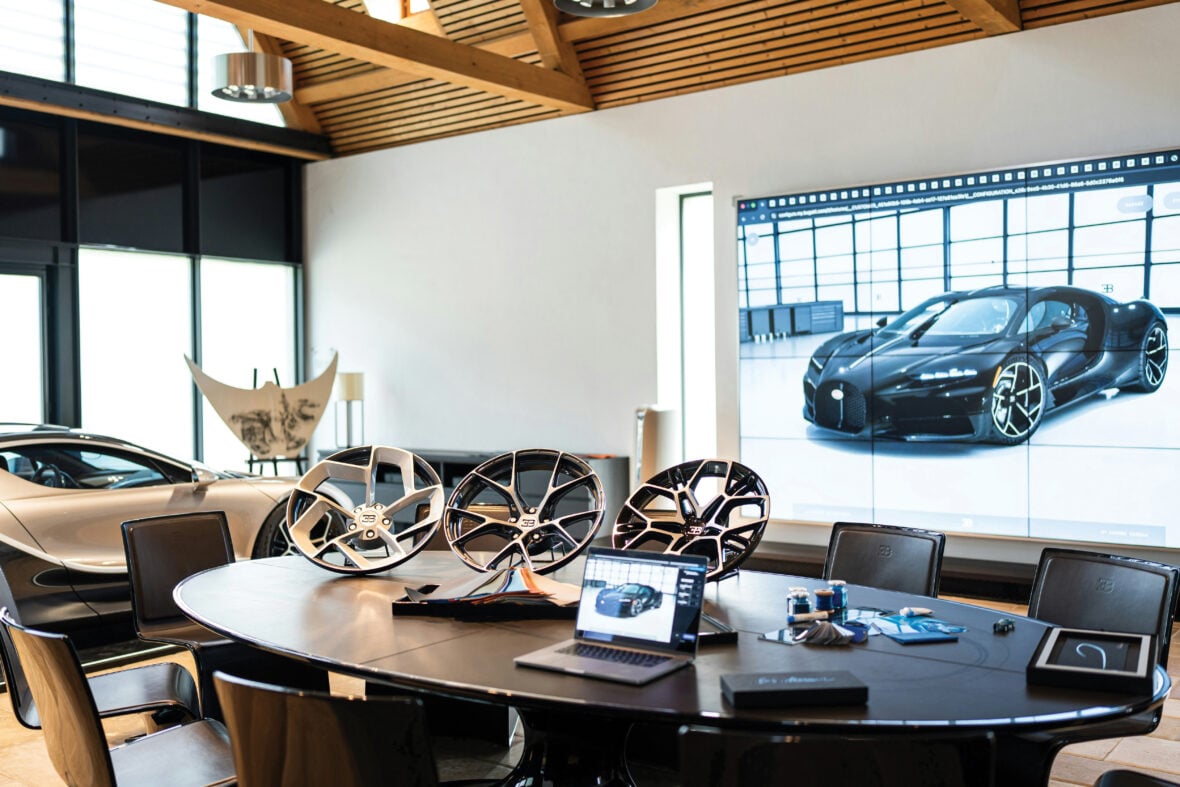
As your G800 skids to a stop at Strasbourg-Entzheim Airport, a black Bentley Bentayga awaits, chauffeur holding doors open. You slip inside and are soon whizzing past the Château Saint Jean’s iron gates, under the ivy-covered stone gateway of John the Baptist, and around to the back of the stunning manse fit for royalty. Soon, you are ushered into the Atelier to see engineers putting the finishing touches on several new Bugatti Tourbillons. But you, sir, are not here to buy a Bugatti; you just won the Super Bowl. No, you are here to design your very own model—something that hasn’t been possible for the last century.
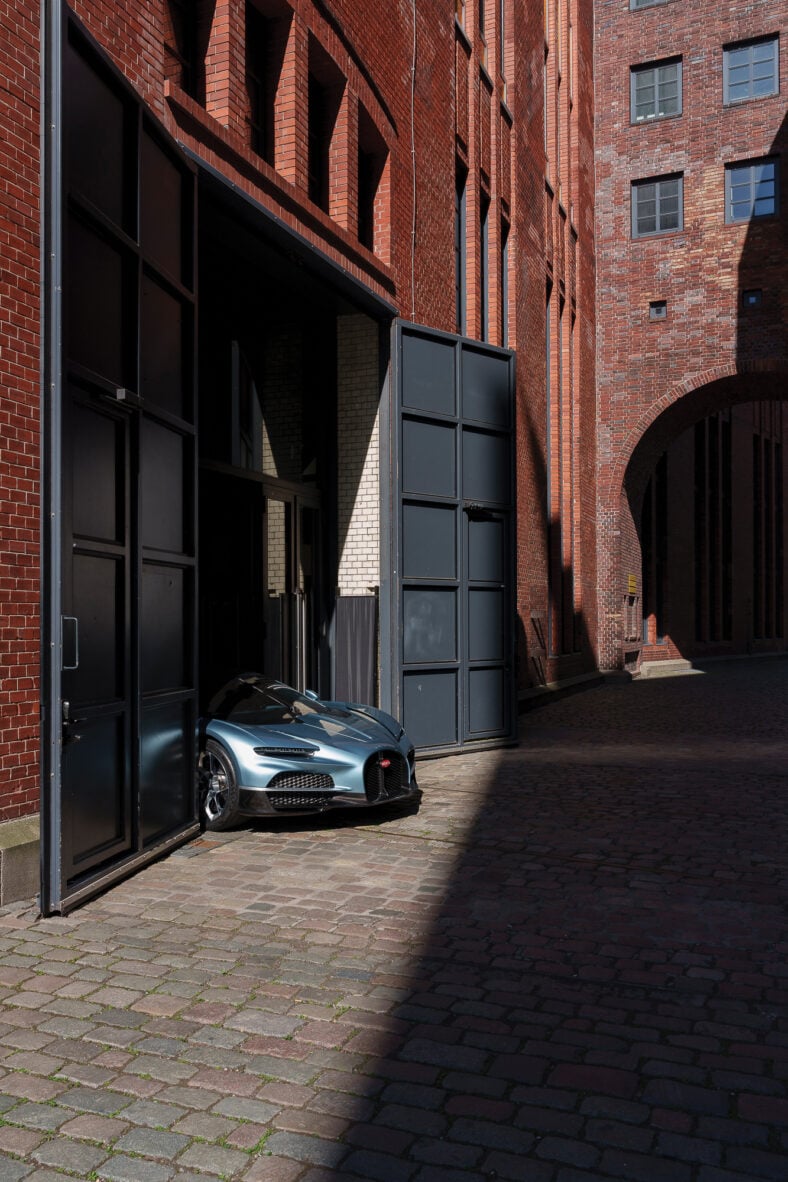
While Bugattis have always offered insane levels of customization—one can famously match the exterior paint to the exact aquamarine green of your newborn’s iris, incorporate 3D laser engravings of your favorite pet, or line your dash with ostrich leather and platinum—what you could never do is create your own Bugatti model. Until now, that is.
“What a lot of our customers want is an incredible level of customization,” Mate Rimac, CEO of Bugatti-Rimac, tells Maxim of their just-launched Programme Solitaire. “Of course it’s about a beautiful car, beautiful design, but it’s more about the journey we take together.”
When Ettore Bugatti founded his eponymous marque in 1909, he set in motion an uncompromising pursuit of performance and engineering. But the obscene levels of bespoke tailoring for which Bugatti is now known came decades later. Though Bugatti has long been renowned for its ultra-luxurious saloons and lust-worthy designs, what initially put the French marque on the map was pure engineering. Among Ettore’s first quantum advancements in racing was lowering the driver’s seating position, creating better balance and a superior center of gravity. While this technological leap is often credited to the inaugural Bugatti Type 10, Ettore actually first applied it to a vehicle he designed for the German firm De Detrich years earlier, proving his engineering mettle long before he formed his company.
“Brand strength gets built on merit, it doesn’t just happen because you are around for a long time. And if you don’t bring anything new, the brand will not grow.”
Bugatti CEO Mate Rimac

It was not until the Type 41 in 1927 that Bugatti first imagined building cars for pure opulence, although with a gargantuan 12.8-liter 8-cylinder powerplant, performance was never forgotten. Bugatti created a rolling chassis with a ludicrously palatial 14-foot wheelbase, on which customers would hire distinguished coachbuilders like Ludwig Weinberger, Kellner Frères, and Gangloff to construct the bodies. While Ettore excelled in engineering, he lacked the artistic streak that ran strong through his bloodline—his brother and father being acclaimed furniture and jewelry designers, his grandfather an architect. It did not skip his children, however, as Ettore’s firstborn Jean believed the car must be conceived as a complete work—technical brilliance and sculptural beauty seamlessly intertwined.
“Ettore’s son was a very gifted, talented designer, and he brought the craft of coachbuilding in-house,” Rimac reminds us. “Jean was then responsible for some of the most beautiful Bugattis, because he understood how you combine the technical part with design to make an even more beautiful car.”


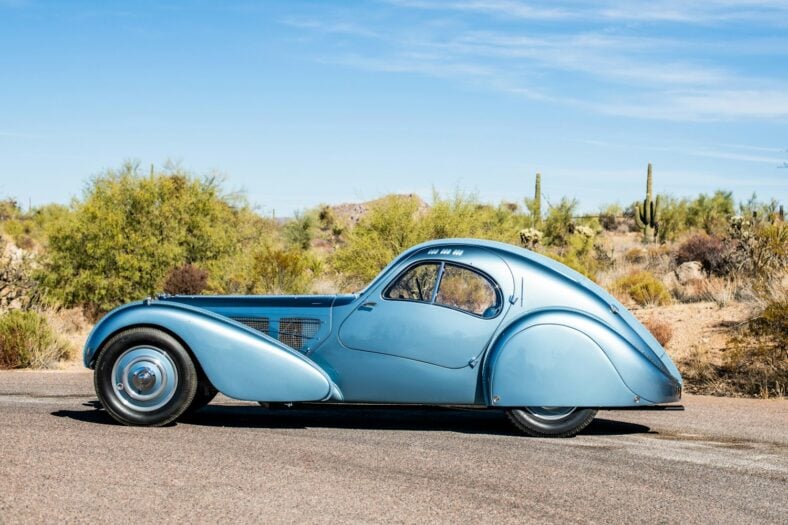
Since that day, the fusion of design with engineering has defined Bugatti’s DNA. Take the legendary Type 57 Atlantic, one of the most coveted vehicles on the planet. By lowering the engine in the chassis, Jean achieved a dramatically lower hoodline than his contemporaries ever could, creating one of the most iconic silhouettes in automotive history. It was a feat only possible when engineering and design share the same roof.
“That is something that only the manufacturer can do,” Rimac underscores forcefully. “If you are limited by the rolling chassis, which is always the same, you are then limited and can just do window dressing. You’re not actually making substantially different designs. Jean Bugatti understood that, and that’s why we had some of the most beautiful Bugattis in the era when he was active.”
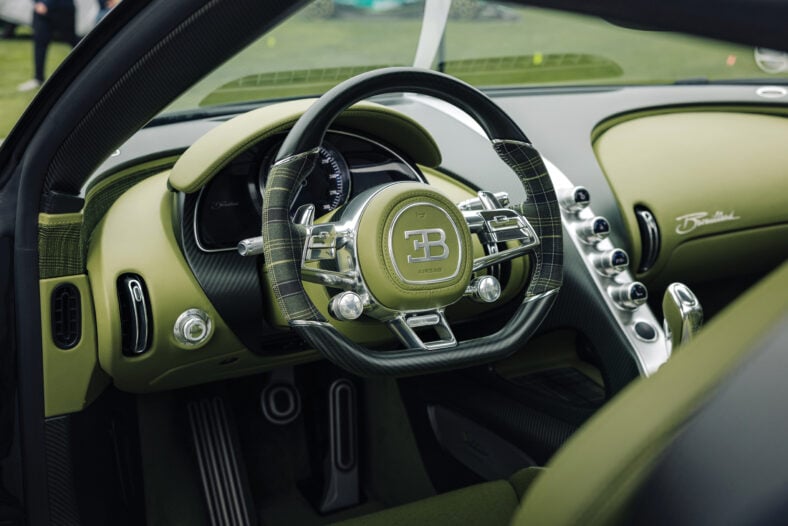
And today, with the creation of the Programme Solitaire, that tradition continues—piercing well beyond surface customization into true structural and technical artistry. The program’s first offspring debuted at this summer’s The Quail gathering during Monterey Car Week, with Bugatti design director Frank Heyl numerating the singular elements of Molsheim’s latest: the Brouillard. Although built around the landmark W16 powertrain of the Chiron, the Brouillard is its own unicorn.
“There’s one corner that I particularly like that stands out to me,” Heyl tells us, pointing out the rear fender, just above the volume of the horseshoe-spoked wheel. Because of the equine inspiration, they opted for a highly organic form language. “I find it particularly attractive because it is shaped like a muscle pushing through skin— very athletic, no gram of fat.” Other highly unique features include a miniature, hand-crafted glass horse-head sculpture in the machined aluminum gear shifter, seat fabrics stitched in part from safely harvested horsehair, and a central bright-finished metal rib offsetting the radiant mossy matte green paint job.
“Once built, Bugattis do not really disappear. They stay and endure the decades, and sometimes even centuries.”
Bugatti Design Director Frank Heyl

“My dream is when I’m a grandpa, I want to be able to walk the lawn of one of those concours d’élégances in a few decades from now with my grandchildren and show them the cars that granddaddy had been working on back in the day,” Heyl divulges. He reminds us how last year the legendary Type 35 marked its centennial anniversary, with numerous concours-presented models also still racing on the track—underscoring the timeless fortitude of the brand. “Once built, these [Bugattis] do not really disappear,” he muses. “They stay and endure the decades, and sometimes even centuries.”
Of course, even if you own your own NFL team, your chances of getting your rarefied fingers on a true one-of-one Solitaire creation remain slim. Making only two a year, the program is booked for the foreseeable future. This is because, rather than personalization, Solitaire demands participation. Customers don’t just choose from options— they help script Bugatti’s next chapter.
“Our first Solitaire client, Michel [Perridon], is not just a collector,” Rimac adds. “He’s a historian of the brand.” Rimac shares how it was the Dutch entrepreneur who first approached him about wanting to design his own Bugatti someday, well before Solitaire was even imagined. Moreover, Perridon already had the name in place: Brouillard, after Ettore Bugatti’s favorite horse. An animal the engineer loved so much, he invented a patented latch that Brouillard could open with his mouth to let himself in and out of his stable at will.

and tailored by Bugatti designers and craftsmen. (Bugatti)
To be handpicked for the inaugural Solitaire, Bugatti began by vetting the list of its apex clientele. “First, we are checking with those who are close to us, people we know really well, that we understand, that know us,” Rimac reveals. “They are also qualified in terms of how many Bugattis they have, and how big their collection is.”
Once selected, the process had only just begun. The CEO recalls Perridon visited the Berlin and Molsheim offices at least five times to go over drafts, challenges, developments, and more. “Michel was the perfect first customer,” Rimac effuses. “This wasn’t just about building a car. It was about creating modern Bugatti history. For Michel, it fulfilled a dream. For us, it was the ideal way to launch Solitaire.”
Shockingly, Rimac discloses that the Programme Solitaire was only imagined barely a year ago, the result of a discussion between himself, Heyl, and Bugatti managing director Hendrik Malinowski. The fact that they could accelerate such a unique, robust program from initial concept to a rolling model on the ground—the Brouillard seen in Monterey is not the actual car, but rather a simulacrum of what will be built—in a single year seems almost impossible to comprehend. Especially in an industry infamous for its glacial decision-making. As we learned in 2024 when invited to chat with Rimac and Heyl at a super-secret preview of the Tourbillon, this level of elite corporate agility can only be achieved with a team as tight, intimate, and clear-eyed as the Bugatti brain trust.
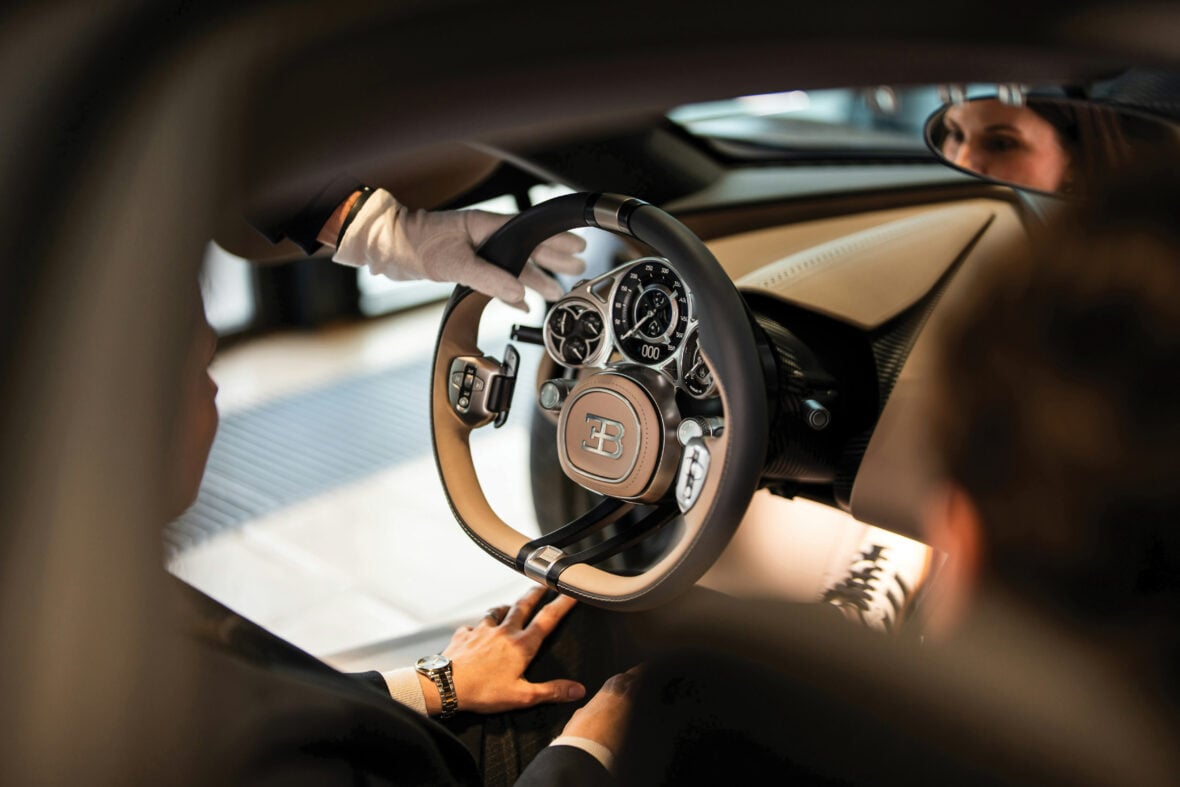


Featuring a mind-blowing naturally aspirated V16 engine, zero screens, and analog dials on the gauge cluster exposing the gear work like a skeleton watch, it’s not an exaggeration to claim the Tourbillon might be the most groundbreaking hypercar of the 21st century. Bristling with analog bravado, the Tourbillon embodied the renegade philosophy of Bugatti and its leadership, to zig when the world is zagging. Now, the Programme Solitaire too shatters norms, elevating bespoke customization to never-before-seen next levels.
“Brand strength gets built on merit, in my view. It doesn’t just happen because you are around for a long time,” Rimac states matter-of-factly. “And if you don’t bring anything new, the brand will not grow.”
Follow Deputy Editor Nicolas Stecher on Instagram at @nickstecher and @boozeoftheday.
This article originally appeared in Maxim’s Winter 2025 issue.