








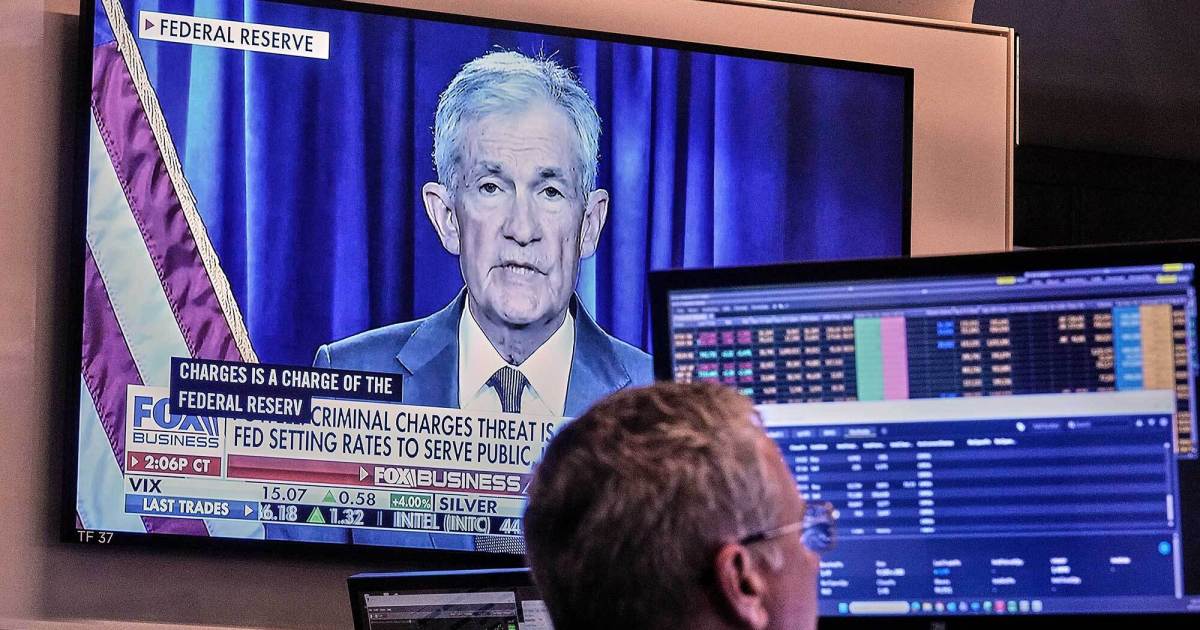
On Sunday night, news broke that the Justice Department has commenced a criminal investigation into Federal Reserve chair Jerome Powell, an unprecedented move that marked an aggressive escalation of Donald Trump’s ongoing effort to seize more control of the historically independent Fed, which sets monetary policy for the US economy.
For months, Trump has expressed frustration with Powell because the Fed has refused to decidedly lower interest rates. The administration claims that this investigation is not retaliation for the president’s dissatisfaction with the Fed, but rather about lies Powell allegedly has told about the $2.5 billion renovation of the Fed’s office building in Washington, DC. In a rare public statement on Sunday night, the usually reserved Powell called out this framing: “The threat of criminal charges is a consequence of the Federal Reserve setting interest rates based on our best assessment of what will serve the public, rather than following the preferences of the President,” he said.
The investigation has raised concerns among economists and the business world about the potential impact to the US economy if a first-in-history DOJ prosecution against the Fed chair is allowed to move forward—and how it might compare to cases of political intimidation or prosecution of central bankers in other countries, from Turkey to Argentina.
I spoke to Jason Furman about these questions. A Harvard economist, Furman previously served as President Barack Obama’s chief economist, leading his Council of Economic Advisers (CEA) during Obama’s second term. On Monday, Furman signed on to a statement decrying the Powell investigation that is cosigned by every living former Fed chair, as well as former Treasury secretaries and CEA chairs who’ve served both Democratic and Republican presidents.
Our conversation below, edited for length and clarity, explores the importance of central bank independence to strong economies, and the grave consequences that have arisen around the globe when that independence has been compromised.
Let’s back up for a second: Why is central bank independence important?
If you don’t have an independent central bank, you’re investing enormous power in a president who can abuse it and follow their whims.
There are also two broader arguments: Number one is that we have fiat money, which means you can print as much as you want, whenever you want. That is a wonderful, amazing thing to help respond to recessions and prevent depressions, but it also can be really abused and cause a lot of inflation. So, we need some way to make sure that it’s limited. An independent central bank is the way to have your cake and eat it too—a fiat currency that you can use aggressively to respond to recessions, without a huge amount of inflation.
Finally, there’s been an awful lot of economics research for several decades now which has documented that the more independent your central bank, the lower your inflation, the lower your interest rates, at no cost at all, in terms of recessions or higher unemployment and the like. So, it really does empirically seem to be a free lunch.
The statement you signed on Monday, along with other economists who’ve served at the highest levels of government, is short—just four sentences. One of them says that this attack on Powell is akin to what happens in nations that have far less developed economies than America’s—what you call “emerging markets with weak institutions.” What are some of them?
There are examples in other places, though many of them get complicated. In Zimbabwe, they prosecuted the central banker. The central banker probably had messed up pretty badly the way they handled monetary policy, but they also messed it up badly because they listened to the government. So they listened to the government, caused a lot of inflation, and then got prosecuted for it. Indonesia had a case like this, though it’s possible that the central bank actually was somewhat corrupt and had misused money.
So when you start looking at cases in emerging markets with weaker institutions, you know, there’s a certain amount of messiness and complexity that differs from the unfortunately simple, clear-cut thing happening the United States right now: Jay Powell is not corrupt. The people prosecuting him are.
What happened in these other markets once central bank independence was compromised?
“I don’t think the United States is going to be like Zimbabwe anytime soon, but the reason it’s not going to be is precisely if we know about those examples, talk about them, and make sure that they don’t happen here.”
In Argentina, they ended up with so much inflation they stopped publishing the data. They had a massive default, a very, very deep recession, and ended up with the largest bailout program in the history of the International Monetary Fund. The poverty rate went up. The unemployment rate went up. This was in 2015, but in 2001, Argentina had a similar recession, and dozens of people were killed in demonstrations related to it. Zimbabwe ended up with inflation in the trillions of percent—just absolutely mind-boggling—and almost complete economic collapse.
So these, to me, are very, very extreme warnings for the United States. Of course, I don’t think the United States is going to be like Zimbabwe anytime soon, but the reason it’s not going to be is precisely if we know about those examples, talk about them, and make sure that they don’t happen here.
You also mentioned these countries in a post on Bluesky, where you listed governments that have either prosecuted or threatened to prosecute central bankers as political intimidation or punishment for monetary policy. It’s a long list! Is there one country that is a particularly relevant example for what seems to be starting here?
The closest analogy to what President Trump is trying to do is what President Recep Erdogan did in Turkey.
So Turkey had a relatively high inflation rate. It was in the low double digits, and President Erdogan thought that the way to reduce inflation was to cut interest rates. When his central banker refused, the person was fired. In another case, a central banker was threatened with criminal prosecution and investigated for officially unrelated things—but it was obviously about the choice of monetary policy. That central banker was forced out in the face of this investigation.
Then Erdogan got someone along the lines of what he wanted: They cut interest rates dramatically. Inflation took off and rose to 85 percent. There has been a lot of suffering in Turkey in the years since, and a lot of political discontent. The systems that are meant to protect central banks from being overly politicized failed in Turkey, and the result was a very serious crisis for people there.
So Erdogan prosecuted central bankers for something unrelated—but it was clearly a punishment for monetary policy the leader didn’t like. That rings true with what is now happening with Powell, where the investigation is ostensibly into his statements about the renovation of the Fed’s DC headquarters. But how far does that analogy extend? How likely is it that the chain of events turns out like they did in Turkey?
I do think the United States is very different from Turkey, and so Trump is much less likely to succeed. There are a few protections here. One is that monetary policy is made by the votes of 12 people on a committee (the Federal Open Market Committee, the Fed’s primary policymaking body), and the chair of that committee is just one of the 12. I think that those 12 people historically often did what the chair told them to do. But they are getting increasingly independent. And if they thought it was Donald Trump trying to tell them what to do, they would get more independent.
“What Donald Trump would love is to be able to change the independence of the Central Bank tomorrow. To do that, he would need to be able to fire people or intimidate them into leaving with criminal prosecution.”
The second protection is the Senate, which has had way too little backbone over the last year, but when it comes to things that might mess with financial markets and the stock market, you’re seeing a little bit of backbone: Two senators have already come out strongly critical of this, talking about concrete actions they’re going to take to not confirm anyone else to the Fed as long as this [Powell investigation] is going on.
And then finally, it’s just hard for me to imagine that US courts would follow through. With [the Justice Department prosecutions of] James Comey and Leticia James, the courts threw those cases out. And if there was a really, truly spurious case here—and this looks like a really, truly spurious case—I have enough faith in the legal system, which has placed some constraints on Trump in general and looks like it’s going to place more constraints when business and the economy are at stake.
This is the latest and most dramatic turn in a list of actions the administration has taken to assert more control over the Fed—like Trump’s ongoing court battle to fire Fed Governor Lisa Cook. Why do you think the Trump administration is doing this?
I think Trump has a deep-seated conviction from decades in the real estate industry that low interest rates let you do more. My guess is the low interest rates help him personally. But I actually don’t think that’s the essential motive here. I think he is capable of all sorts of personal corruption, but in this case, it’s much more a mindset of: You think it’s good for you, you think it’s good for the world, and you think it’s good for a lot of the people around you.
So what Donald Trump would love is to be able to change the independence of the Central Bank tomorrow. To do that, he would need to be able to fire people or intimidate them into leaving with criminal prosecution. My guess is the courts will stop that from happening. So then, the threat here is not a sort of instant decapitation—it is a longer-term, patient effort.
Even if the courts stop a prosecution from happening, Trump does get one appointment to a vacancy, both Fed governor and chair slot this year. He gets another appointment two years from now. Maybe someone else leaves early, and he gets another appointment. Over six years President Trump and his successor could appoint multiple people and basically use that to take over.
If that longer-term takeover happens, how much closer do you think monetary policy gets to some of these extreme emerging market situations that you’ve talked about?
I don’t think it’s something that would happen super-fast, but it could last a long time: You know, Argentina was a great economy, and now it’s very different than the United States. And central bank independence really is one of those few items you’d have on the list as to why those two countries are so different.
So I don’t know how much closer it gets. It depends on just how rigid the people appointed are. And just how much they’re willing to ignore warning signs in markets—and their own appearance with the public that they would be failing.