







A version of the below article first appeared in David Corn’s newsletter, Our Land. The newsletter comes out twice a week (most of the time) and provides behind-the-scenes stories and articles about politics, media, and culture. Subscribing costs just $5 a month—but you can sign up for a free 30-day trial.
In 1984, George Orwell observed that a fascist state relies upon its ability to control—or obliterate—memory. As Winston Smith, the ill-fated protagonist, ponders the Party’s ability to manipulate reality and history, Orwell writes, “Everything faded into mist. The past was erased, the erasure was forgotten, the lie became the truth.” Another passage in the novel describes the Party’s relentless effort to construct the dominant narrative: “Every record has been destroyed or falsified, every book has been rewritten, every picture has been repainted, every statue and street and building has been renamed, every date has been altered. And that process is continuing day by day and minute by minute. History has stopped. Nothing exists except an endless present in which the Party is always right.”
Sound familiar?
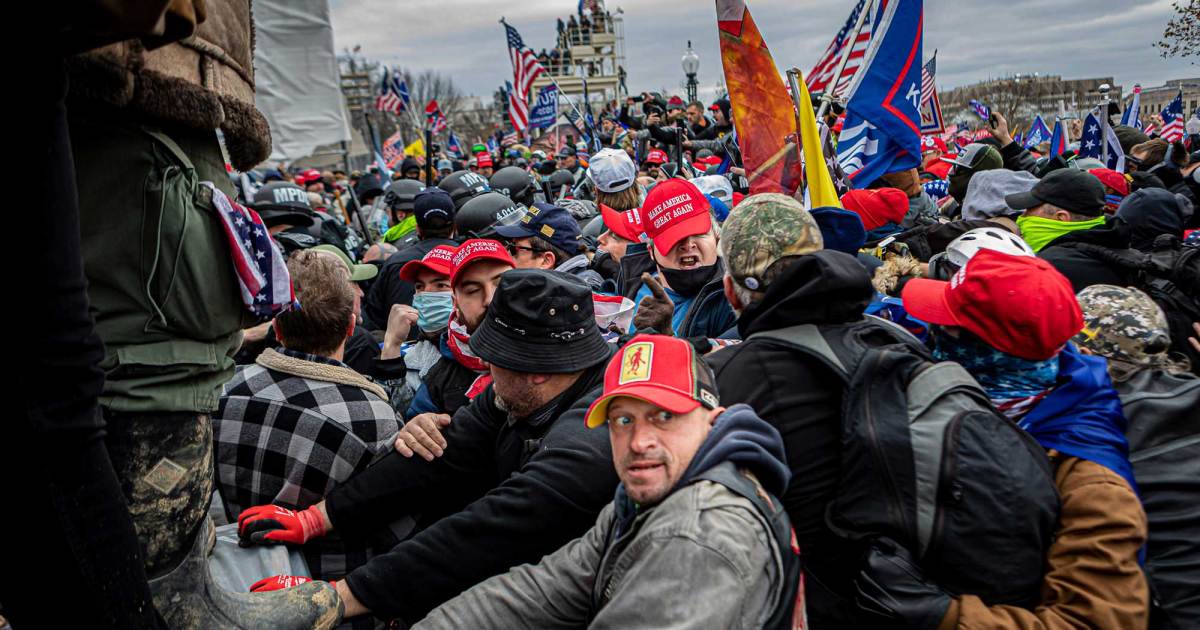
It’s been five years since a mob of thousands of Donald Trump supporters—which included Christian nationalists, white supremacists, neo-Nazis, Confederate flag wavers, militia members, and other extremists—assaulted the US Capitol to try to halt the peaceful transfer of power from an outgoing president to an incoming president. The basic facts are well established: Trump refused to accept legitimate election results. He falsely claimed he had won the 2020 contest and spread baseless lies and conspiracy theories about the election. He spent weeks scheming to overturn the election and remain in power. Promoting these falsehoods, he incited that insurrectionist attack on Congress in which more than 140 law enforcement officers were injured. While the melee was occurring, he abandoned his duty to defend the Constitution and waited 187 minutes before calling on his brownshirts to leave the Capitol.
Like the Party in Orwell’s dystopia, Trump and the Republicans have sought to rewrite history and erase the stain of Trump’s profound betrayal of America.
This is all undeniable. Yet Trump and his cult refuse to accept these fundamentals. Like the Party in Orwell’s dystopia, Trump and the Republicans have sought to rewrite history and erase the stain of Trump’s profound betrayal of America. He pardoned the violent marauders, and his henchmen in charge of the FBI and Justice Department have fired agents and prosecutors who participated in the investigation and prosecution of these thugs. And Trump’s MAGA legions mounted a disinformation campaign that advanced various conspiracy theories—the FBI did it! Antifa did it!—to absolve Trump and his thugs.
More important, an entire political party and tens of millions of American voters memory-holed Trump’s war on American democracy and his embrace of political violence. What is perhaps the gravest transgression ever committed by a US president has been airbrushed out of the picture and the perp allowed (by a majority of voters) to return to the scene of the crime. This is one of the most worrisome turns in American history. If our democracy cannot protect itself from such peril and repel such a dangerous threat, can it survive?
Trump’s triumph over reality was made clear this past week. On New Year’s Eve—one of the deadest times for the news cycle—the Republicans on the House Judiciary Committee released the closed-doors testimony it had recently received from Jack Smith, the special counsel who led the investigations that indicted Trump for conspiring to overturn the 2020 election and for allegedly swiping highly sensitive White House documents. Both cases ended after Trump won the election in November. (Under Justice Department policy, a sitting president cannot be prosecuted for federal crimes.)
Smith insisted on a public appearance, apparently knowing he had the goods on Trump. The Republicans said no and questioned him in a private session—all the better for controlling the narrative.
Smith, as you know, has been repeatedly denounced by Trump as a lunatic who waged witch hunts and investigated hoaxes generated by his fellow Deep Staters, the Democrats, and the media. And Republicans hauled Smith in as part of their never-ending crusade to find (or concoct) evidence to bolster Trump’s paranoid fantasies and conspiracy theories—and to buttress their hyperbolic charge that Trump and Republicans have been the victims of what they call the “weaponization of government.”
Smith insisted on a public appearance, apparently knowing he had the goods on Trump. The Republicans said no and questioned him in a private session—all the better for controlling the narrative. The fact that they made public the transcript on a holiday night tells you what you need to know about who got the best of whom.
The 255-page transcript is an important document that every citizen should read. (I know, I’m being fanciful.) Smith ran circles around the GOP committee members and their staff. “Our investigation developed proof beyond a reasonable doubt that President Trump engaged in a criminal scheme to overturn the results of the 2020 election and to prevent the lawful transfer of power,” Smith said at the start. He added, “Our investigation also developed powerful evidence that showed that President Trump willfully retained highly classified documents after he left office in January of 2021, storing them at his social club, including in a ballroom and a bathroom. He then repeatedly tried to obstruct justice to conceal his continued retention of those documents.”
Trump tried to take advantage of this spasm of cop-beating violence to illegally remain in office. That foul deed should have disqualified him from ever holding any position of authority. Yet…
Smith patiently explained how Trump’s (alleged) crime related to January 6: “January 6th was an attack on the structure of our democracy in which over 140 heroic law enforcement officers were assaulted. Over 160 individuals later pled guilty to assaulting police that day. Exploiting that violence, President Trump and his associates tried to call Members of Congress in furtherance of their criminal scheme, urging them to further delay certification of the 2020 election.”
This is an accusation that sums up Trump’s perfidy: He tried to take advantage of this spasm of cop-beating violence to illegally remain in office. That foul deed should have disqualified Trump from ever holding any position of authority. Yet…
A key exchange occurred when a Republican staffer (whose name is redacted in the transcript) asked, “The President’s statements that he believed the election was rife with fraud, those certainly are statements that are protected by the First Amendment, correct?” This has been a central contention of the Trump cult: You cannot prosecute Trump for stating his opinion that the election was rigged against him. But Smith fired back: “Absolutely not. If [these false statements] are made to target a lawful government function and they are made with knowing falsity, no, they are not.” Statements made to promote a fraud are not protected by the First Amendment.
Later on in his testimony, Smith remarked that the elections case against Trump was much like an “affinity fraud”—that’s when, he said, “you try to gain someone’s trust, get them to trust you as a general matter, and then you rip them off, you defraud them.” Trump, he told the committee, “had people…who had built up trust in him, including people in his own party, and he preyed on that.” And once again, Smith reiterated, fraud is not covered by the First Amendment.
This Republican staffer took another shot at it and said, “There’s a long history of candidates speaking out about they believe there’s been fraud [in an election]…I think you would agree that those types of statements are sort of at the core of the First Amendment rights of a Presidential candidate, right?”
Not at all, Smith replied: “There is no historical analog for what President Trump did in this case. As we said in the indictment, he was free to say that he thought he won the election. He was even free to say falsely that he won the election. But what he was not free to do was violate federal law and use knowing—knowingly false statements about election fraud to target a lawful government function. That he was not allowed to do. And that differentiates this case from any past history.”
The Republicans kept trying to mount a theoretical defense for Trump. This staffer pointed out that during the hullabaloo over the 2020 election, Trump was receiving information on supposed election fraud from Rudy Giuliani, John Eastman, Jeffrey Clark, and Sidney Powell, and he asked, wasn’t Trump just “regurgitating what these people have told him?”
Smith had a sharp retort:
No. And, in fact, one of the strengths of our case and why we felt we had such strong proof is all witnesses were not going to be political enemies of the President. They were going to be political allies. We had numerous witnesses who would say, “I voted for President Trump. I campaigned for President Trump. I wanted him to win.” The speaker of the house in Arizona. The speaker of the house in Michigan. We had an elector in Pennsylvania who is a former congressman who was going to be an elector for President Trump who said that what they were trying to do was an attempt to overthrow the government and illegal. Our case was built on, frankly, Republicans who put their allegiance to the country before the party.
Call 911. There was a murder in this Capitol Hill office, as Smith decimated the various lines of defense Trump’s handmaids hurled at him. He forcibly denied Trump’s indictments were political acts or that his office had been “weaponized.” In an exchange with Rep. Pramila Jayapal (D-Wash.), he explained the importance of his investigation.
Jayapal: What happens if there is election interference and the people who are responsible for that are not held accountable?
Smith: It becomes the new norm, and that becomes how we—how we conduct elections.
Jayapal: And so the toll on our democracy, if you had to describe that, what would that be?
Smith: Catastrophic.
The Smith transcript generated headlines…for a day. Like most everything else in our information hypersphere, this story did not have much staying power. Trump’s attempt to blow up the constitutional order has become old news. Ho-hum. He got away with this allegedly criminal act because he won the election. His pardons of the violent criminals who attacked hundreds of cops is just one item on a long list of outrages that quickly come and go.
Many Americans, it seems, couldn’t hold on to a clear memory of January 6 for even a few years—or couldn’t be bothered to.
A high-profile public appearance in which Smith vigorously presented the case against Trump might not at this point change the overall public perception of Trump’s attempted power grab and the violent raid he triggered. But that would have drawn more attention and served the truth. Which is why Rep. Jim Jordan (R-Ohio), the chair of the committee, and his fellow Republicans made damn sure that did not happen.
Today is the fifth anniversary of January 6—a shameful day in American history. And in the last election, the nation—or about half of its voters—welcomed back into the house the arsonist who tried to burn it down. The past 10 years have sadly showed us that a wannabe authoritarian in the United States can succeed in denying reality and wiping away history. Trump did that with the Russian attack on the 2016 election, which he aided and abetted by echoing Vladimir Putin’s false claims that Moscow had not intervened and by insisting ad nauseum that it was a hoax. And he has done the same with January 6, hailing it a “day of love” and “a beautiful day” and calling the rioters “great patriots.”
Many Americans, it seems, couldn’t hold on to a clear memory of January 6 for even a few years—or couldn’t be bothered to. This demonstrates how susceptible people can be to what the Party did in 1984: Erase the past (even the most recent past) and then erase the erasure.
Trump is back in the White House, pushing his agenda of authoritarianism far beyond what he could only dream of during his first term. Future historians—if there is history in the future—will wonder about much in this era. But what might puzzle them the most is how the man who nearly annihilated our constitutional republic was able to worm his way back into the presidency. Gore Vidal once referred to the nation as the “United States of Amnesia.” On this dark anniversary, it’s good to remember that Trump is in power today because there’s been too much forgetting.