




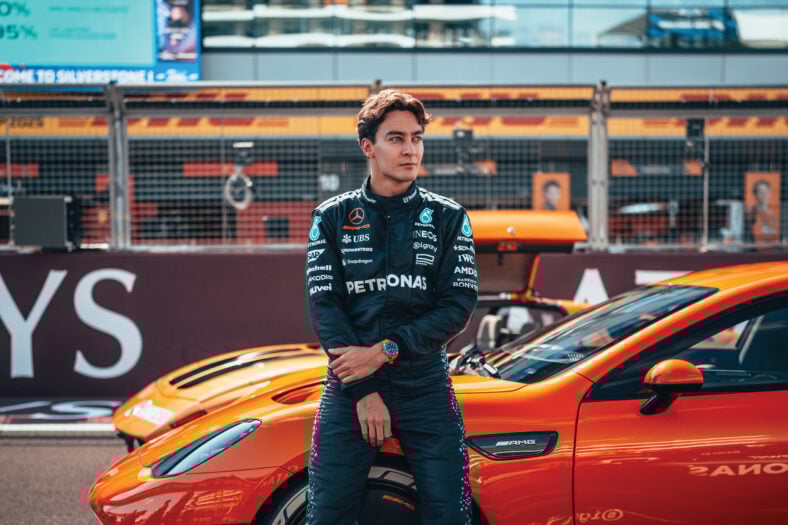

George Russell is a man in the midst of a transformation. When the fresh-faced Formula One driver first arrived at the Mercedes-AMG Petronas headquarters in 2022, his role was well defined. Sharing the garage with none other than Lewis Hamilton—the seven-time Drivers’ Champion, considered by many the greatest driver in the history of the sport—Russell’s duty was to support Lewis in every way imaginable, while simultaneously ensuring he racked up points for the team along the way. His success out of the gate was remarkable, scoring a pole position in Hungary and even winning his first Grand Prix in São Paulo in his inaugural season with Mercedes. At its completion, Russell finished an impressive fourth in the World Drivers’ Championship.
Now, just a scant three years later, the prodigious English driver commands the drivers’ room. When Hamilton shocked the motorsport world by leaving AMG for rival Ferrari, Russell graduated from cub to alpha lion, looked upon to lead his storied team once again to glory. While the McLaren duo of Lando Norris and Oscar Piastri dominated the 2025 season, Russell kept his team competitive in nearly every race—reaching the podium 9 times and claiming the checkered flag in Montreal and Singapore. The extremely quick, balanced and cerebral driver ended the season fourth in the standings in a thrilling season that came down to the last race.

We caught up with Russell just before the Dutch Grand Prix to find out how he’s tackling these newfound alpha responsibilities, his hopes for next season, and if he’s noticed the growing global support for his on-track grit.
When you first entered the Mercedes-AMG Petronas garage you were driving under Lewis Hamilton. And now, as you enter your prime, here comes a promising but inexperienced driver to learn under you. How have you processed this evolution?
When I came into Mercedes, I had three years under my belt [at Williams Racing], but I was new to the team, and I wanted to use my ears more than my mouth, if you know what I mean. I wanted to sort of soak in all the information and see how Lewis does his business, because it’s clearly worked for so long. And over time I became more confident, and the team was giving me an equal voice within. So naturally, when Lewis moved on to Ferrari, and with Kimi [Antonelli] joining the team being naturally so young, it was just a natural transition. We’re in this process now of trying to rebuild the team to get back to winning ways.
Some people are very quiet and like to remain in the background, while others prefer to grab the reins of leadership. How have you enjoyed this post-Lewis role?
I recognize our job as drivers is far more than just driving the car on a Sunday. We have to help direct the team with development, giving our feedback, what we’re feeling from the race car. We’ve got to lift the team up through times of struggle. We’ve got to keep on pushing the two-and-a-half-thousand people who work for the team. So, you recognize that if you can tick all of these boxes and get all of the troops behind, pushing in the same direction, ultimately it is only going to benefit yourself. And drivers are notoriously quite selfish individuals.

I want to win, but I need everybody within the team to bring their A game, as well as myself, to get that opportunity. And I think when you hold yourself to such a high standard, you know that puts pressures on your co-workers. And when they push themselves to such high standards as well, and you see them operating at the best of their ability, that puts the pressure back on you to ensure you’re maintaining that level. So it goes both ways, and I’ve sort of enjoyed this season. But of course, Formula One is a challenging sport, and to find yourself in the right path to success it’s like turning an oil tanker, you know. And if you’re pointing slightly in the wrong direction, to get that oil tanker lined up and on the right track to success isn’t a matter of overnight work. It’s a matter of everybody contributing, and that’s what we’re working towards.
One thing that fascinates me about F1 drivers is how you psychologically handle a season when you know you’re probably not going to win the championship. How do you look forward to a race when you know it’s going be very, very difficult to win? Do you ever consider it a lost season?
I think drivers who treat a season when they’re not winning as a lost season lose their chance when the opportunity does come. So, I’m treating every single race I go to as if this is going to be the race that we’re going to win, and I need to bring absolutely everything to it. And I know my opportunity will come. I don’t know if that will be next year, in two years, five years, or 10 years, but I need to keep performing at the highest level of my ability to then be ready for that moment.

And you look at it with the McLaren guys just two years ago, they were the slowest team on the grid. Nobody would have predicted they would be winning the championship in two years’ time, and if they gave up in that moment and just said, “This is a lost season,” they probably wouldn’t be winning a championship now. As I said, we’re all these troops, and we’ve got to keep on pushing, pushing that oil tanker to be pointing in the right direction.
Every several seasons in F1, there’s a major rule change, a reshuffling of the deck. One such shakeup is coming next year. With a championship team like Mercedes-AMG behind you that has the proven track record of starting these refreshed decks in a good spot, do you look forward to seeing what next season brings?
Yeah, absolutely. We’re not giving up on this season, but we know we’re not going to be winning the championship this year, and we recognize next year is a huge opportunity. I can’t wait. There are 20 drivers currently who can’t wait. There are two drivers, you know, who are both in orange at the moment, who are quite enjoying the season as it is, but everybody’s looking forward to that new opportunity of new successes.
“I’m treating every single race as if this is going to be the race that we’re going to win, and I need to bring absolutely everything to it. I know my opportunity will come.”
George Russell

As a director for the Grand Prix Drivers’ Association, how do you balance keeping the sport entertaining with optimizing safety? How does that unique role play in your thoughts?
Well, there’s no reason why the cars can’t be as safe as possible, while the sport is as entertaining as possible. There’s no reason why those two things can’t co-exist. And what makes the sport entertaining is good racing, good overtakes, these glamorous destinations that people love to see F1 go into. Actually, the people, if they see the cars are slightly safer or slightly more unsafe, I don’t think that has a huge sway in their viewpoint. And for me, I’ve unfortunately had friends of mine lose their life with crashes. I’ve had friends of mine had legs amputated in crashes, When somebody so talented has an unfortunate incident, and you see that outcome, you want to try to contribute to improving the safety. If one of my friends could still be here today if things were slightly different…. [pause] I want to ensure that doesn’t happen to any of us moving forward. And those incidents don’t discriminate.
How do you personally balance risk? Have you shifted in you what you consider acceptable and unacceptable risk? Or are you just as balls out as ever?
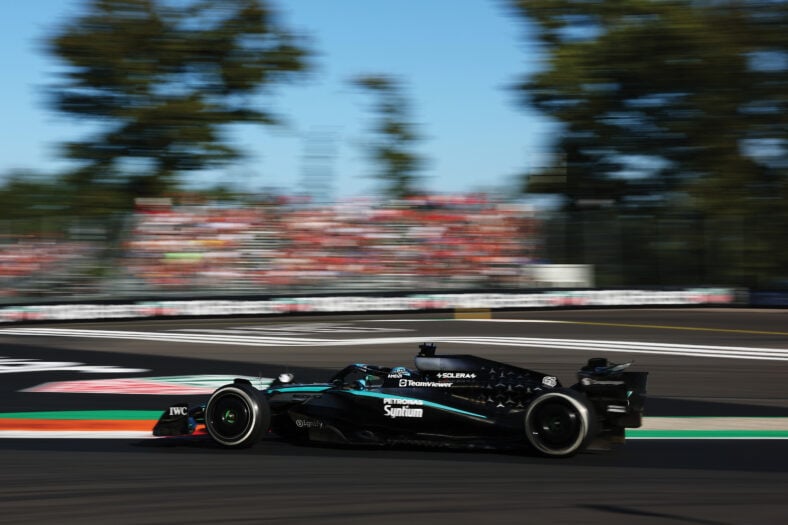
Yeah, I’m definitely as balls out as I once was. But I think there’s a difference between high risk and stupid risk. I see guys who do things that are just reckless, and it’s very high risk, whereas the top guys can put it all on the line and still avoid those reckless moments. Going into a corner that isn’t flat out and trying to do it flat out isn’t risky—that’s stupid. But if you believe, and you’ve got the confidence in the machine beneath you—I think this can be flat. Now is the moment. This is the last part of qualifying—I’m going to go for it. It’s not the first lap of the weekend, in the first practice session, that is where you need to be sort of smart about it. To answer your question, it hasn’t really shifted. I’ve always been quite wise I’d say when it comes to that.
What was the best lesson you learned from sharing a garage with Lewis Hamilton, either explicitly or just by observing him in action?
I think the biggest thing I learned from him is just how he kept the morale around the team so high, even through moments of difficulty. You know, he was a true leader within this team, and he was a true hard worker. He was the first in, last out, and that set the standard for everybody else within the team.
So it wasn’t standing up to bullies on the track?
No, it wasn’t [chuckles].
Because there seems to be a lot of groundswell support for how you’ve stood up to some drivers that fans feel need to be pushed back on a little bit.
I’m just standing for my own values, I didn’t do anything for public approval or anything. I just stand for my values and how my parents raised me to be.
This article originally appeared in Maxim’s Winter 2025 issue.