








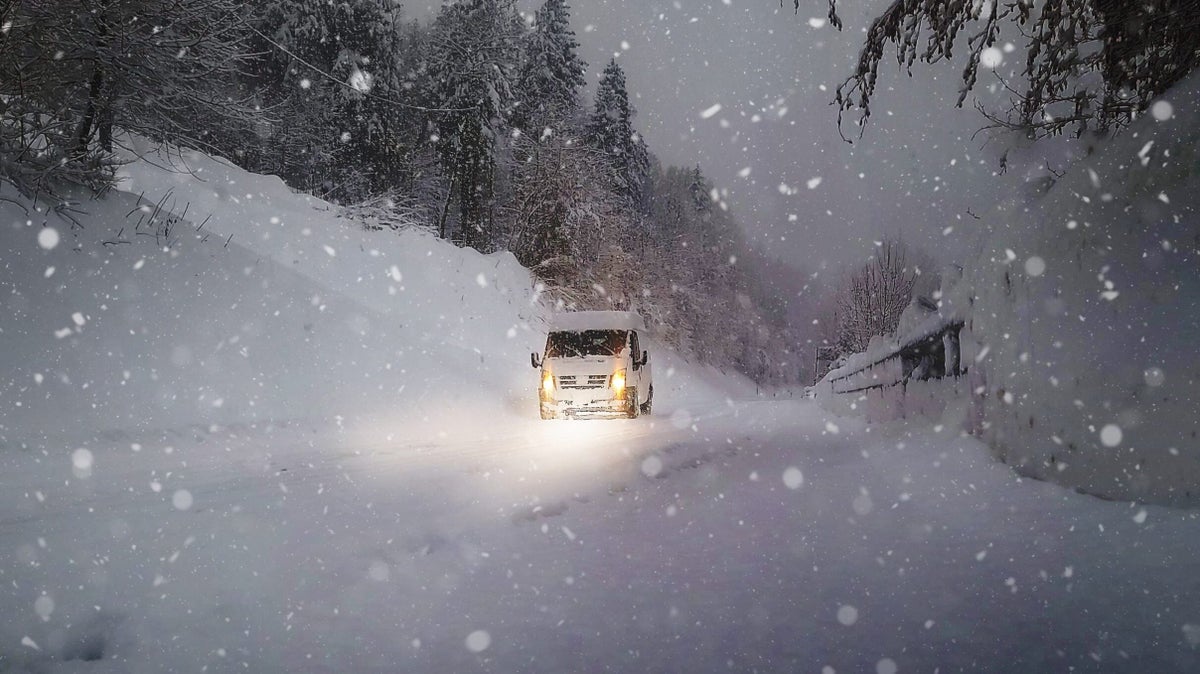
No one ever anticipates getting caught in a blizzard. But a gentle flurry can whip into a violent whiteout storm in a matter of minutes. The best way to survive severe winter weather is to always prepare for the worst, and as weather grows ever more unpredictable, getting stuck on the road or in the mountains, even when you’ve checked the forecasts in advance, could happen to any of us.
“Winter has teeth,” says Harding Bush, associate director for security operations at Global Rescue. “Preparation and planning are essential if you’re heading out into the elements.”
I learned this all too well when I was in college in Boston. I attempted to drive home to New Jersey in my 1980 Volkswagen Rabbit in what started as a light snow storm. By the time I left the Massachusetts border, both of my windshield wipers had blown off the car, and I couldn’t see 100 feet in front of me. Terrified, I pulled into a gas station, and the attendant convinced me to wait out the storm in the warm convenience store rather than try to forge ahead or hunker down in my car.
According to the National Weather Service, a blizzard is a combination of blowing snow, with winds in excess of 35 miles per hour and visibilities of less than one quarter mile for at least three hours. If you’re on the road, your instinct may be to outdrive the storm, but the lack of visibility can become treacherous. The U.S. Department of Transportation estimates that 900 people are killed and nearly 76,000 injured in vehicle crashes during snowfall each year.
“I recall driving from Colorado Springs to Denver in a whiteout and I got caught between two semis,” says Dan Baird, head instructor and owner of California Survival School, the largest wilderness survival training program in the United States. “I was blinded by white stuff at every curve in the road. It’s not a situation you want to be in.” As soon as road conditions or visibility start to deteriorate, you should pull off the road to a safe location and wait out the storm, he advises.
Be Prepared: Winterize Yourself and Your Vehicle
It may be 60 degrees and sunny at your house, but if you’re planning to drive through a cold area,you should be dressed appropriately, says Baird. “I see plenty of people leave San Francisco in board shorts and flip-flops to drive to Big Bear [Mountain] to hot tub at a friend’s cabin and then their Tesla gets stuck. You should ask yourself if you’re forced to be in the elements for a few hours, will you freeze in what you’re wearing?”
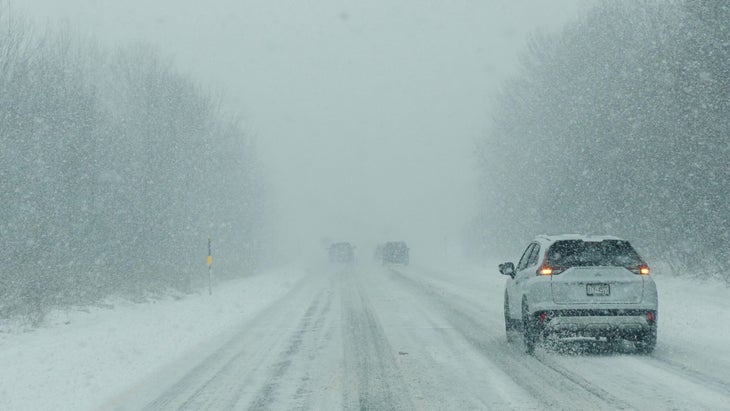
Nearly 70 percent of the U.S. population lives in snowy regions. Even if you’re just driving to grandma’s house, your vehicle should be winterized with proper tires, de-icer, durable windshield wipers, and it should be stocked with a snow brush, an ice scraper, and a winter emergency kit. And always set out with a full tank of gas or fully charged electric vehicle.
Stephanie Fox, national spokesperson for the American Red Cross, says that a winter kit should include:
- high-energy, non-perishable snacks
- a gallon of water per person
- flashlight with extra batteries
- first aid kit
- power banks to use as battery backups
- blankets or sleeping bags
- rain gear
- extra sets of dry clothing, mittens, socks, and hats
- newspapers for insulation
Wool clothing and blankets are preferred, says Baird. “Anything wet against your skin rips heat off the body 25 percent faster than dry air,” he says. “Wool retains about 80 percent of the heat even when damp or wet. That’s why it is such a good base layer.”
Arthur Knapp, founder of Arcturus Primitive Skills Institute in Michigan recommends stocking the car with a shovel, a head lamp or flashlight, a tow strap, a brightly colored bandana to use as a signal, dehydrated meals and a portable stove, and kitty litter. “The gritty stuff can provide traction for your tires in case you get stuck,” he explains. Another hack is to pack a candle and a can of Crisco. “You can break off the candle, stick it in the lard, light it and you’ll have a heat source for at least three days,” he says.
What to Do If You Become Stranded
If you have to pull off the road, stay in the vehicle, remain calm, and wait for help. “It’s easier for rescue folks to find you in a car,” says Bush. Fox advises not to leave the vehicle to search for assistance unless help is visible within 100 yards. “Display a trouble sign to indicate you need help, like hanging a brightly-colored cloth on the radio antenna,” she says. If you have a brightly-colored blanket and sleeping bag and don’t need it for warmth, Bush suggests draping it over the roof of the car so your vehicle is more visible to search and rescue.
Regulating your body temperature is critical. If you have a gas vehicle, turn on the engine for about ten minutes each hour. One hour of run time is the equivalent of around one gallon of gas. While the engine is running, use the heater and leave the overhead light on for extra visibility. It’s important to keep the exhaust pipe clear of snow to prevent carbon monoxide poisoning and crack open a downwind window for ventilation. Baird says electric vehicles tend to have more efficient heaters. His tip is to amp up the seat warmers.
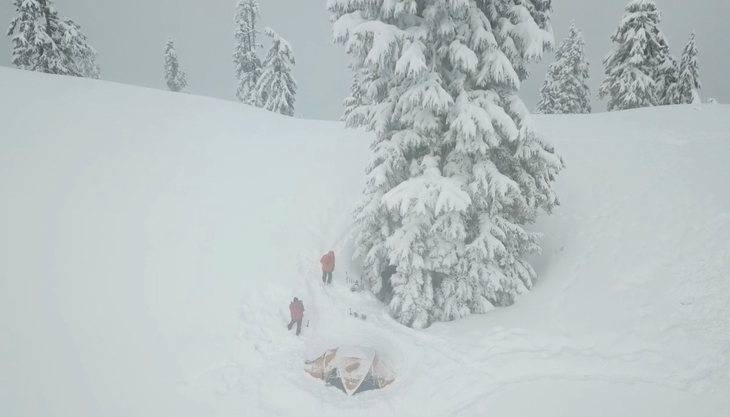
Hypothermia is a real threat. You may not feel thirsty or hungry, but try to drink fluids to avoid dehydration, which can make you feel more susceptible to the ill effects of cold, says Fox. To stave off hypothermia, do light exercises to keep up circulation and clap your hands and move your arms and legs occasionally. “If more than one person is in the vehicle, you should huddle together for warmth,” says Fox. “Wrap yourself in newspapers, maps, and even the removable floor mats to help trap more body heat.”
If you begin to feel numb or weak, lose consciousness, exhibit a glassy stare or impaired judgment and extreme shivering, call 911 for help. Baird notes that even iPhones have satellite capabilities these days.
If You’re Out on the Trail
If you aren’t in a vehicle, similar rules apply. Head out hiking or ski touring with a pack stocked with layers, food and water, a first-aid kit, and a winter emergency kit. If weather turns bad, don’t panic, says Knapp. “I tell people to assess the situation in three concentric rings,” he says. “Take ten minutes to take stock of what you have in your pack, what’s immediately around you, and what is in sight up to the horizon.”
He advises hikers and skiers to always carry three ways to start a fire: waterproof matches, a windproof lighter, and a ferrocerium rod (also known as a spark rod). The latter will give you 1,000 fires, he says. The rod should be about six inches long and a half-inch in diameter so you have enough surface area to create a spark with a shard of glass or a knife.
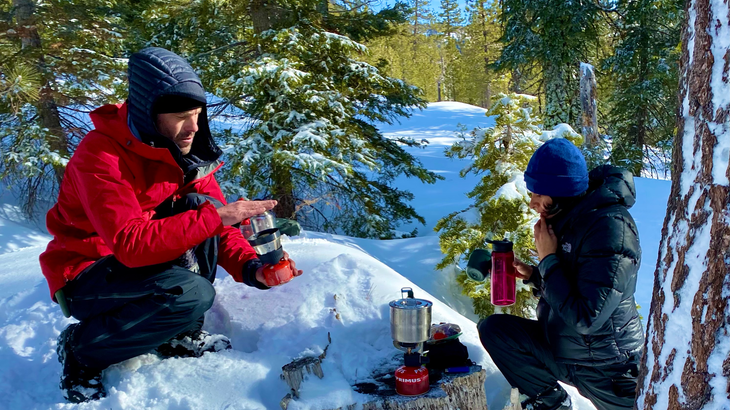
When the sun starts to set, you need to seek shelter. California Survival School’s three-day, cold weather survival course teaches students to build a snow shelter, among other skills. If you don’t have any tools, Knapp recommends creating a framework from branches and covering it in tree bark and other debris that can trap body heat. Or sit on your skis or pack, he says; lean against a tree and drape a reflective blanket around your shoulders and try to light a candle inside to create a heat source.
If you run out of water, you may be tempted to eat the snow. Don’t. It will lower your core body temperature. To melt the snow in a pinch, find any metal container, even a discarded energy drink can, and melt the snow in it, says Knapp.
Whether you’re driving to the ski slopes or ski touring in the backcountry, always tell someone your plan, says Baird. “If you check off those small safety steps before you set out, it can prevent a big disaster.”
Jen Murphy is a regular contributor for Outside. After driving unprepared in a blizzard in college, she now keeps her car stocked with a wool blanket and a winter emergency kit.
The post Trapped in a Blizzard? These Expert Tips Will Help You Survive appeared first on Outside Online.