








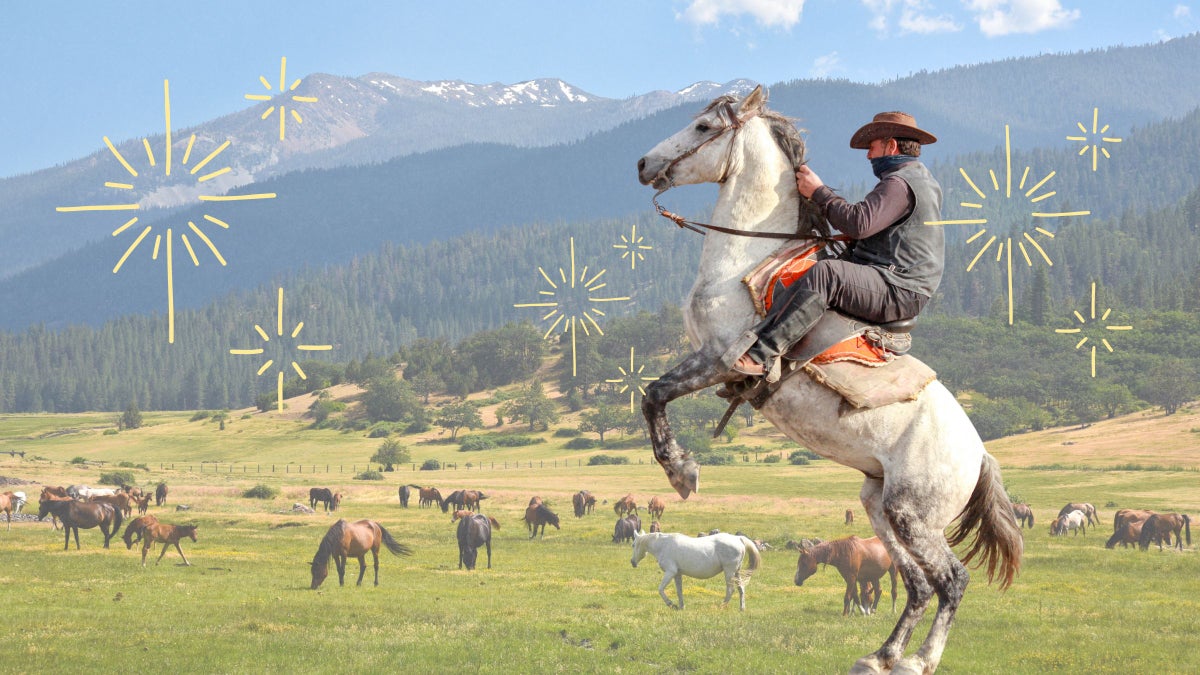
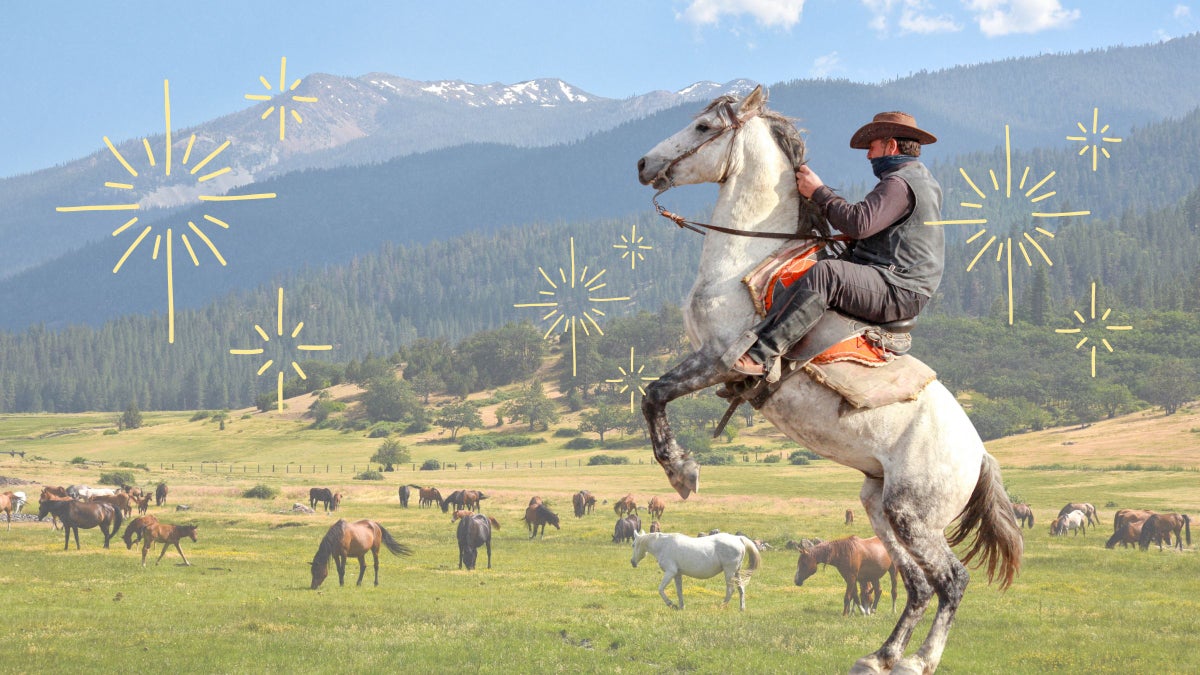
If you’ve watched Yellowstone, read a dime Western, or been to a rodeo, you’ve probably got some preconceptions about what the cowboy life was like—and might understandably assume that, as a career, it’s gone the way of wheelwright or chimney sweep.
You’d be wrong. In ranching enclaves across the Rockies and Great Plains, the Wild West lives on. A number of big beef operations still do things the old-fashioned way: running cattle and riding fence on horseback. But the folks who specialize in this niche career say not to let the movies fool you; cowboy life isn’t all swaggering into saloons and riding off into the sunset.
More often, it’s waking up at 3:30 A.M. because the horses gotta get fed, and going to sleep at midnight because someone’s got to ride them. It’s fighting grizzlies off a mule team in Northern Montana and tracking runaway calves across Wyoming’s open range. It’s rides that leave your legs aching, your lips cracked, and your skin crusted in salt. It’s kneeling in the dust beside a calf you just couldn’t save.
The pay is bad—it shakes out to around $10 to $14 an hour, even for the folks who are good at what they do. And unless you’ve got a steady gig with a year-round outfit, it’s pretty hard to cobble together enough health insurance to cover the bones you break riding in your downtime. But for those who fall in love with the lifestyle, the money soon stops mattering.
To understand why, we spoke to a full-time cowboy making his living in the American West. He’s driven cattle, broken horses, and been thrown from the saddle in some of the most rugged country on earth. Here’s what life looks like from where he’s standing.
The Gig at a Glance
Job Title: Cattle Boss
Age: Mid-thirties
Years in the Business: 20
Starting Salary: $21,600
Current Salary: $48,000
Is Cowboy Life a Dying Art?
There aren’t a lot of people roping or riding horseback anymore. Young people aren’t taking the time to learn it, and teachers aren’t taking the time to teach it. A lot of the people who get brought up on ranches grow up and move away. The other problem is that the land is disappearing. Well-off people are buying small ranches just to turn them into a getaway place. It’s killing our heritage.
So, How Does One Become a Cowboy?
My initiation was waking up with my dad and feeding horses. We had roughly 100 head of cows, 85 head of broodmares, and 5 studs. As a kid, I was always hearing about riding and ranching, and I told myself I wanted to live that life. It’s like reading a book or seeing an old Western—you start hearing stories, and you want to write your own.
When I was 18, I applied for a ranch hand job. There were a lot of folks who said I could never support a family doing this work. But I laughed at them. I said, ‘Just watch. I’ll be the best I can at my trade, and I’ll make a living on it.’ And I did.
What Was It Like Growing Up a Rancher’s Kid?
By the time I was six years old, I was doing dishes, folding laundry, and helping my dad with the animals. We were always taught that no one eats breakfast until the animals are fed. By my teenage years, I was waking up at 4:30 so we could have the chores done before school.
I bet 15 percent of the kids in my grade were from ranching families. I mostly hung out with them, and we were always trying to one-up each other: “I just helped my dad calve 160 head of first-time-calf heifers.” Or, “I helped my dad start 12 colts,” or “I got bucked off twice this weekend.” It was all about the bragging rights.
What Time Do You Wake Up in the Morning Now?
I wake up between 3:30 and 4 A.M. and do my computer work. By 5 A.M., I’m off and running. I make sure my equipment is ready, then I go feed until about 6:30. We have a meeting at 7, so I’ll make that if I can. Then it’s either ride or fix fence. There are some days I’d rather be riding than fixing fence, but you just do what needs to be done.
In the afternoon I take a 15-minute break to spend some time with the kids, and then I hit the ground running again. I try to be done by 5 P.M., but if I have my own horses to ride or my own stuff to do, I do that from 5:30 onward. A lot of times I get done by midnight or 2 A.M.
So You Get Two Hours of Sleep a Night?
Well, I try to get four hours, but it’s two sometimes. I do that all week, and then I crash on a Sunday: I’ll go to bed at 8 P.M. on Saturday and sleep in until 7 A.M.
What Do You Like Most About Your Job?
I love the freedom. There are a lot of people who talk about being either rich on life or rich on money. With this work, you’re rich on life for sure. You’re riding horses, working with cows, and working with good people. You’re on horseback, seeing new country just about every day.
On the ranch I work now, we do everything on horseback, the old-fashioned way. My kids can taste that heritage. And it’s there for them if they want it.
What’s the Most Challenging Part of Being a Cowboy?
In ranching you can never control anything. You can schedule and plan, but you just gotta be prepared for the worst. Take calving season. You’re there to support that new mother, but Mother Nature has full control, and she’ll take those baby cows from you as fast as you can blink.
Then there are times when the baby’s alive, and then out of nowhere you get a crazy heifer who turns around and kills it because her mother instinct is too much. Those are gut-wrenching moments. It makes you realize that time is really short, and a lot of us take it for granted.
Do You Ever Get Used to Losing Animals?
It was worse when I was younger, that’s for sure. The first time I saw an animal die, I was helping my dad with a broodmare. She gave birth to a foal, and it was dead. I’ll never forget that. I bawled my eyes out. Same thing when I did 4H. The first pig I ever sold, I cried and cried. You put your heart and soul into something, and then you realize the name of the game is to sell it so you can provide for other people.
Now I just try not to get caught up in it. Sometimes things are just out of your control. You can’t change it. You can only try your best to keep all the babies alive that you can.
What’s Your Wildest Near-Death Experience?
I’ve flirted with death more times than I can count. I used to say I could ride anything that had hair on it, and that got me into trouble sometimes. The first year I worked out here, I was in charge of the mountain country. Sometimes, I’d go out in the middle of it with a bunch of untouched colts and make ‘em into something. I’d be in wrecks all the time—breaking tack and getting thrown, and doing all that without another soul for 12,000 acres. There’s something satisfying about taking an animal everybody said was only fit for the kill pen and bringing home a horse you can ride.
One time I was riding a string of horses in Montana. It was 46,000 acres, and we ran 6,000 head through it on 7 horses a day. At one point, a group of yearlings tried to bolt and get loose, so I sent my dog out to one side of ‘em, and I rode around the other side to cut them off.
But the footing was terrible—it was all clay, nasty and gumbo-y, all along the edge of this reservoir. I was riding a big horse, and he slipped, and he couldn’t get his footing, and he bailed—and jumped right into the middle of the reservoir with me on him. We were both cold-shocked, and we both swam back to the bank, freezing and shivering. But we got the yearlings.
Are You Still an Adrenaline Junkie?
I’m more of a family man now. So if I can get through the day and spend time with my family—that’s what makes the wheels spin around on this big bus of mine. Just seeing my sons on horseback, being happy. It makes you realize you’ve made the right choices for your kids.
Are You Raising Your Kids to Be Cowboys?
They can all ride, and my older kids can drive teams. They think it’s fun. And that’s what I want them to remember.
I want them to remember that a horse is like any good machine, and you gotta take good care of it. I want them to remember that nothing is easy and that nothing comes for free. I want them to remember how it feels to be out in open country. But if they choose to chase their own dreams, that’s OK with me.
What Do You Wish More People Understood About Your Work?
It’s not a Yellowstone episode. On a real working ranch, there aren’t usually expensive horses or expensive equipment. It’s gritty, and it’s scrappy, and it’s a serious operation. There’s not a lot of glamour to it. If you want to do this work, you need some salt.
Any Advice for Aspiring Cowboys?
You’ve gotta have some kind of try. I don’t care if you mess up 500 times—if you’ve got interest, and you’ve got try, your teachers aren’t gonna give up on you.
Next, surround yourself with people who’ve got more knowledge than you do. Go to a ranch manager and say, “What’s your operation?” And if they say, “This is what we do and how we do it, and we like teaching younger generations,” then bam, jump on those kinds of outfits. Don’t get caught up with the hem-and-hawers and the naysayers.
Then, be a sponge. If you’ve got somebody who wants to teach you, soak it all in and don’t miss a beat.
Quotes have been edited for length and clarity, as well as to preserve the source’s anonymity.
The post I’m a Full-Time Professional Cowboy. Here’s What It’s Really Like. appeared first on Outside Online.