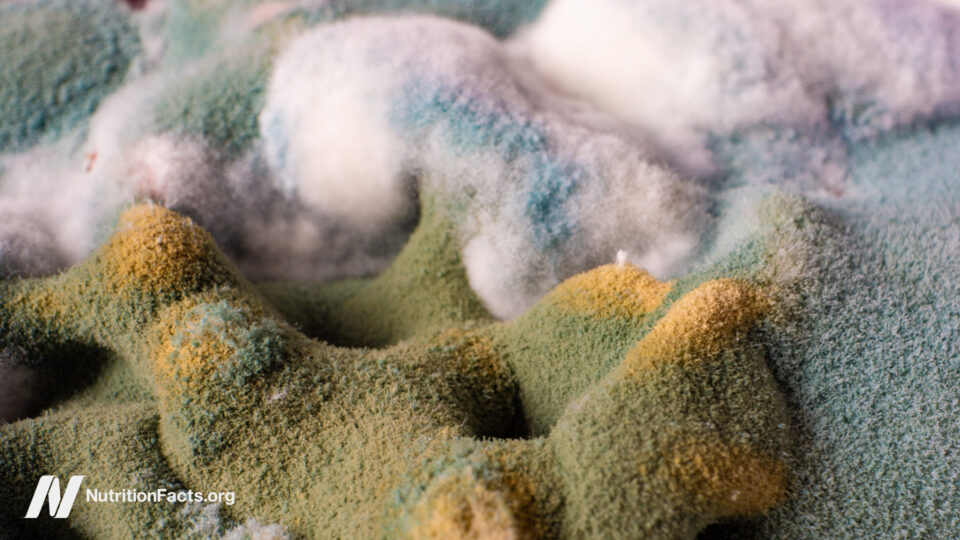









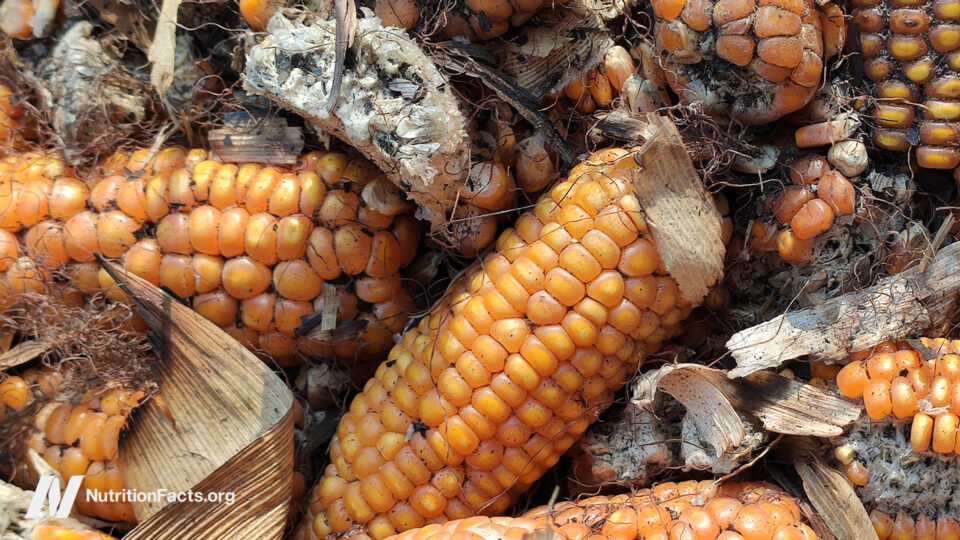
Is “toxic mold syndrome” a real thing? What do we do about toxic mold contamination of food?
In recent years, mold has been blamed for all sorts of “vague and subjective” symptoms, but we have little scientific evidence that mold should be implicated. However, this “concept of toxic mold syndrome has permeated the public consciousness,” perpetuated by disreputable predatory practices of those making money testing homes for mold spores or testing people’s urine or blood. But all these tests are said to “further propagate misinformation and inflict unnecessary and often exorbitant costs on patients desperate for a clinical diagnosis, right or wrong, for their constellation of maladies…The continued belief in this myth is perpetuated by those charlatans who believe that measles vaccines cause autism, that homeopathy works, that fluoride in the water should be removed….”
Mold toxin contamination of food, however, has emerged as a legitimate issue of serious concern, and mycotoxins are perhaps even more important than other contaminants that might make their way into the food supply. Hundreds of different types have been identified, but only one has been classified as a known human carcinogen, and that’s aflatoxin. The ochratoxin I’ve previously discussed is a possible human carcinogen, but we know aflatoxin causes cancer in human beings. In fact, aflatoxins are amongst the most powerful known carcinogens.
It has been estimated that about a fifth of all liver cancer cases may be attributable to aflatoxins. “Since liver cancer is the third-leading cause of cancer deaths worldwide, and mortality rapidly follows diagnosis, the contribution of aflatoxins to this deadly cancer is significant.” And once aflatoxin makes it into the food, there is almost nothing we can do to remove it. Cooking, for example, doesn’t help. Indeed, as shown below and at 1:50 in my video Should We Be Concerned About Aflatoxin?, once it makes it into crops or into the meat, dairy, and eggs from animals consuming those crops, it’s too late. So, we have to prevent contamination in the first place, which is what we’ve been doing for decades in the United States. Because of government regulations, “companies in developed countries…are ‘always sampling’ for aflatoxin,” resulting in nearly $1 billion in losses every year. That may get even worse if climate change exacerbates aflatoxin contamination in the Midwest Corn Belt.

So, on a consumer level, it is more of a public health problem in the less industrialized world, such as in African countries, where conditions are ripe and farmers can’t afford to throw away $1 billion in contaminated crops. Aflatoxin remains a public health threat in Africa, Southeast Asia, and rural China, affecting more than half of humanity. This explains why the prevalence of liver cancer in those areas may be 30 times higher, yet it is not a major problem in the United States or Europe.
Only about 1% of Americans have detectable levels of aflatoxins in their bloodstream. Why not 0%? The U.S. Food and Drug Administration works to ensure that levels of exposure to these toxins are kept as low as practical, not as low as possible. In California, for instance, there has been an increase in “unacceptable aflatoxin levels” in pistachios, almonds, and figs. Unacceptable in Europe, that is, so it affects our ability to export, but not necessarily unacceptable for U.S. consumers, as we allow twice as much aflatoxin contamination.
Figs are unique since they’re “allowed to fully ripen and semidry on the tree.” This makes them “particularly susceptible to aflatoxin production.” It would be interesting to know about the fig-consuming habits of the 1% of Americans who were positive for the toxin. If figs were to blame, I’d encourage people to diversify their dried fruit consumption, but nuts are so good for us that we really want to keep them in our diets. The cardiovascular health benefits we get from nuts outweigh their carcinogenic effects; nut consumption prevents thousands of strokes and heart attacks for every one case of liver cancer. “Thus, the population health benefits provided by increased nut consumption clearly outweigh the risks associated with increased aflatoxin B1 exposure.”
So, we’re left with aflatoxin being mostly a problem in the developing world, and, because of that, it “remains a largely and rather shamefully ignored global health issue….” Where attention has been paid, it has been largely driven by the need to meet stringent import regulations on mycotoxin contamination in the richer nations of the world, rather than to protect the billions of people exposed on a daily basis.
Doctor’s Note
This is the last video in a four-part series on mold toxins. If you missed the others, check the related posts below.