








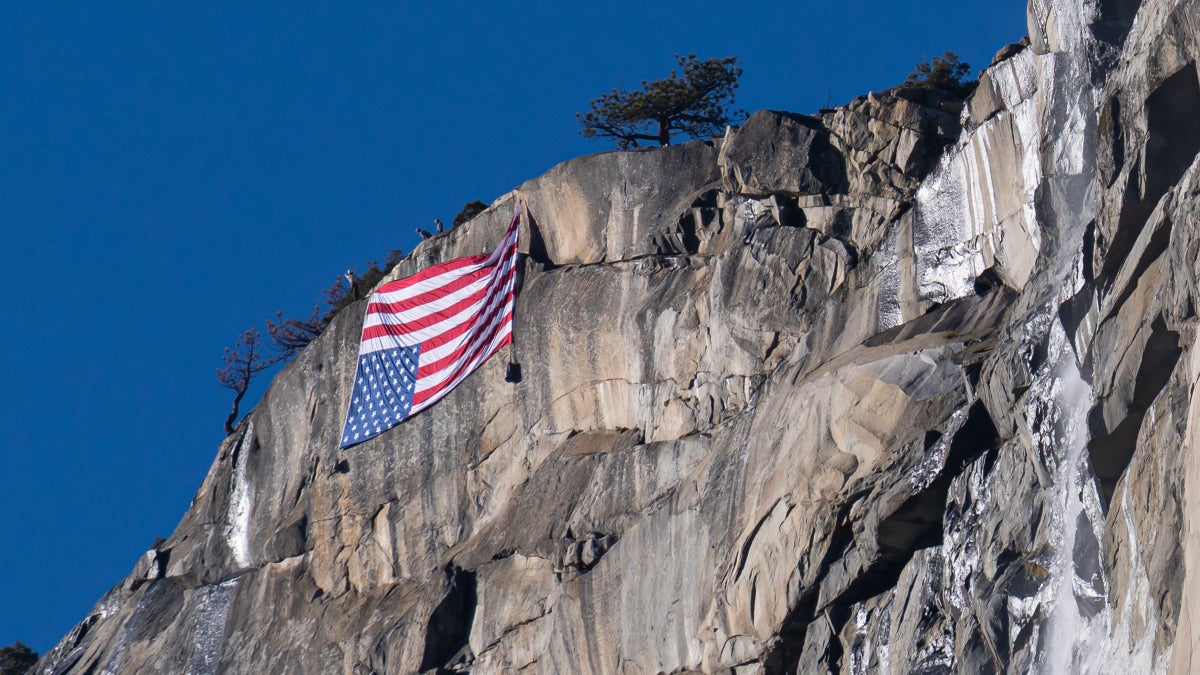
Amid Yosemite’s famous February firefall—a natural phenomenon where the setting sun makes Horsetail Fall glow like molten lava—and the swarms of visitors it attracts, an upside-down American flag waved from the side of El Capitan. It’s the sign of distress, and it marked a striking act of protest in one of the park’s most iconic places.
Soon, similar wayward banners flew through other national parks, from Joshua Tree in Southern California to Colorado’s Rocky Mountain, as part of a nationwide protest. Thousands of people recently joined roughly 1,000 National Park Service (NPS) employees who had been dismissed from their jobs two weeks earlier in a grassroots protest across 433 national park sites.
Leading the charge was the Resistance Rangers, an anonymous group of off-duty NPS employees working in almost every sector of the park service system. The rangers told Outside that they “get paid in sunsets” while opposing staffing cuts, budget reductions, and the illegal termination of probationary employees. And since the Valentine’s Day firing, the group has hosted dozens of peaceful protests supporting the park system, from teach-ins and rallies to bake sales and community gatherings.
“We’re here to safeguard the parks for future generations, and we won’t stop until the system lives up to its mission. At the end of the day, this isn’t about politics—it’s about service,” the Resistance Rangers said to Outside in a collectively agreed-upon statement.
Since President Trump took office for his second term, the NPS lost roughly one-quarter of its permanent staff, according to figures published by the nonpartisan organization the National Parks Conservation Association. And that’s on top of a 20 percent decline in positions since 2010. These cuts threaten the hundreds of sites within the national parks system, which includes monuments, historic sites, and battlefields.
“We think a lot about national parks as these really big, beautiful, iconic landscapes—glaciers, mountains, morraines, and deserts,” the Rangers told Outside. The group highlighted that the national park system expands well beyond the 63 “crown jewels” like Yellowstone and Yosemite.
“If you breathe air, you are benefiting from national parks,” said the Rangers.
At the core of the Resistance Rangers’ mission is the Organic Act, a 1916 federal law that established the NPS. As stewards of the country’s national parks and monuments, the Service is directed “to conserve the scenery and the natural and historic objects and the wildlife therein and to provide for the enjoyment of the same in such manner and by such means as will leave them unimpaired for the enjoyment of future generations.”
It’s a dual mandate, one to preserve the park and its inhabitants while also allowing for recreation, both of which can sometimes be at odds with each other. For instance, preserving the park may involve temporarily closing areas for restoration or research efforts. The Rangers say the impact of recent administrative actions has hindered their ability to fulfill the mandate, putting the future of national parks at risk.
“The Organic Act requires us to leave parks unimpaired for future generations, and right now that promise is at risk. We’ve built the Resistance Rangers to protect the parks and support the people who care for them, and we’ll keep at it until the mission is safe again,” said the Rangers.
Facing ongoing threats of closures and resource restrictions, the group aims to ensure all 85 million acres of national park land can adequately respond to climate change, continue to tell its histories, and invest deeply within connected communities through partnership building.
“The Rangers have created an interconnectedness between each park unit that didn’t exist before,” said the group. Chronic underfunding and short-term political goals over long-term preservation continue to pressure an already strained park service—but its rangers aren’t giving up so easily.
The group says it’s not going anywhere anytime soon. Looking forward, the Resistance Rangers hope to continue building capacity to fulfill the legal responsibilities outlined in the Organic Act—all to protect parks for future generations to come.
The post Meet the ‘Resistance Rangers’ Fighting to Protect Your National Parks appeared first on Outside Online.