











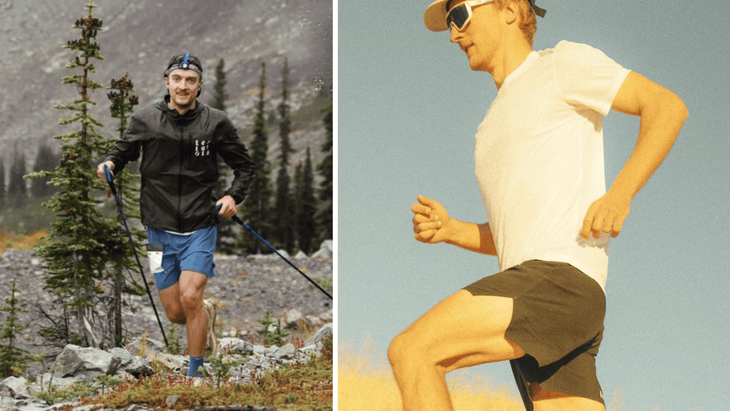
On September 27, Alex King won the Ultra-Trail Whistler by UTMB 100K by over 30 minutes. But we’re not here to talk about that. We’re here to talk about the $29 pair of shorts, and the rest of the eye-raisingly inexpensive gear, that powered him the 62 miles and 17,000-plus feet of climbing and descent to the finish line.
The shorts, t-shirt, running vest, and socks are made by Terignota, the running brand King, 30, founded last year.
“Trail running should be accessible and affordable,” he tells Outside Run, when asked about his mission to revolutionize running clothes.
At less than a year old, Terignota products have landed on multiple world-class trail racing podiums. One of its shirts won a Gear of the Year award from Outside.
“At nearly a third of the cost of other shirts, simply put, you will not find a higher quality shirt at a better price,” the Outside gear team wrote. “Crafted from 100% polyester with a woven grid pattern, it checks all the boxes: lightweight, breathable, and comfortable.”
Those are all well and good accolades, but how is King actually competing with industry big dogs in such a short amount of time, in such a novel style, all by himself? We had to learn more.
From Toe to Head
It started with two pairs of socks.
In 2024, King was training for trail and ultrarunning at a high level. His goal: throw down a breakout performance that could earn him a sponsorship. He was in Boulder, Colorado, for a training camp when he walked into a local running store to buy some running socks. He walked out $50 poorer.
“This is insane,” King recalls thinking. “I just paid 50 bucks for what, like 50 grams of fabric?”
But this $50 investment inspired a personal challenge to create a better sock for less. King started sketching his vision of what a “trail running sock” should look like and found a few manufacturers to make it. From there, he iterated on the designs. Once he was happy with the sock, he figured why stop there? The passion project snowballed, leading to more products including prototype shorts and t-shirts by mid 2024.
That August, King ran CCC, a 100K as a part of the UTMB World Series Finals. He crossed the line as the 79th man, four hours behind the winner. King left Chamonix disappointed, and also clear-headed.
“After putting an immense amount of pressure on myself and having some part of my ‘self worth’ wrapped up in CCC and then coming away with a disappointing performance, I realized performing at a high level at any given race was never going to bring me the satisfaction and happiness that I fantasized about,” King says.
After pursuing professional running for nearly a decade, a mediocre performance at the highest level had him searching for a deeper personal purpose.
“I needed to find happiness, satisfaction, and self-worth outside of performance,” he says. “I was done waiting around to have my perfect day on the world stage of trail running, get recognized by and signed by a sponsor, become a true professional athlete, and live the dream of getting paid to run. I was just going to build that damn life for myself, no matter if anyone else gave me permission.”
An Immediate Hit
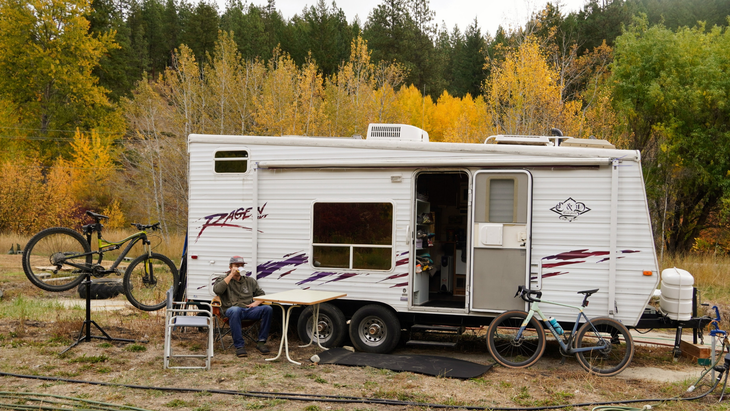
King officially launched Terignota on November 26, 2024, out of his camper trailer in Leavenworth, Washington. He started with four products: the men’s Sendero Short for $29, Trail Tee for $22, Crest Cap for $19, and the Shorthorn Socks at $9.75 a pair.
For context, running shorts from Nike, Lululemon, Tracksmith, and Janji all retail for $60-$80. And at the top of the range, Satisfy sells shorts for $180-$220.
In less than a year, Terignota has expanded to eight products, including women’s and men’s shorts, t-shirts, and Grid-Fleece Hoodie for $34, and the seven-liter Valhalla Hydration Vest for $84, which just came out this November.
And exactly one year after King’s existential crisis at the CCC finish line, the brand scored its own first big wins in the same place. Running in a pair of the Sendero Shorts that she purchased herself, Lauren Puretz finished eighth as the top American woman at the 2025 UTMB. Two days earlier, Claire DeVoe placed 12th and top American at OCC, the 50K event during the UTMB World Series Finals, in the Sendero Short and Trail Tee.
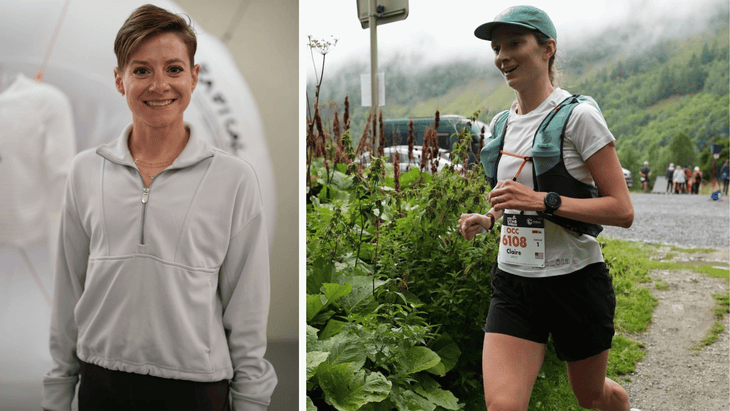
Puretz, a 42-year-old mother, and full time OB/GYN, was also the first unsponsored woman to cross the finish line of what is arguably the most competitive 100-mile race on the planet. An already challenging race with 30,000 feet of climbing and a world class elite field (Courtney Dauwalter was 10th!), this year’s edition left racers pelted by rain and frigid temps.
“I do so poorly in cold events, I was overly prepared. I had hand warmers and a change of clothes at every aid station,” she says. The one constant, under tights, a rain jacket and other layers: the Terignota Sendero Short. “I kept the shorts on the entire time. They were super comfortable, and worked for the whole race.”
Grassroots on the Global Stage

Puretz remembers joking with fellow racer, Arden Young, “UTMB is not for the poor.” First there’s 17 items on the mandatory gear list including, water-proof gloves, pants and jacket, and international flights if you’re coming from North America. Then, of course there’s an entry fee that’s close to $500.
With so much of that money going to large companies, Puretz found refuge in her $24 cap.
“I’m all about supporting that kind of business, this exact person,” she continues, commenting on King’s addition to the trail community’s inclusive culture. “I am supporting local, small businesses if I can.” She pre-ordered the hydration vest.
DeVoe, too, elected to run in a Terignota kit for OCC, her biggest race of the year.
“I like that [Terignota products] are actually reasonably priced and the money isn’t going to giant companies,” DeVoe adds. “I love that it’s local: Washington based.”
The Pacific Northwest trail running community has flocked to the brand, with Washington and Oregon accounting for a fourth of Terignota’s sales according to a June report published by the brand on Instagram.
“Two people were cheering mid-race in the fog near Col de Balme,” DeVoe says. “And they shouted ‘Terignota!’ It’s like the brand is an extension of the Pacific Northwest community.”
King of the Grind
So how did one trail runner with no apparel design experience create a running apparel company nearly overnight? The story starts with eye-opening business trips to Asia.
“I saw behind the curtain,” King says, of his time visiting Chinese factories while working as a designer for Naish Kiteboarding right out of school. “A product that costs the company $30 is sold for $400.” That was unacceptable to him, and he set about to create a new paradigm.
“I wanted to see what the absolute minimum overhead costs were possible while still running a sustainable business,” he says.
In 2020, he tried out this lean business model with a new venture, Roost Work, building tiny homes out of an old cow barn that he converted into a full wood and fabrication shop in Trout Lake, WA.
“I love going all-in on whatever I’m doing,” King says.
Everything was going according to plan—trail running like a pro and working on tiny homes in the winters to pay bills—until the summer of 2023 when, one day while playing basketball, King fully ruptured his achilles.
An Unknown Land
That August while recovering from achilles surgery, King inadvertently created the Terignota brand.
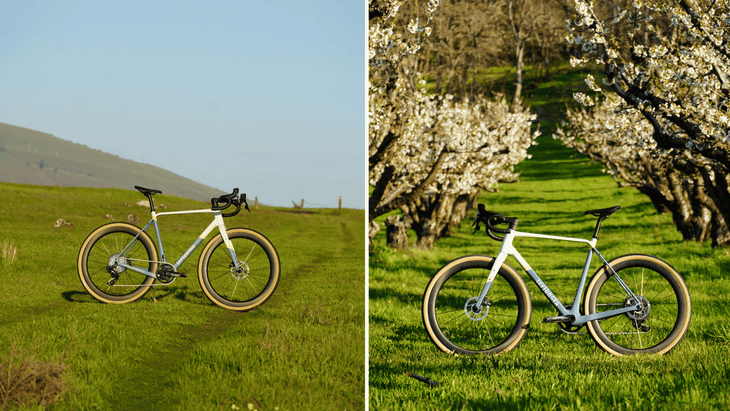
He took up gravel bike racing during the forced downtime from running. When it was time to upgrade to a faster, carbon bike, he used his first-hand experience and the advice of a friend, Nik Benzer, to buy directly from a factory in China and build the bike himself. Benzer advised King that he may have trouble reselling a “no-name, unbranded bike.” King’s solution was to create a “fancy sounding name” and a font, and had the Chinese factory custom paint the new logo on the frame. ‘Terignota’ was born.
The name, King says, is a combination of the Latin words ‘terra’ and ‘ignota,’ which together became “an unknown land.”
“I fell in love with the name Terignota,” he says. “At that point in my life, it felt like I was walking through a completely unknown land. I had no idea if I would ever be able to return to the sport I love, no idea if I could ever be as fit as I once was, no idea if I could use my body in the same way as I once had. And I wanted to honor that moment and that feeling.”
“I wanted to remind myself of the hard times we’ve all been through,” he continues, “and the ability to walk through those unknown lands and come out on the other side a better person for it.”
So, What’s the Catch?
Terignota currently operates out of two old windowless hotel rooms on the third floor of an old building in Leavenworth, Washington, for $700 a month. The company has no investors, no paid advertising, limited inventory, and one employee—King.
“The business model revolves around simplicity and reducing costs in every way we can,” King says. “One of the major ways we’re able to keep costs down is by only having one version of each product and making that version the best we can. This way, we don’t have to do some crazy discounting at the end of each season or end up throwing away a ton of inventory.”
Terignota further reduces consumer costs with grassroots marketing and selling directly to the consumer. You won’t find Terignota products in brick and mortar stores or on online retailers.
And yet, King is committed to not compromising on quality, sustainability, and environmental impact. Terignota products are packed with zero plastic and mailed in 100% recycled materials. Over the next year-and-a-half, he aims to switch fabric sources from virgin polyester to 100% recycled materials—with some products switching sooner.
“Within the next six months, our Grid-Fleece hoodies, Crest Caps, and tights that are launching spring of 2026 should all be made with recycled material,” he says. “Along with this, we are looking into natural fiber alternatives and additions to reduce our environmental impact.”
As for how this switch will impact the cost of production, King thinks it will be minimal.
“It is simply a factor of scale,” he says. “Recycled fabrics are not yet standard, so they have to be produced specifically for the client at a scale that we had not previously been able to achieve or afford. With the growth we’ve experienced over the last year, we’re confident we’ll be able to switch to recycled fabrics with minimal impact to pricing.”
King has also been strikingly transparent. In a six-month report, he shared the costs of materials, profits, and a detailed breakdown of where consumer dollars go.
“When was the last time you saw a brand disclose all of their financial information, tell you exactly how much they are paying to have the product made, and exactly how much profit they make off each product, where your money is going?” he says.
He aims to bring that level of transparency to working conditions and labor practices in the factories where Terignota products are manufactured.
“The majority of the factories we use are used by many other large, well-known brands, including North Face, Salewa, REI, Hoka, Raide, and Camelbak,” he says. “As we aim to be a fully-transparent company, we know this is a subject we need to improve and work on. We hope to release a full ‘factory report’ sometime in 2026 after we are able to visit and independently verify all the information on working conditions that our manufacturers have shared with us so far.”
Looking Ahead

With all of King’s focus on sustainability, the one looming question is: Is he being sustainable to himself?
“When I started the brand, there was no ‘end-goal’ or ‘grand vision’,” King says. “I simply wanted to see if it was possible.”
With any new company, there are bound to be changes. At the rate the brand is growing, King may have to hire another employee, find a bigger space, and should eventually pay himself. But with any change, King remains committed to an ethos of transparency, disruption, affordability, and centering the community.
“If we end up ‘disrupting the market’ and opening people’s eyes to what they are actually paying for when they buy a $150 pair of shorts, we’re stoked,” he says. “If we help lower the cost of entry to trail running across the board and force other brands to improve their business models to be able to reduce prices, we’re really stoked. But whatever happens, we’ll just be here doing business our way and a different way.
The post The Story Behind the $29 Shorts Taking over Trail Running appeared first on Outside Online.