









If one day I’m to be rescued while backcountry skiing or running whitewater, I have a dreamlike vision of the scenario. Tall, handsome, kind-eyed firefighters save my life with the sun glimmering from behind their heads—much like any silhouette scene of Harrison Ford in Indiana Jones. (Hey, this is my dream, OK?)
My nightmare scenario, on the other hand, might involve a newly unveiled AI-powered four-legged robotic dog. But alas, I’m not asleep. This is total reality.
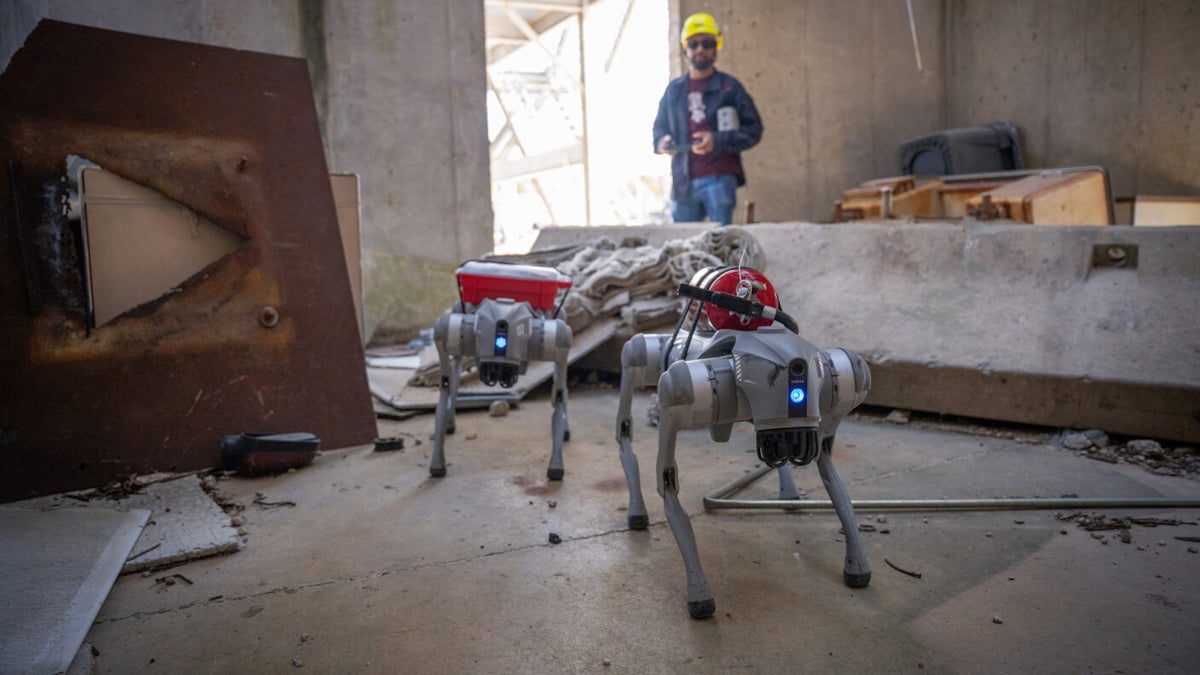
Engineering students at Texas A&M University recently unveiled a robotic dog that sees, remembers, and (gasp!) thinks. The four-legged machine never forgets where it’s been or what it’s seen, and researchers suggest it has the memory of an elephant. (Meanwhile, I’m over here thankful my dogs can’t talk.)
With a computer for a brain, the robot dog understands human voice commands—unlike my actual dogs—and uses AI-camera input to plan its paths and identify objects.
The device’s inventors believe it may be the future of search-and-rescue operations.
I’m someone who often recreates with dogs, and to be real, I count myself lucky if my two Australian shepherds don’t get stuck between my edges while we’re backcountry skiing.
As my editor so eloquently put it, the invention looks as if Robocop and Beethoven the St. Bernard had a love child, and Peter Thiel then raised that child which was then programmed to eliminate human life. It’s a cross between a Terminator and a Pound Puppy, and I would know, I’m currently fostering four of them.
I’m quivering.
Technically speaking, the robotic dog, according to the Texas team, is “a terrestrial robot that uses a memory-driven navigation system powered by a multimodal large language model (MLLM).” In other words, it interprets the world around it using visual inputs to decide which route to take—all while making real-time adjustments. These paths are saved and integrated into computer systems.
The concept itself isn’t new, but applying robots with memory-driven navigation systems to broad search-and-rescue scenarios hasn’t been done. Rough terrain, uncharted territory, and disaster zones can change constantly, presenting new opportunities for those in need of help. Every year, hundreds of people are rescued from dangerous situations, often in remote, unpredictable, and chaotic environments.
A robotic dog that can visually see and memorize its environment may allow rescuers to respond in new and innovative ways.
Like us, the robotic dog uses reactive and deliberative behaviors to make decisions thoughtfully—well, as thoughtful as an inanimate object can.
“Moving forward, this kind of control structure will likely become a common standard for human-like robots,” Sanjaya Mallikarachchi, an engineering doctoral student who created the robot, said in a news statement.
The advanced navigation system helps the robot avoid previously traveled paths and obstacles, giving it a particular advantage in unmapped areas and places where GPS might be limited. It’s a bizarrely futuristic notion, sure, but researchers say it fills a gap in rescue.
“The core of our vision is deploying MLLM at the edge, which gives our robotic dog the immediate, high-level situational awareness and emotional intelligence previously impossible,” said Isuru Godage, assistant professor and project advisor, in a new statement.
“This allows the system to bridge the interaction gap between humans and machines seamlessly. Our goal is to ensure this technology is not just a tool, but a truly empathetic partner, making it the most sophisticated and first responder-ready system for any unmapped environment.”
But let’s make one thing clear: however helpful and novel the robot is, watching it maneuver through its environment gives a sense of the uncanny valley.
And nightmares.
The post This Robotic Rescue Dog Could Change How We Survive Disasters, but the Video Is Giving Me Nightmares appeared first on Outside Online.