







Toyota’s recent reveal of a new performance brand comes on the heels of last month’s Century brand unveiling. But while Century competes with Rolls-Royce and Bentley for the top of the luxury market, the new GR brand is aimed at performance heavyweights like Porsche and Mercedes AMG. Inspired by the legacy of the Toyota 2000GT and the Lexus LFA, and fueled by the relentless competitive nature of Akio Toyoda, the new GR GT supercar and GR GT3 racecar are mic drops on wheels.
The Reveal
In the shadow of Mount Fuji at Toyota Woven City, I joined automotive journalists from around the world at the Inventor’s Garage, a massive industrial space that was formerly the Toyota Higashi-Fuji plant, where the first Century cars were built in 1967. We were offered blankets and hand warmers for the drafty space, but the energy in the crowded presentation hall was more than enough to keep us warm.
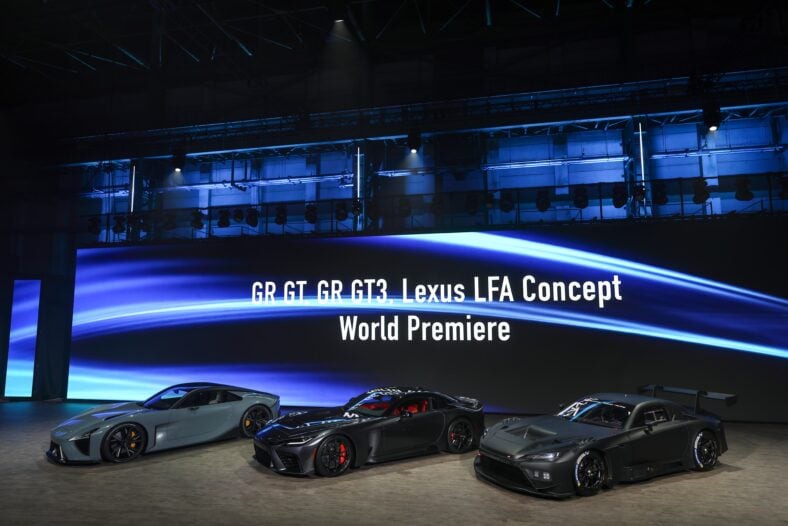
Fog machines filled the massive, black-walled room. Vertical rows of spotlights on both sides of a stage cut the fog like lasers while electronic music echoed through the cavernous space and a screen-projected clock ticked down. There was already one sporty silhouette on the stage, draped in fabric, and room for two others to pull in behind it.
The clock struck zero and the cover was pulled from the car on stage with the swiftness of a magician’s silk. A black curtain parted at the end of the room and two sets of headlights appeared, the loud revving of twin-turbo V8 engines pounded through the room and the low-slung cars rolled in to a choreographed stop.
The three cars on stage were the high-performance trinity of Toyota’s near future: the GR GT Supercar, the GR GT3 racecar, and the Lexus LFA concept, which we recently reported on from the Japan Mobility Show; hiding in plain sight since then under the alias of “sports concept.” Looking left to right from the LFA to the GT3 is a progression from beauty, to brawn, to pure aggression.
First to take the stage was Simon Humphries, operating officer and chief branding officer for Toyota. “The emotional side has come back to the company,” said Humphries, “Whether that’s in terms of driving dynamics, engineering, production, or my field of design, there has been a fundamental change in the company mindset.”

He didn’t need to say another word. The emotions were all right there on the stage behind him. Next to speak was Toyota Board Chairman Akio Toyoda, whose grandfather founded the brand, and for whom the GR is a true passion project. Standing in a black suit in front of the three cars, Toyoda used an unexpected word to describe the motivation behind the GR Project: “humiliation.”
The actual word he used is the Japanese concept of “kuyashisa,” and there’s no direct English translation, so “humiliation” had to do the work of a concept dating back to the 8th century that means being fueled by the doubt of others, along with a nagging sense of failure and defeat. It’s a feeling many of us have felt, some of us have been driven by, but only in Japan has it been given its own word. And it’s not one you’d likely hear at the reveal of an Italian or German sports car. For Toyoda, it was a feeling he first felt nearly 20 years ago at the Nürburgring.
A Rough Day At The Ring
Back in 2007, Toyota didn’t make a true sports car. Akio Toyoda took an old Supra to the infamous German track, where he raced under the alias of “Morizo,” a name taken from a Japanese cartoon shrub. He raced under the banner of a then-unknown Gazoo Racing team, which got its name from the Japanese word for picture or image.
On the track, the prototypes from other brands left him in their dust. Every time he was passed by another European supercar, Toyoda said it felt as if he could hear them all saying that Toyota could never make a car like that.
Toyoda’s humiliation was compounded at Pebble Beach in 2011, when he was told that Lexus cars were “boring,” and he vowed to never endure either indignity again. “We used that pain and frustration as our driving force and continued our focus on simply making ever-better cars,” said Toyoda.
Since that time, he’s been on a mission to prove that Toyota can make world-class performance cars that are anything but boring. Apart from being the chairman of the board, Toyoda is also the company’s master driver. It’s an advisory role responsible for adding what he calls the “secret sauce,” and which I interpreted as a sort of performance umami—engine noise, braking noise, and other empirical elements are tuned to give the car a certain special and indescribable feeling that transcends specs like handling and horsepower. They used the term “Kaiwa,” or the “conversation between car and driver,” to describe this.
The Cars
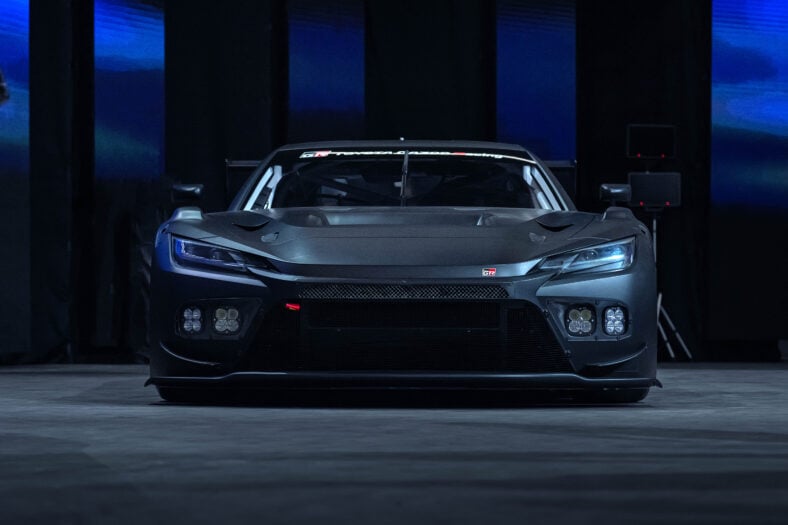
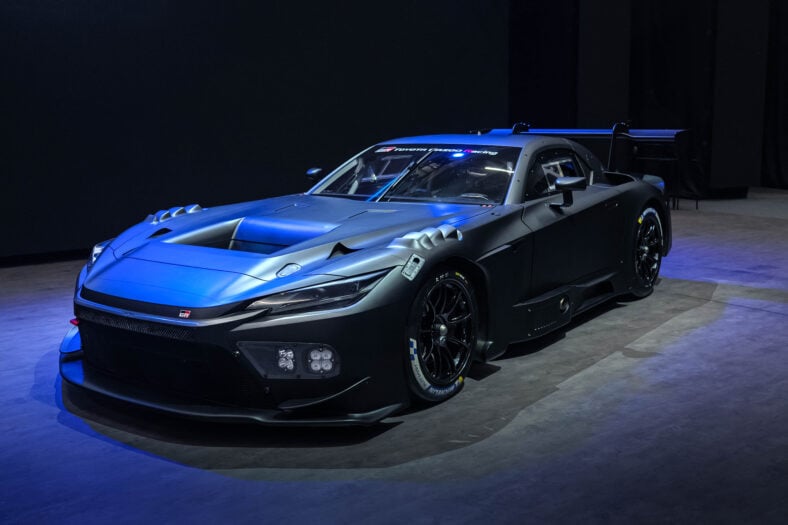
I had already swooned over the LFA a few weeks prior, but everyone in the audience was seeing the GT and the GT3 in person for the first time. They did not disappoint. Both are still in development, but the GT looked like you could see it in a showroom tomorrow, and the GT3 looked just as ready for the racing pits. The GT was a glossy dark gray with a bright red suede interior, and the GT3 was a matte dark gray (bordering on black) that looks like it could have been inspired by the Batmobile.
From an engineering point of view, both the supercar and the racecar were designed around the same three core principles: very low to the ground, very light and rigid, and very aerodynamic. They were both too low to even stick your foot under. They share a hollow aluminum frame—a first for the automaker—and an extensive use of carbon fiber. The body itself was designed around airflow. Normally a car is designed first and then airflow is considered, but with these GRs, chief designer Koichi Suga describes a “completely backwards approach,” that led to a body shaped by the flow of air in and out, at very high speeds.
Takashi Doi, the project general manager of the GR GT, described the two cars simply: the GT is a “racing car for the street,” and the GT3 is all about the fact that “we want to win.” Both cars share a new twin-turbo V8 and the same hollow aluminum frame, and both carry the same GR badge, but the two diverge from there.
The GR GT
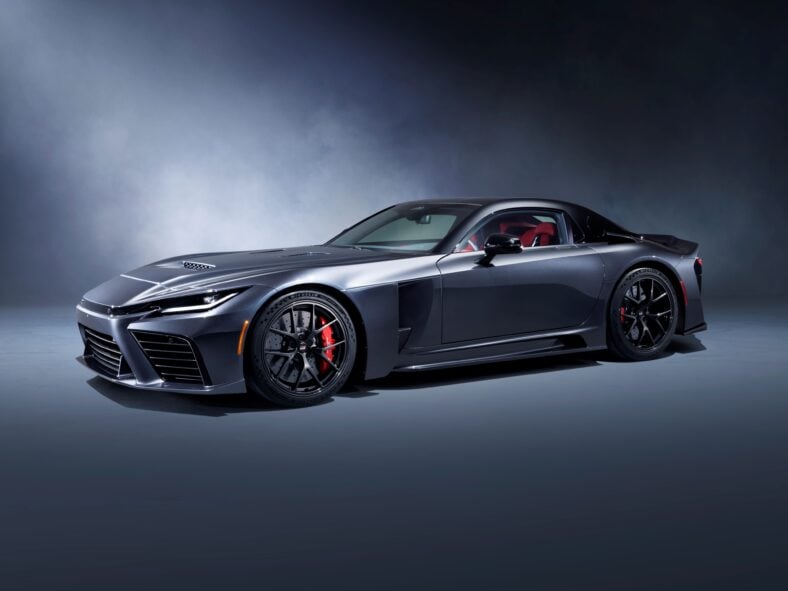
The GT is the one you’ll encounter first in the world, and the only one you’re allowed to buy. It has a hybrid system paired with the new twin-turbo engine and produces at least 641 horsepower and 627 pound-feet of torque. Though these numbers could go higher, as both are just development benchmarks.
The GR Project engineers described how professional drivers know how to get 100 percent out of a car, whereas for the rest of us, the question is, “How close can a gentlemen driver get to 100 percent?”
The hybrid system on the GT is there to help drivers get as close to 100 percent as possible by aiding in response assist, gear changes, and turbo lag mitigation (or removal). Potential buyers will be able to get behind the wheel of a GT in 2027, and they’ll be sold in Lexus dealerships. No pricing is available yet, but we were told to look at others in the category, like the Porsche 911 GTS, for comparison.
The GR GT3
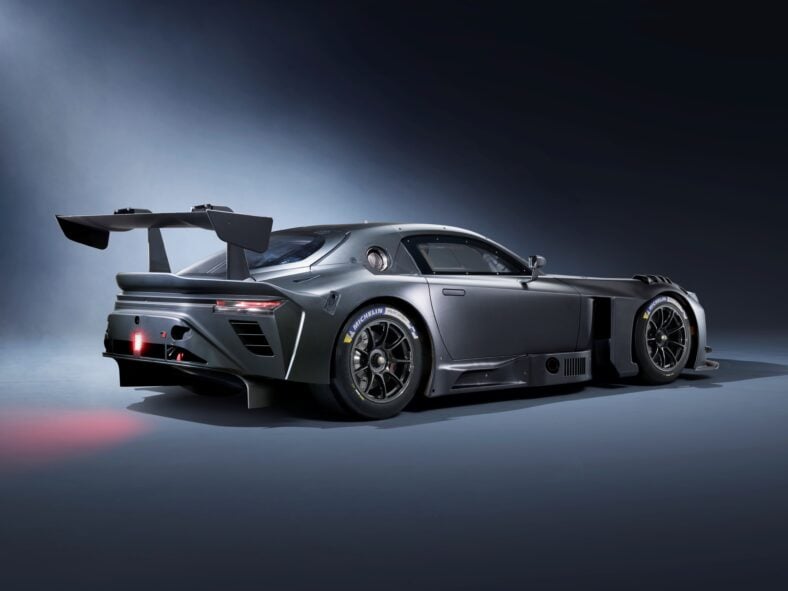
Less was revealed about the performance specs of the GT3. It shares the same rigid aluminum frame and uses the same powerplant, but without the hybrid system. It’s also much lighter, presumably making it faster. In person, it really looks like something out of the DC Universe.
Final Thoughts
There is a bright aura of legacy for Toyoda surrounding the GR brand and its two flagship rides. A racing team name he coined playfully two decades ago to see what was possible with the big boys at the Nürburgring has finally come of age as the GR brand. It’s a bold statement, a serious flex, and a deep commitment of time and resources to win.
I once asked the heir to a famous whisky brand why they decided to release an expensive 30-year-old whisky when they could make more money selling two batches of affordable 15-year-old whiskies over the same span of time. “Because we can,” she said. Toyota could’ve done plenty of other things besides develop two new wildly ambitious sports cars that would have been much more efficient on paper. But how boring is that?