







Editor’s note: This story contains content and images that may be sensitive for some readers.
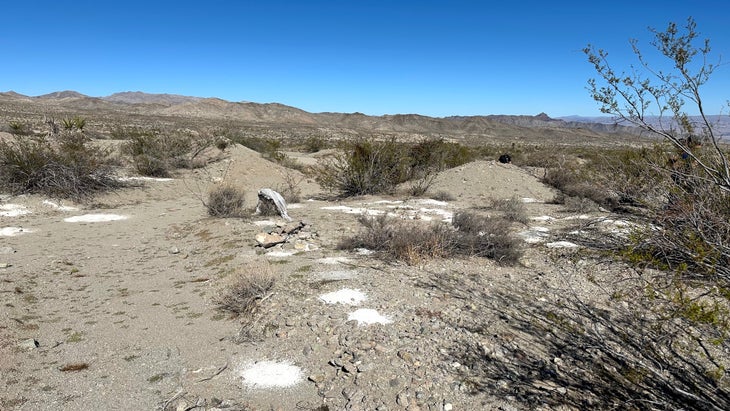
In July, a man was walking along a deserted stretch of the Nevada desert when he came across a macabre discovery: several hundred piles of cremated human remains, dumped on Bureau of Land Management (BLM) land. The strange discovery kicked off an investigation by local and national authorities.
Now, a Nevada funeral home has taken custody of more than 300 sets of cremated human remains. Months after their discovery, no one has come forward to claim them, and federal officials are offering few answers about where the “cremains” ended up in the Mojave Desert.
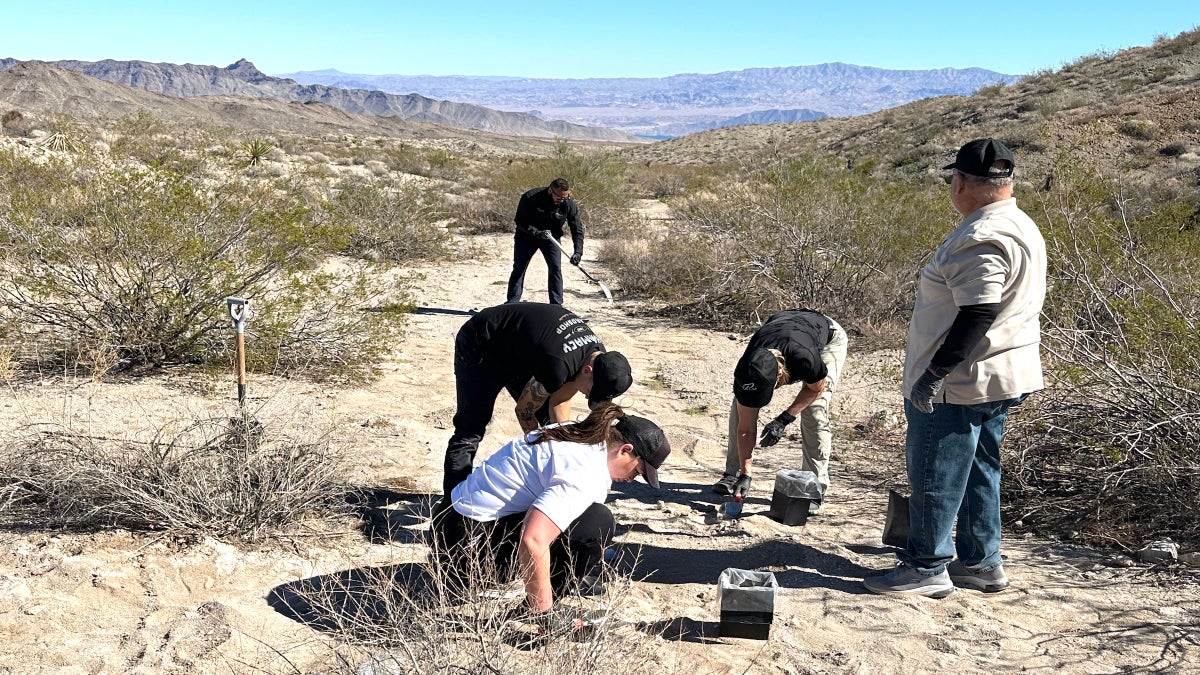
Stephanie McGee, executive director of the Nevada Funeral and Cemetery Services Board, was one of 11 funeral industry professionals who volunteered to collect the cremated remains left behind.
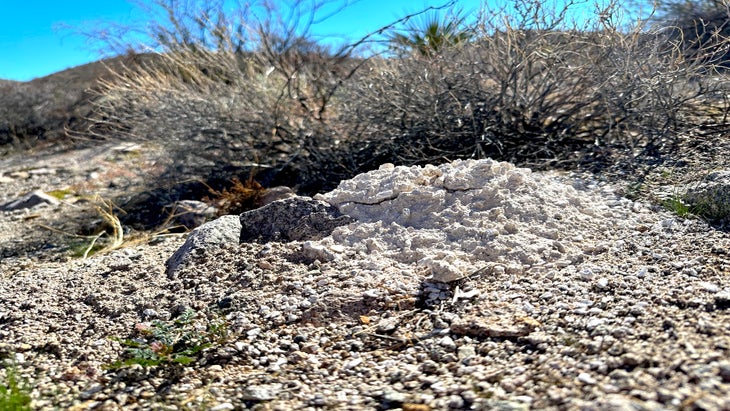
“It was a warm day in late October. We drove out on a dirt road, and there were two areas of cremated remains,” McGee recalled to Outside in a phone interview. “My first impression was just sadness. It was an incredibly sad scene of the different sets of cremated remains, all varying shades of gray or brown.”
In her decades of work as a public servant and regulator, McGee says that she’s never seen a scene like this. The ashes weren’t scattered, but were instead dropped in “little piles.”
The remains were discovered in August when an unnamed person found piles of ash on a dirt road outside of Searchlight, Nevada, a small town of about 400 people located an hour south of Las Vegas. David Charns, a reporter with the local television station, 8 News Now, broke the story.
“I had never experienced anything like that before. It was a surreal and, honestly, sad moment,” Charns told Outside, adding that his news team received a tip about the remains from a viewer.
But months later, questions remain unanswered. The U.S. Department of the Interior, which manages the BLM, declined to provide further details to Outside, citing the ongoing investigation.
A Funeral Home Likely Abandoned the Hundreds of Cremains
Experts told Outside that the remains were most likely dumped by a crematorium or a funeral home.
“The sheer number of the piles of remains, as well as their proximity to each other, indicated that a commercial entity is responsible for this,” McGee told Outside.
Investigators have a good idea of where the remains came from, according to Charns. But who is responsible for dumping them has yet to be publicly announced.
Candi Cann, a professor at Baylor University in Texas who examines death, dying, and grief, told Outside that it’s not unusual for cremated remains to go unclaimed. Cann said that abandoned cremains present a challenge for crematoriums.
“Some people don’t return to claim the ashes of their loved ones after they’ve had them cremated, for a variety of reasons ranging from an avoidance of death and finality to not knowing where to put the ashes or how and where to scatter them,” Cann told Outside. “While it’s estimated that approximately six percent of all cremains go unclaimed following cremation, I’ve found that in practice, that number is often higher, and funeral homes then have to figure out how to store or dispose of the cremains.”
But commercial disposal of cremains on public land is illegal.
After a person is cremated, a funeral home is generally required to hold their remains for two years, Cann said. After that point, it’s the company’s responsibility to scatter them. It could be that nobody is looking for these people, and very likely that the remains were those never picked up by next of kin. As cremation rates increase, Cann says she expects the number of unclaimed ashes to grow, as it’s a more common problem than people realize.
Is It Still OK to Scatter Ashes on Public Lands?
Cremains are not considered hazardous substances, and the BLM generally allows private individuals to spread ashes as long as they comply with state law. Even so, the question of scattering ashes on public land is more complicated than some might think, prompting even private citizens to reconsider when, where, and how they remember their loved ones.
“There’s no law that specifically prohibits scattering private ashes on public land in Nevada,” said McGee. “No matter where you go, though, if you’re going on public land, then you need to check with the authority over that land to ensure that you don’t need a permit.”
Laws for scattering ashes on public land vary by state, Cann added. For example, private citizens can spread cremated remains in National Parks, but a permit is required, and regulations must be followed, according to the National Park Service. (For more on scattering ashes on public land, Cann referred Outside to this blog, which summarizes how federal law and states manage the issue.)
For some, disposing of ashes is a morbid thought. For many, it’s the last thing a family wants to consider after the loss of a loved one. Regardless, after-death considerations are something that everyone must grapple with at some point.
“A lot of people don’t know what to do with the ashes once they have them,” said Cann. “Some just never return and assume the funeral home will take care of them. Unfortunately, this is an infrastructure issue for funeral homes and is more common than you might imagine.”
As the Active Investigation Continues, the Story Is Far from Finished
Of the more than 300 piles of cremated remains, just three dead individuals were identified using information at the location. McGee declined to comment on what this information was.
Cann and McGee agree that it’s unlikely the other individuals will be identified. Cremation occurs at a temperature of around 1400 to 1800 degrees Fahrenheit and burns everything but bone, which is then placed into a pulverizer to create a powdery ash of even consistency.
“This means there isn’t much left that one could extract DNA from,” Cann said. “That being said, there are also sometimes bits of dental fillings or steel pins that would help identify the deceased, but those would need to be with the cremains, and often funeral homes dispose of or recycle those and separate them from the ashes.”
The cremated remains were placed in urns and will be housed at a site hosted by Palm Mortuaries outside of Las Vegas.
“I don’t know if you’re ever prepared for something like this. This is a human—somebody’s daughter, mother, brother, or father. Somebody’s relative. They were loved, and it’s important to recognize that at every stage,” McGee told Outside. “With each pile that I dealt with, I would pause and think about the individual who was there and have thoughts for them.”
The post Hundreds of Human Remains Have Been Recovered in the Mojave Desert, and Nobody Is Claiming Them appeared first on Outside Online.