








I first encountered taxidermy because I wanted fresh meat for my sled dogs, and I heard of a taxidermist in town with a dilemma. He often discarded bear parts in the woods—which is, by the way, perfectly legal—and hikers kept stumbling upon the skinned bear hands and calling the sheriff, thinking they’d found a murder victim. It turns out that skinned bear hands look human—and murder, the sheriff told the taxidermist, is bad for tourism. So, upon meeting, we struck up a solution: the taxidermist would save the meat that he’d otherwise dump, and my dogs would have a great source of local, free-range, wild-caught protein. I got used to entering the taxidermy shop for bins of venison and bear scraps, admiring whatever mounts were in progress, but I rarely stuck around. So when I learned of an urban taxidermy course in Chicago—a six-hour marathon in which students would skin, scrape, stuff, and ultimately take home their own dead rat—I was distinctly curious. What was this taxidermy process actually like, anyway? And who were these city folks who wanted to stuff rats?
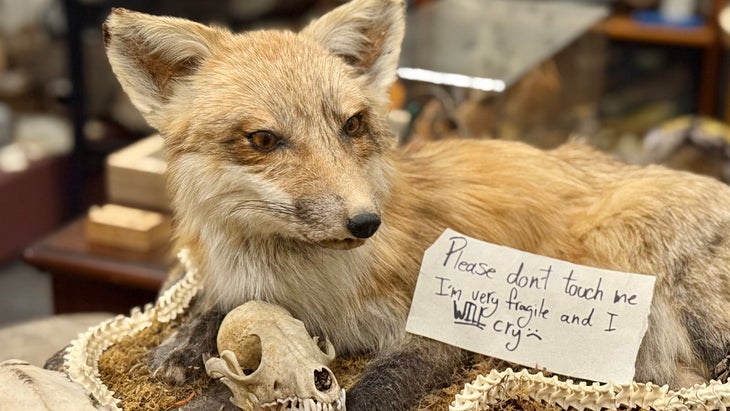
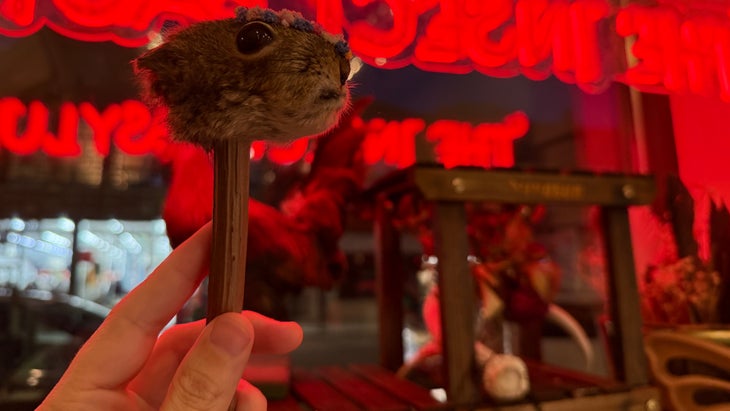
The course was held in a place called The Insect Asylum, a self-described insect museum that also hosts classes, dances, poetry readings, and a pet possum named Opal. The first thing that struck me, upon entering, was the smell: part chemical, part beast, and thick as the air in a sauna. Each shelf in the place was covered in skulls, bones, crystals, posed scorpions, and curiosities that only revealed themselves when I leaned close, like what appeared at first to be a bouquet but turned out to be squirrel heads on sticks. I lifted one, horrified and fascinated in equal measure; “Oh,” chirped an employee, “you found the squppets!”
The squppets—squirrel puppets—were made from roadkill; like much of the contents of the museum, they were aggressively ethical, but still left me feeling faint. I had wondered why the class, which went from 3 P.M. to 9 P.M., didn’t include a dinner break. Now I understood that I wouldn’t possibly be hungry.
The taxidermy instructor, Rob, led me down a hallway (“Be sure to close the gate—there’s a tegu, but he’s bruminating”; I thought I had misheard until I spotted a massive lizard half-buried in a pile of wood shavings) and into the basement, which held a small table and four chairs. Rob, who uses it/its pronouns and wore a purple mushroom-print shirt that looked like it had been left in the sun for six months, sat down in front of a mount in progress: a hollow rat skin, which looked like a deflated velvet balloon, and a metal kidney-shaped bowl with the skinless rat himself, a gentle curl of muscle and bone. Rob lifted its skinned rat gently. “I call him Aladdin because he’s a street rat,” it said, adding that Aladdin had been killed by a terrier and that, at our latitude, he could carry at least 35 diseases, but it would probably be fine because he’d been frozen for months.
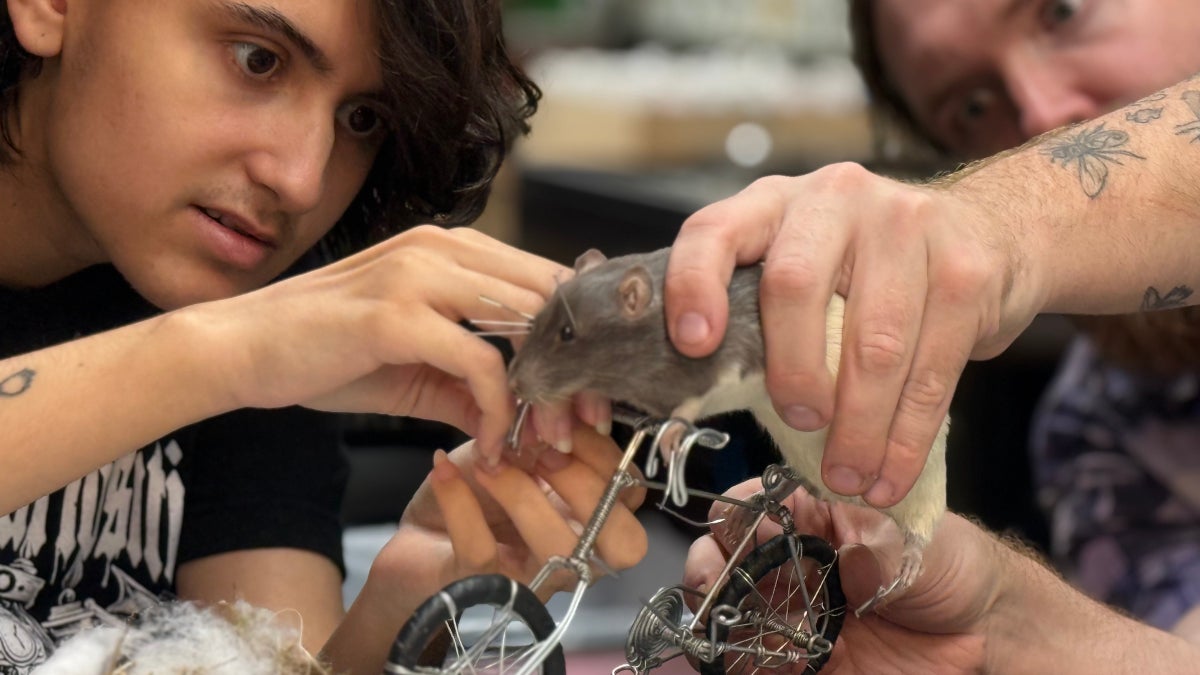
A young woman, Sofia, leaned forward from across the table, inspecting Aladdin. I sat down beside her. At that moment, the third and final student—22-year-old Anthony—burst into the room. “Are we just going to do standard poses,” he asked with some urgency, withdrawing a small metal bicycle from his backpack. “Because I want to put my rat on this bike.”
“You can do anything!” said Rob cheerfully. It pulled out three ziplock bags, which featured the three rats we’d be working on: one blonde, one piebald, one gray. Sofia reached for the blonde, and Anthony the piebald. I took the gray. Rob had skinned our rats ahead of time, but we’d be scraping off the fat and sinew ourselves. I poured my rat out of his ziplock and he fell to the table with a wet thump.
His skin was tough but stretchy, and scraping it with a blade felt oddly satisfying: fat gathered in strands and gelatinous lumps, and I pinched it away with my fingertips, time and again. After a few minutes, I stopped feeling nauseous, entranced by the precision of the work: the paper-thin ears, the lips that flapped open, the sandpaper scales of my rat’s tail. In my mind, I named him Meatball, in honor of my one-year-old daughter’s current favorite word. It just felt right.
As we hunched over our respective rats, Rob talked about its journey to taxidermy. At six, Rob’s grandfather gave it a bag that he said was a gift, but that turned out to hold 12 dead rats. “He wanted me to man up and be less afraid of death,” Rob recalled, but the effect on the child was the opposite: the bag of rats spurred a phobia so severe that from then on, whenever Rob encountered a dead animal, it was so terrified that it lost its vision. “It happened once in a crosswalk,” Rob said, gently flopping Aladdin onto his back. “I saw roadkill and my vision went black, and then the light started to change. I thought I could actually die if I didn’t face the fear.” Rob signed up for a pigeon taxidermy class at a local museum, hoping for some exposure therapy, and within ten minutes had learned more about bird anatomy than in an entire college class about animating animals. A beautiful thing about taxidermy, Rob said, pulling Aladdin’s tail out of its skin with a schloop sound, is that you could connect with the animal, being as respectful as possible. “I find myself talking to the animals a lot, explaining the process. I try to make as few marks as possible. When kids ask what I’m doing, I say, ‘This is an animal that reached the end of its time here in life, but that doesn’t mean it’s the end of the time that we can appreciate and learn from it.’”
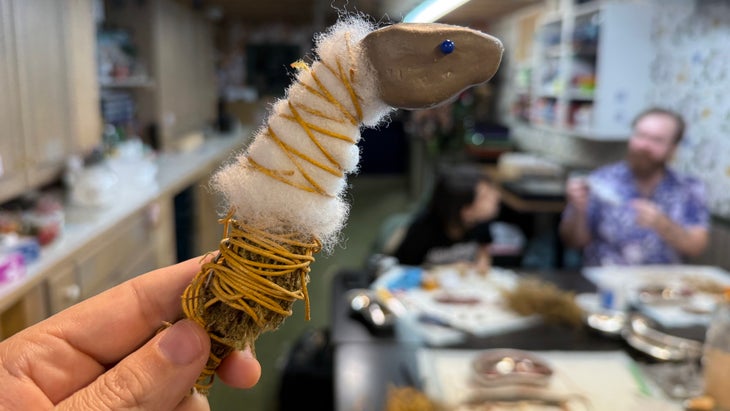
The hardest part of the process was sculpting the form. We used air-dry clay to mold heads, lichen wrapped in twine to form the shapes of a pelvis and ribs. I measured each dimension—ribcage, skull, forearms—against Meatball’s body, trying to do him justice with wire and moss and clay. When I finally slid the scraped skin over the form, fitting the head and arms and tail into place, it felt like bringing the dead back to life.
And at some point, a funny thing had happened. I loved Meatball.
“That’s the whole point of the Asylum,” Rob told me. “We’re reclaiming what’s beautiful and interesting about the things we’ve been told are bad or gross.”
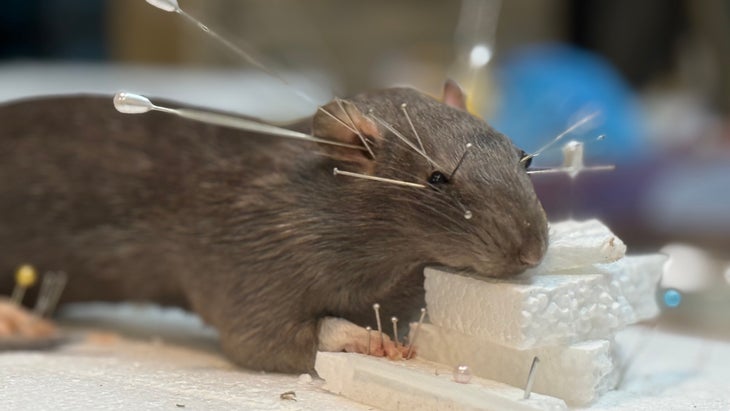
I don’t expect to take up taxidermy as a hobby. But something real changed over my many hours with Meatball’s skin and body: it stopped feeling aversive. Here were the muscles he’d used to play, to eat, to chew; the tail he used for balance, and wrapped around himself to sleep. When I brushed his tiny hairs in place with a toothbrush, it felt like I was giving him his last tongue bath. And in the way that loving one dog can make you feel love for all dogs, I felt almost hopeful, when I left that night, that I’d see a rat or two scurrying down the gutter outside. Any friend of Meatball’s, I decided, was a friend of mine.
The post The Surprisingly Tender Art of Rat Taxidermy appeared first on Outside Online.