








This story was originally published by The Watch, Radley Balko’s substack publication, to which you can subscribe here.
In the 15 years from 2010 through 2024, 375 people in Texas were exonerated after being imprisoned for crimes they did not commit. Of those, 97 received some form of compensation or settlement from the state. Collectively, those 97 people spent more than 1,200 years in prison. The state paid them just under $156 million, or an average of about $130,000 per person per year behind bars.
Last year, New York City paid out $205 million to settle 956 lawsuits alleging police abuse. That figure includes about $16 million each to two men who served three decades in prison for a murder they didn’t commit. It also includes people who were wrongly raided and beaten by police, and people who were outright framed by law enforcement.
I bring up these figures because, according to multiple reports, Donald Trump is about to order the government to pay him “damages” for the FBI raid on his Mar-a-Lago mansion and for special prosecutor Jack Smith’s two investigations of him—one for stealing, hoarding, and improperly sharing classified documents, and the other for Trump’s effort to overturn the 2020 election. He’s going to pay himself $230 million.
So Trump—who didn’t spend a minute behind bars—about to swindle about 50 percent more than the total amount of money paid to the 97 innocent people who were incarcerated for more than 1,200 years in Texas. Or about 12 percent more than the total paid last year to 957 victims of police brutality in New York City.
One key difference between the raid on Trump’s resort and other disputed police raids I’ve covered: Trump is still alive.
I’ve written at length about both police abuse and wrongful convictions. I’ve seen and interviewed and known the people hurt by bad cops and prosecutors. Trump’s payout isn’t just corrupt and cynical, it’s among the most outrageous and infuriating of his many abuses of power. It’s the biggest payout ever for allegations of misconduct by either police or prosecutors. This would be true even if you divided it in half to separate the raid from the investigations.
The same man who was immunized from his crimes by the US Supreme Court, was reelected to the most powerful office on the planet, and has openly used the office to enrich himself and his family by billions would now be further abusing his power to declare himself the biggest victim of injustice in American history. It’s just a brazen, stubby, vulgar middle finger at rule of law.
Trump originally filed his lawsuit last summer, before he was reelected. Back then, he was asking for a mere $100 million. Two things happened to embolden him. First, Chief Justice John Roberts gave Trump the green light to weaponize the Justice Department for his own benefit. Second, Trump took full advantage of Roberts’s hall pass and filled the top slots at the department with the same attorneys who represented him in both his civil and criminal cases.
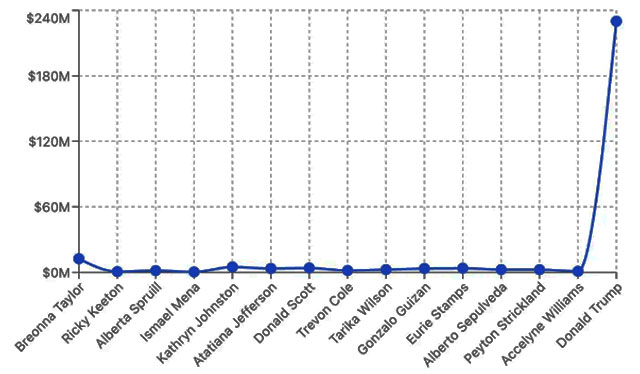
Let’s first look at how the raid on Mar-a-Lago compares to actually botched police raids. I made a little chart comparing the insane amount of money Trump wants to pay himself to the settlements and jury awards won by real victims.
Here are a few things to keep in mind: First, the raid on Mar-a-Lago went down a bit differently than these other raids. In most of the other raids, the police battered down a door during a high-risk, “dynamic entry” operation, then unjustly shot someone inside the home. At Mar-a-Lago, the FBI notified Trump’s security detail to let them know they were coming. In fact, Trump himself was given a warning months ahead of time. They also deliberately conducted the raid when Trump would be out of town to save him any embarrassment.
But it gets worse. (Note: I’ll be using this phrase frequently.)
Most of those other raids were conducted on little to no evidence—typically on dirty, uncorroborated information from drug informants or random calls to police. In most cases, the police found no evidence of a crime, often because they raided the wrong house. The raid on Mar-a-Lago came after an extensive investigation, and after federal authorities gave Trump multiple opportunities to return the classified documents he had taken. He refused.
There’s one other key difference between the raid on Trump’s mansion/golf club/event space and all of these other raids: Trump is still alive. The other people listed below are dead, because they were killed in these raids. The only tangible injury Trump has claimed from the Mar-a-Lago raid is that FBI agents tracked some dirt into his bedroom when they didn’t take off their shoes.
Settlements Resulting From Law Enforcement Raids

But this is just the harm that Trump claims from the FBI raid. He also claims to have suffered injury from being accused of federal crimes. So let’s also compare the damages Trump is seeking to the damages awarded to people who were wrongly convicted.
This, too, won’t be a perfect comparison. But the incongruence only makes the money Trump is demanding all the more obscene. First and foremost, whereas exonerated people have been proven innocent, the evidence against Trump is persuasive. He was never exonerated. Instead, his money, power, and position allowed him avoid a trial. He escaped election charges because the US Supreme Court cloaked him in immunity. And he only escaped trial in the classified documents case by getting himself reelected. No court, prosecutor, or investigative body has declared Trump innocent in either case. And while we like to say that you are presumed innocent until proven guilty, we definitely do not say that you’re entitled to a massive payout if a criminal investigation fails to result in a conviction.
If the $50,000 the typical exoneree gets were the width of a typical city block, the amount Trump is claiming would be the width of Texas.
Currently, about 40 states have laws to compensate the wrongly convicted. These laws vary in how they’re structured, but most pay a predetermined amount of money for each year of incarceration. These annuities ranges from a low of about $18,000 per year in Iowa, to a high of $200,000 per year in Washington, DC. But the most common figure is $50,000. Some states don’t pay the money in a lump sum, and in many the annual payout isn’t heritable. So if the government spent 10 years fighting your exoneration, that’s 10 years of payments neither you nor your family will ever see.
Some states also require the wrongly convicted to waive their right to sue in order to collect compensation. So while some exonerees in those states have sued and received multimillion dollar payouts, they took a risk in doing so. They could just as easily have ended up like, say, John Thompson of Louisiana—a man who was wrongly convicted two separate times, spent 14 years on death row, and was nearly executed seven times. A jury awarded Thompson $14 million. Then the Supreme Court threw out the award.
Lawsuits also usually take years—sometimes more than a decade—to resolve. If you just got out of prison and are struggling, you’ll get no compensation while your case slogs its way through the courts.
Trump will get all of his money at once. He’ll be able to pass it on to his heirs (or just have it buried with him). And he won’t have to wait for a lawsuit to wind through the courts. I also don’t know of any exonerees who were in a position to exploit their charges to raise hundreds of millions of dollars from their supporters, or who wore their charges like a crown to get their old job back.
But it gets worse.
Trump isn’t stopping with himself. He wants his criminal friends to be paid, too. He has reportedly ordered the DOJ to pay his former national security advisor Michael Flynn $50 million as compensation for the investigation and criminal charges against him. I suspect that if he doesn’t get pushback, we can expect him to pay others, too.
I believe the word for this is chutzpah. Flynn is a dangerous QAnon nut who initially pled guilty to lying to the FBI about meeting with members of the Russian government during the 2017 transition.
The guilty plea itself was the product of a plea bargain in which the government agreed not to charge Flynn for the other shady things he’d done. For example, Flynn failed to register as a foreign agent while on the payroll of a businessman with close ties to the Turkish government. While advising the incoming Trump administration, Flynn reportedly recommended kidnapping a pro-democracy dissident legally residing in the US and extraditing him to Türkiye at the behest of its authoritarian leader, Recep Erdoğan.
Trump had been warned by the Obama administration that Flynn was a national security threat. Yet Trump promptly appointed Flynn to the most sensitive national security position in all of US government. Now Flynn and Trump plan to make you, me, and the rest of the country pay Flynn $50 million.
So let’s compare what Trump and Flynn endured—and what they’re paying themselves as compensation—to what people actually wrongly convicted of crimes get in compensation.
So far, no investigative body has determined that Jack Smith’s case against Trump was political or malicious. But that may not matter.
The average person exonerated in 2024 spent 13.5 years behind bars. Prison is obviously psychologically destructive. But it also breaks bodies, and the health care is typically dreadful. People leaving prison have a 50 percent shorter life expectancy than people of similar demographics who never served time.
Again, neither Trump nor Flynn were ever incarcerated. Flynn initially pleaded guilty to one charge of lying to the FBI, then retracted his plea. There was then some extended and complicated litigation before Trump ultimately pardoned him. Trump himself was never tried, convicted, or punished for any of the federal charges for which he now wants $230 million.
That means both are seeking to be compensated, not for the harm of incarceration, but for damage to their reputations. Again, Trump (a) wore his criminal charges like a badge, (b) exploited the charges to raise a ton of money, and (c) as the charges were pending, was reelected to the most powerful position on the planet.
I’m not seeing the harm.
If both reported payouts happen, Flynn will be getting $6.25 million per year since he was indicted. Trump will be getting about $100 million per year. Again, the low end of annual compensation for an exoneree is $18,000 per year—of incarceration, not since indictment. The average is $50,000, and the high is $200,000.
Here are some ways to visualize these numbers:
- If the $50,000 a typical exoneree gets per year were the height of a basketball, what Trump is demanding would be the height of the Empire State Building.
- If the $50,000 the typical exoneree gets were the width of a typical city block, the amount Trump is claiming would be the width of the state of Texas.
- If the $18,000 the typical exoneree gets in Iowa were the average height of a human being, the amount Trump is claiming would be about the height of Mt. Everest.
There actually is a federal law that allows some people who have been acquitted or cleared of federal charges to be compensated. It’s called the Hyde Amendment, and it was passed in 1997.
But the Hyde Amendment limits compensation to court and attorney fees. And few people have been able to use it. That’s because merely being acquitted or cleared isn’t enough. You also need to demonstrate that the federal officials investigating or prosecuting were doing so maliciously. A 2010 USA Today report looked at 201 cases in which a federal judge cited prosecutorial misconduct in dismissing criminal charges. Just 13 of those people were able to get compensation under the Hyde Amendment. There isn’t much reason to think it’s any different now.
So far, no investigative body has determined that Jack Smith’s case against Trump was political or malicious. No investigative body has found that Smith violated Trump’s constitutional rights.
Trump’s attorneys initially asked for $100 million in punitive damages under the FTCA—a law that does not allow for punitive damages.
But it gets worse! Thanks to immunity policies created by the Supreme Court, even people unambiguously hurt by police or unjustly prosecuted are unlikely to get relief through the courts. The odds of success in such lawsuits are so long and the litigation so costly that, except in absolute slam-dunk cases with sympathetic victims, few attorneys are willing to take them on.
This is especially true in cases involving the federal government. It’s all but impossible to sue federal police or prosecutors for constitutional violations. In 1971, the Supreme Court created a path to court in the case Webster Bivens v. Six Unknown Named Agents of Federal Bureau of Narcotics. But the court has consistently narrowed its scope. (It’s gotten so bad that civil rights attorneys sometimes joke that the only way to get these cases in front of a jury is if your client is named Webster Bivens.) The court all but overturned the precedent in the 2022 case Egbert v. Boulet.
To understand how this jurisprudence plays out in the real world, consider the case of Hamdi Mohamud. She’s a Minnesota woman who, along with dozens of other people, was framed by a St. Paul police officer. She spent 25 months in custody. The officer was working with a federal human trafficking task force. She framed Mohamud and the others on witness tampering charges in order to protect an informant.
There’s no dispute about Mohamud’s innocence. But the federal courts have ruled that state and local police who work on federal task forces get the same protection as federal law enforcement. And so, citing the Supreme Court’s ruling in Egbert, the Eighth Circuit has dismissed Mohamud’s lawsuit, ruling that the officer who framed her was protected not by the already-generous qualified immunity afforded to state and local police, but the broader near-absolute immunity given to federal officers.
Mohamud is a far much more sympathetic victim of government overreach than Trump. She has suffered much more harm, and did nothing wrong. Yet not only did her case never get to a jury, she couldn’t even get discovery. The courts ruled that because the officer had immunity, nothing Mohamud’s lawyers might have found, no matter how damning, would have made a difference.
There is one other way to sue federal officials: the Federal Tort Claims Act. This law allows plaintiffs to sue the agency that employs the offending officers under federal torts law. But the FTCA is incredibly complicated. It also requires plaintiffs to exhaust all other legal options first. FTCA trials are decided by judges, not juries, and judges tend to be more deferential to law enforcement.
But the biggest problem with the FTCA is that it prohibits punitive damages. Civil rights cases are exorbitantly expensive. Attorneys take them knowing that most will be thrown out before they ever get in front of a jury. They put in the considerable investment to investigate and litigate hoping they’ll get one of the handful of cases that results in a large award. Punitive damages are what bump these cases into the millions. Without them, only public interest firms like the ACLU, NAACP, or Institute for Justice would be in a position to take these cases.
Had he not been elected president, Trump’s lawsuit against the FBI and DOJ would have been laughed out of court. And as I’ve argued here in the past, not only was Trump not treated poorly, he was given an almost embarrassing amount of deference. The judges in these cases bent over backwards to accommodate him. And given that there’s no evidence his rights were violated, his claim of $230 million in damages would have been scoffed at by the courts and likely brought a reprimand for his attorneys.
In his original lawsuit, for example, Trump’s attorneys asked for $100 million in punitive damages under the FTCA—which, again, does not allow for punitive damages. If anyone else tried to claim punitive damages under that law, their attorneys would have been embarrassed by the first judge to read the case. But because Trump now presides over the DOJ, he gets to bypass the courts. That his attorneys badly misstated the law may not matter. The law itself is now irrelevant.
Some January 6ers are now demanding “reparations” similar to the compensation paid out to exonerees.
Some interest groups have hinted at lawsuits asking federal courts to stop any payouts to Trump or Flynn. We’re obviously in uncharted territory here, so who knows how those lawsuits will go. But my hunch is that no matter who brings a lawsuit, the current Supreme Court will rule that they lack standing to sue.
The most galling part of all this is that Trump is an enthusiastic supporter of the very laws that make it so difficult for other victims of government abuse to recover damages. During the 2024 campaign he promised over and over that he would confer “immunity” on police officers from criminal and civil liability and any other form of accountability. He has also said that police should be “unshackled” and “unleashed” to “do their jobs.”
Trump doesn’t understand the laws and policies that govern police misconduct. But the people around him do. And sure enough, his administration has made clear that they will provide zero oversight and will conduct no civil rights investigations into police abuse.
Well, almost no oversight. Trump did fire the FBI agents and federal prosecutors who worked on the cases against him, the cases against his allies, and the cases against the January 6 rioters.
In June, Trump also ordered the DOJ to pay just under $5 million to the family of Ashli Babbitt, the woman shot and killed by a Capitol police officer during the January 6 riots. Babbitt was part of the mob attempting to enter the Speaker’s Lobby. She and the mob ignored multiple warnings from police. The officer who shot her has been cleared of any wrongdoing. So had Trump not ordered the payout, the lawsuit by Babbitt’s family almost certainly would have been thrown out of court.
Administration officials have also suggested that they might target progressive prosecutors who do try to hold abusive cops accountable, arguing that their investigations are violating the police officers’ civil rights.
Trump was campaigning on a promise to make law enforcement immune from any form of liability at the same time his lawsuit against the DOJ and FBI was pending in federal court. He wanted to make it harder to do precisely what his lawsuit sought to do. Yet because he was reelected, he and his allies get to swerve around those laws and accelerate directly to a payout.
Ah, but it gets worse.
Trump, of course, also pardoned the January 6 rioters and insurrectionists soon after he was inaugurated. So far, at least 22 of those he pardoned have been convicted of unrelated crimes, including home invasion, aggravated kidnapping, aggravated sexual assault, possession of child pornography, sexual assault of a minor, manslaughter, burglary, grand theft, and reckless homicide. One was arrested for surreptitiously filming women at his father’s tanning salon. Another was recently sentenced to life for plotting to murder FBI agents. Yet another was arrested for threatening to kill House Minority Leader Hakeem Jeffries.
It probably goes without saying, but if the people Joe Biden or Barack Obama pardoned went on to commit as many new crimes as the January 6ers have, Republicans would be setting the Constitution on fire to strip future presidents of the pardon power.
Here’s the fun part: Many of those January 6ers are now seeking refunds for the restitution they were required to pay. Some have been successful, in part because the DOJ hasn’t put up any opposition. In fact, according to my sources, the federal government is encouraging them to seek reimbursement—at the direction of insurrectionist attorney-turned-senior DOJ official Ed Martin.
Those sources also tell me some at DOJ are also encouraging January 6ers to seek reimbursement of attorney’s fees under the Hyde Amendment. Many of the rioters hired private attorneys with funding from MAGA nonprofits. This raises the possibility that, if successful, these taxpayer-funded reimbursements could go back to MAGA advocacy groups.
And it apparently won’t end with attorneys fees. Some January 6ers are now demanding “reparations” similar to the compensation paid out to exonerees. While there’s some evidence that some of these people may have been overcharged, none were treated differently than anyone else in the federal system. And most of them were, in fact, guilty. Rather famously, many of them documented their own crimes.
An attorney for several insurrectionists has pushed for the DOJ to establish a “reparations fund” and a panel to determine which of them should be eligible for damages above and beyond attorney fees. The same lawyer said he believes that Martin is championing this idea within DOJ. But they may not even need Martin. Trump himself has also said he’s open to the idea of a reparations fund for January 6ers.
If any January 6er cited Trump’s pardon as proof of their innocence in a claim seeking damages—despite having documented their crimes on social media—they’d be laughed out of court. But they may not need to go to court. If the DOJ decides to support the idea of reparations, I’m not sure there’s much to be done about it.
The most innocuous explanation for all of this is that Trump wants to reward his supporters for their loyalty. The more sinister explanation is that he wants to keep them grateful in case he needs them again.
On November 17, journalist Amanda Moore broke a story for The Intercept that somehow manages to capture all of this madness in a single headline:
Pardoned Capitol Rioter Tried to Hush Child Sex Victim With Promise of Jan. 6 Reparation Money, Police Say
But it gets worse. (I promise, that’s the last one.)
This brings me to the Republicans’ most recent example of shameless, nakedly corrupt self-dealing: Republican senators tucked a provision into the bill to reopen the government that would allow any senator whose phone records were obtained by Jack Smith to sue the federal government—for $1 million per phone.
It appears that eight senators would be authorized to sue. To be clear, Smith did not bug these senators’ phones. With a judge’s authorization, he obtained a record of their ingoing and outgoing calls around January 6, 2021. That’s not only perfectly legal, it’s routine in criminal investigations.
Incredibly, the language in the bill applies only to these eight senators. It doesn’t even apply to House members whose records Smith also obtained. At root, the bill seeks to authorize eight of the most powerful people in the world to pay themselves $1 million or more from the US Treasury.
The senators snuck this provision into the funding bill because it opens courthouse doors that would be closed to anyone else. Even if Jack Smith had, say, illegally broken into these senators’ homes and held their families at gunpoint, it is, again, almost impossible to sue a federal prosecutor. In short, these are very special boys and girls who want very special rules for themselves.
Here’s the thing: If Smith had truly violated their constitutional rights there might be a wisp of a chance that these senators might empathize with others who have been wronged and change the law. (I know, I know. But I wrote a wisp of a chance—and by “wisp” I mean ethereal and vaporous, like Tommy Tuberville’s intellect, or Josh Hawley’s courage.)
But these senators know that what Smith did was perfectly legal. So they changed the federal law only to benefit the eight of them—and only for this specific reason.
Oh, and one other thing: Most people only get a year to file their civil rights lawsuits. The senators made their special law retroactive to 2022.
After public backlash, including from some of their House colleagues who were presumably angry that they weren’t cut in on the action, a few of the eight senators have since publicly stated that they don’t plan to take advantage of the provision.
That’s great, I guess. Sorry you got caught! But if they hadn’t intended to help themselves to $1 million in taxpayer funding, they wouldn’t have stuck in the provision and voted for it in the first place. (Note: Some coverage claims the amount is $500,000, but the language allows them to sue for damages at two stages in the charging process.) Only Sen. Lindsey Graham said he definitely plans to sue. Which is extremely Lindsey Graham of him.
This week, the House passed a bill to repeal the authorization. But because the original bill containing the authorization is now law, the bill to repeal it must pass the Senate as well. And as we all know, a single senator can block legislation. And sure enough, a single senator is now blocking the body from voting on a bill that would keep him from helping himself to at least $1 million in free money from taxpayers.

As we continue to see the barrage of videos showing Border Patrol and ICE agents brutalizing undocumented people and US citizens alike, someone inevitably responds that they can’t wait for the victims to sue the agents for everything they have. Those lawsuits just aren’t going to happen. Those cops have been “unleashed” to terrorize as they please. And just in case any of them mistakenly believe that they should show some restraint, Stephen Miller has assured them that they have “immunity.”
Meanwhile, if you’re Donald Trump or one of his supporters, you get to crime with impunity knowing that anyone who attempts to hold you accountable for your criming will be punished.
As with most things MAGA, it’s tempting to say this is all baldly hypocritical. But it really isn’t. Hypocrisy would mean that Republicans are willing to violate their core principles when convenient. But the party really only has one core principle now: Everything the government does must either benefit Donald Trump and his allies or punish his enemies. And Republicans are more devoted to this single principle than either major party has been devoted to anything in my lifetime.
That isn’t hypocrisy. It’s a cult of personality—and the cult leader happens to be the president of the United States.